

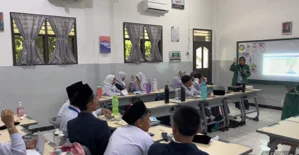
MEDAN, JurnalPost.com – Students from Group 51 on Bullying, part of the Compulsory Curriculum Course (MKWK) at the University of Sumatera Utara (USU), held a socialization event on preventing digital bullying or cyberbullying at SMA Unggulan Al-Azhar Medan Johor on Monday (9/11/2026).
The activity, which began at 14.00 WIB, involved 20 USU students as organizers and was attended by 25 students from class XI F at SMA Unggulan Al-Azhar Medan. This session is part of a project-based MKWK curriculum under the guidance of lecturer Dr. Halimatussakdiah, S.S., M.Si.
Through this initiative, the students aimed to raise awareness among teenagers about the dangers of bullying in the digital space while encouraging them to build a communication environment that is safer, healthier, and based on mutual respect.
Cyberbullying is a pressing issue that requires attention, especially among adolescents who are active on social media and various online communication platforms.
Unlike conventional bullying, which typically occurs through direct interaction, cyberbullying can take place via private messages, social media comments, group chats, or the dissemination of content that harms others.
Therefore, understanding the forms, impacts, and methods of handling cyberbullying is considered essential to teach from a school age.
Introducing the Forms and Impacts of Cyberbullying
During the presentation, students from Group 51 provided education on the definition of cyberbullying, its causes, various forms of digital bullying, its impact on victims, and steps for prevention and intervention.
The students were introduced to behaviors that constitute cyberbullying, such as harassment through repeated messaging, sharing private information without consent, impersonation to harm others, digital stalking, and excluding individuals from online communication groups.
Furthermore, participants were encouraged to understand that actions perceived as jokes on social media can have serious consequences if intended to embarrass, intimidate, or hurt others.
Cyberbullying not only has the potential to disrupt a victim's social relationships but can also affect their psychological well-being, self-confidence, academic concentration, and comfort in daily life.
Through this session, the organizers emphasized the importance of using social media responsibly, respecting the privacy of others, and refraining from sharing posts that could humiliate someone.
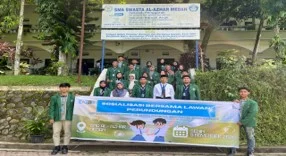
Students were also encouraged to show empathy toward peers experiencing bullying, including providing support and helping victims seek appropriate assistance.
Students Taught How to Report Cyberbullying
In addition to discussing psychological impacts, Group 51 explained the steps to take when someone experiences or witnesses cyberbullying.
Students were advised not to retaliate with similar behavior. Instead, they were encouraged to document the incident by saving evidence such as screenshots, messages, or other relevant information.
This evidence can be used when reporting incidents to school authorities, digital platform administrators, or law enforcement, depending on the severity of the situation.
Participants were also reminded not to hesitate to share their experiences with parents, teachers, school counselors, or other trusted individuals.
If bullying causes severe psychological distress, victims can seek additional support through counseling services or professional help.
Regarding legal aspects, the students introduced several regulations related to victim protection and digital conduct, including the Law on Information and Electronic Transactions (UU ITE), the Child Protection Law, the Criminal Code (KUHP), and the Regulation of the Minister of Education, Culture, Research, and Technology Number 46 of 2023.
Introducing these legal aspects aims to provide an understanding that actions in the digital space have consequences and carry responsibilities for users.
Interactive Socialization through Games and Discussion
The activity, which lasted approximately 45 minutes, was not limited to lectures but also actively involved the participants.
Following the opening, three student representatives presented the core material on cyberbullying.
To create a more relaxed atmosphere and increase student engagement, the committee held an ice breaking session featuring a word-chain game.
The event continued with a discussion and Q&A session. During this time, students had the opportunity to ask questions or share their thoughts on bullying issues they might have encountered at school or on social media.
The committee also provided prizes to students who answered questions correctly.
This approach was intended to help participants grasp the material more easily while building the confidence to discuss bullying issues.
Toward the end of the session, participants were asked to complete an evaluation questionnaire to measure changes in their understanding after the workshop.
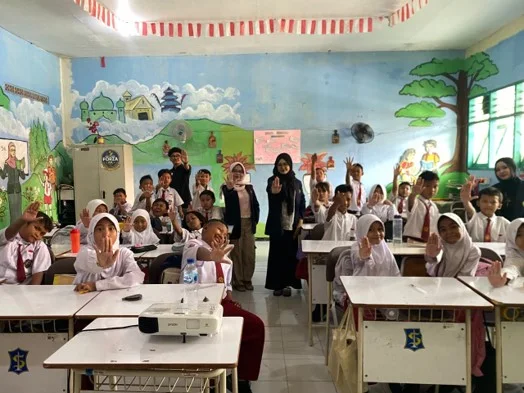
The event concluded with a documentation session and a group photo of the USU students and the SMA Unggulan Al-Azhar Medan students.
Evaluation Results Show Improved Student Understanding
Based on the pre- and post-socialization questionnaires, there was an increase in participant understanding across the three measured aspects.
Regarding the definition of cyberbullying, the number of students demonstrating understanding increased from 15 people or 60 percent to 21 people or 84 percent.
Meanwhile, the number of students who could identify examples of cyberbullying rose from 17 people or 68 percent to 24 people or 96 percent.
Improvement was also seen in knowledge regarding how to report cyberbullying. Before the session, 11 students or 44 percent knew the reporting steps. After the activity, this number increased to 19 students or 76 percent.
These evaluation results indicate an increase in participant knowledge after receiving the educational material.
However, understanding of reporting procedures remained the aspect with the lowest achievement compared to the other two indicators.
This finding serves as an evaluation point for Group 51 to suggest strengthening material on reporting mechanisms and access to assistance in future educational activities.
Promoting Sustainable Anti-Bullying Campaigns
During the implementation, the committee faced several technical challenges, including a faulty projector cable used to display the presentation.
Additionally, information regarding the schedule was only received on the day of the event, limiting preparation time.
Despite these obstacles, the socialization series was successfully carried out to completion.
As a point of improvement, Group 51 recommends earlier coordination with the school and thorough equipment checks before activities begin.
The student group also hopes that education on cyberbullying will not be limited to one-off sessions but can be developed into a sustainable program within the school environment.
One recommendation is to implement anti-bullying campaigns via Instagram and other digital media to reach a wider student audience.
Furthermore, schools are encouraged to provide a safe and easily accessible reporting space so that students who experience or witness bullying can seek help without fear.
Through this project-based MKWK activity, students from the University of Sumatera Utara are expected not only to apply the knowledge gained during their studies but also to make a tangible contribution to raising public awareness, particularly among the younger generation.
The socialization also serves as a reminder that creating a healthy digital environment requires collective involvement from students, teachers, parents, and social media users alike.
With increased awareness of the dangers of cyberbullying, students are expected to become wiser, more responsible technology users who care about the safety and comfort of others in the digital space.
Organizers: Group 51 on Bullying, MKWK University of Sumatera Utara
Lecturer: Dr. Halimatussakdiah, S.S., M.Si.
Activity Documentation:
YouTube: https://youtube.com/@nobullying_51
Instagram: https://www.instagram.com/nobullying_51








Comments 0
Write a Comment Share your response