

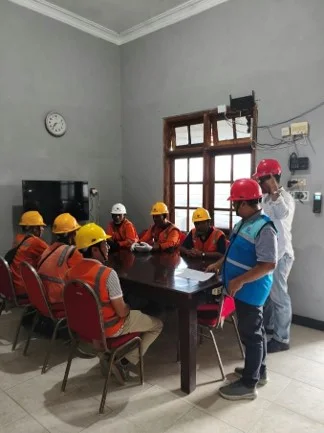
JurnalPost.com - What is the actual price of a worker's life? Is it comparable to the value of a multi-billion rupiah project, a completion target, or corporate profit? This question serves as a reminder that occupational health and safety (OHS) 3 is not merely an administrative rule to be fulfilled, but a moral responsibility that must never be ignored.
Amidst the demands of an increasingly competitive industrial world, worker safety is sometimes at risk of being placed behind productivity targets. In reality, one small oversight in the work environment can lead to major consequences, even claiming someone's life.
As a student at the University of 17 August 1945 (Untag) Surabaya currently undergoing an internship, I have seen firsthand how the implementation of OHS 3 plays a vital role in company operations, particularly for those in the contracting sector.
I gained one such experience while interning at PT Cita Yasa Perdana, a contractor company specializing in electrical work.
This field of work carries risks that cannot be underestimated. Every day, field technicians face potential dangers ranging from high-voltage electric shocks and falls from heights to extreme weather conditions that increase the risk of workplace accidents.
Such situations demand that companies not only pursue project completion but also ensure that every worker receives adequate protection.
Learning from OHS 3 Implementation at PT Cita Yasa Perdana
During my internship, I observed that PT Cita Yasa Perdana pays close attention to the implementation of occupational health and safety. The company has an OHS 3 officer or division tasked with supporting the supervision and execution of safety procedures.
The presence of an OHS 3 officer is a crucial part of ensuring that field activities run according to procedure and helping workers understand potential hazards that may arise.
Based on my observations during the internship, there are several steps the company takes to support the safety of its workers.
First, the use of personal protective equipment (PPE) is a requirement before work begins. Workers must also possess a work permit corresponding to the type of activity being performed. This provision is essential to prevent high-risk work from being carried out without adequate safety preparations.
Second, the company pays attention to training and workforce competence, especially for field technicians who deal directly with electrical risks.
Third, supervision is conducted to identify potential hazards early on. Workers are also encouraged to report unsafe conditions so they can be addressed immediately before causing an accident.
Fourth, health screenings are conducted before certain work activities begin, including blood pressure and heart rate checks. This step aims to help ensure that the worker's physical condition is fit to carry out their duties.
Fifth, the company provides breakfast before work starts as a form of care for the workers' needs.
Sixth, a safety briefing is held every morning. Through this briefing, workers receive reminders regarding safety procedures, task distribution, and potential risks that need to be anticipated.
Seventh, OHS 3 inspections and audits are conducted on various aspects supporting the work, including operational vehicles, worker health conditions, and materials used.
To me, these steps demonstrate that the implementation of OHS 3 is not enough if it is only written in company documents. Safety must be part of daily work habits, from preparation until the entire job is finished.
A Worker's Life Cannot Be Replaced by Money
Behind the work uniforms and safety gear worn by every worker, there are families waiting for their return.
A technician is not just a part of the company's workforce. They may be a father who must support his children, a mother who is the breadwinner for her family, or a child who is their parents' hope.
When a workplace accident occurs, the impact is not only felt by the company through operational losses. There are families who must face loss, and perhaps even experience permanent life changes.
No amount of money or financial compensation can truly replace a person's presence in their family.
Therefore, in my opinion, companies should not view the safety budget as a burden that can be reduced to cut operational costs. Instead, protecting workers is a vital investment to maintain business continuity and human dignity.
A Company's Professionalism Is Measured by Its Workers' Safety
The success of a contractor company is often judged by the quality of work, the punctuality of project completion, and the ability to meet customer needs.
However, there is one indicator that is no less important: how the company protects the people working behind that success.
A project completed on time is certainly an achievement. However, that achievement should not be attained by sacrificing worker safety.
PT Cita Yasa Perdana, like other contractor companies, has a responsibility to continue maintaining and improving the consistency of OHS 3 implementation. Supervision, evaluation, training, and the active involvement of all workers must be a continuous process.
This internship experience gave me the understanding that workplace safety is not just the responsibility of the OHS 3 officer. Management, field supervisors, and every worker have a role in creating a safe work environment.
Ultimately, the measure of a company's success is not just how many projects were successfully completed, but how great its commitment is to ensuring that workers can return home safely.
Because, for the families waiting at home, no project achievement is more valuable than the return of their loved ones.
My message is simple: Prioritize occupational health and safety. Do not let your family know you only through a photograph.







Comments 0
Write a Comment Share your response