

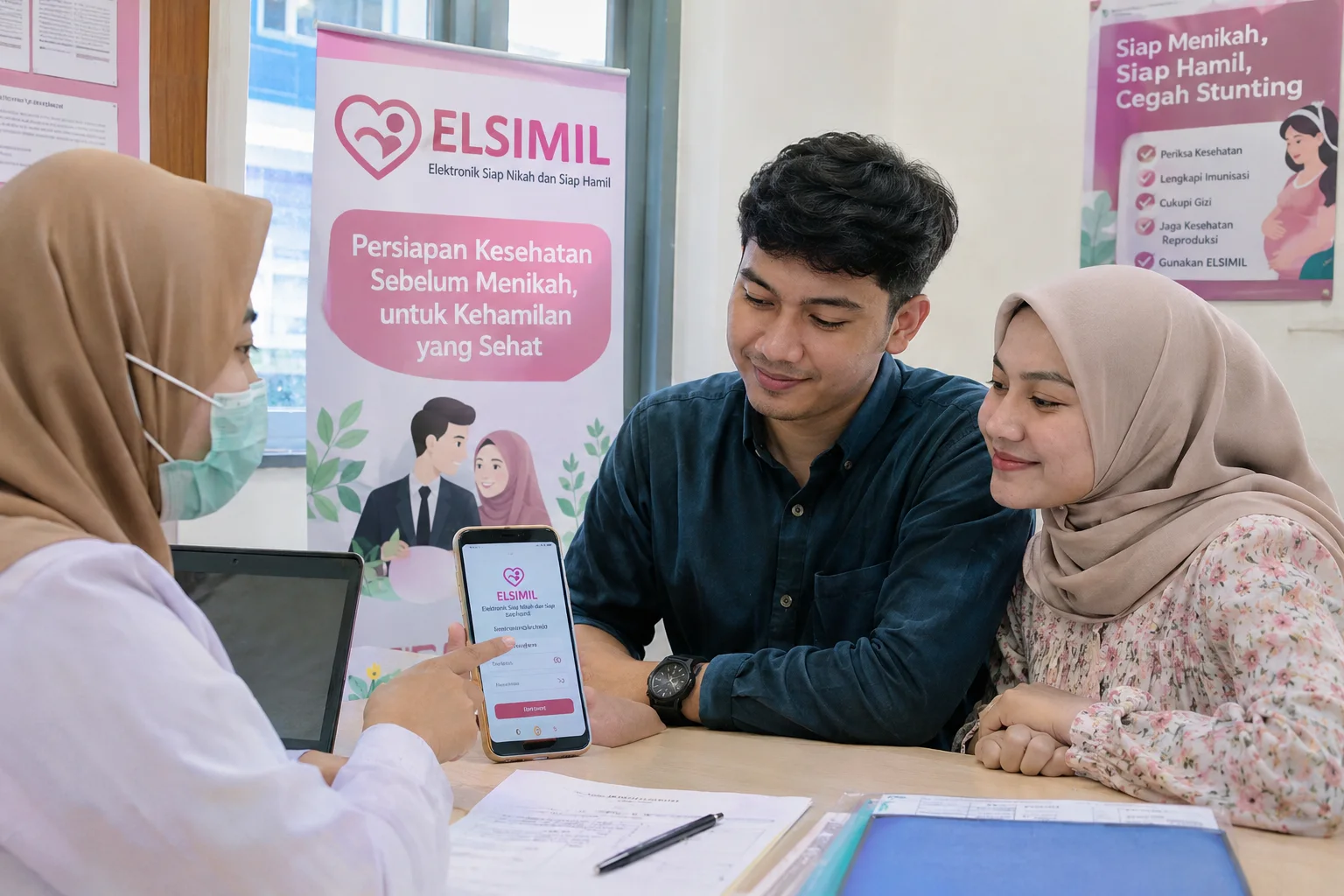
JurnalPost.com Wedding preparations are often synonymous with setting dates, choosing venues, and managing administrative documents. However, one equally critical aspect is preparing the health of the couple before they enter married life and plan for pregnancy.
As technology advances, health preparation for engaged couples is increasingly integrated with digital services. One such innovation is the Electronic Ready to Marry and Ready to Conceive (ELSIMIL) application, designed to support health screening and guidance for couples as part of efforts to ensure healthy pregnancies and reduce stunting risks from the pre-conception stage.
The introduction of ELSIMIL is certainly a positive step in leveraging technology for public health services. Through a self-entry mechanism, self-entrycouples can participate directly in providing information regarding their health status.
However, behind this convenience, questions arise that warrant attention. Do all engaged couples possess the same level of knowledge, technological access, and ability to understand and accurately input health information?
This question is vital because the quality of health data depends not only on the sophistication of the application but also on the social and cultural conditions of the users.
Social Disparities Affect Health Data Quality
From a social epidemiology perspective, an individual's health cannot be separated from their environment. Education, occupation, income, access to information, and opportunities to obtain health services influence how one understands and makes decisions regarding their health.
The same applies to the use of ELSIMIL.
Couples who own smartphones, have stable internet access, and possess good health literacy likely find it easier to navigate the data entry process. Conversely, those facing limitations in devices, internet connectivity, or health knowledge may encounter difficulties.
Furthermore, the ability to operate a smartphone does not always align with the ability to understand health information.
An individual might be accustomed to using social media and various digital applications, but they may not necessarily understand terms related to nutritional status, medical history, or reproductive health that appear in the screening form.
This condition has the potential to lead to input errors, either because questions are not understood correctly or because the user is unaware of the specific health information requested.
Research by Marintan, Purna, and Karmia (2024) on engaged couples in Padang found a correlation between pre-conception health knowledge and screening results via the ELSIMIL application.
These findings indicate that the understanding of the couple is a crucial aspect that must be considered in the implementation of digital health screening.
Thus, the issue of data quality should not be viewed merely as an individual error but must be understood within the context of social disparities that affect the community's ability to access and utilize health services.
Culture and Beliefs Influence Couple Openness
Beyond social factors, culture influences how someone conveys information about their health condition.
In some communities, discussions regarding reproductive health, medical history, or personal conditions are still considered sensitive.
Not everyone feels comfortable disclosing such information, especially if they do not understand who can access the data and how its confidentiality is protected.
Feelings of shame, concerns about judgment from others, and fear that health information might be leaked can affect the openness of couples when answering screening questions.
As a result, the information entered into the application may not fully reflect the user's actual health condition.
However, such discrepancies do not always mean that the couple is intentionally providing false information.
It is possible they do not understand the intent of the questions, are unaware of their exact health status, or do not feel secure enough to share personal information.
Therefore, an approach that blames the user when incomplete or inaccurate data is found risks ignoring the root of the problem.
It is more important to evaluate whether the processes of communication, education, guidance, and information confidentiality protection are functioning effectively.
Nutbeam and Lloyd (2021) explain that health literacy is a social determinant of health. An individual's ability to access, understand, evaluate, and use health information is closely related to the opportunities and resources available to them.
This perspective reinforces the understanding that producing quality health data is a shared responsibility between users, health workers, and service providers.
Digitalization Must Not Replace Human Support
The ease of data entry through applications is indeed a key advantage of digital health services. However, digitalization should not be interpreted as shifting the entire responsibility from health workers to the public.
The self-entry mechanism should be viewed as a means to increase the engagement of couples, not as a replacement for the need for direct communication and support.
Richardson and colleagues (2022), through their study on digital health equity, emphasize the importance of considering differences in access, ability, and user conditions in the implementation of health technology.
Without considering these factors, digital innovation has the potential to widen health service disparities.
In the implementation of ELSIMIL, the role of health workers and the Family Assistance Team is vital.
Support is not just about ensuring the couple can open the app or complete the form. Officers also need to help users understand the purpose of the screening, explain questions that are not well understood, and provide opportunities to clarify information.
Communication should be conducted using simple, non-judgmental language that maintains privacy and respects local social and cultural values.
Furthermore, the system needs to support processes for re-examination and data correction if incomplete or inconsistent information is found.
The support approach cannot be generalized. Couples with low health literacy may require more in-depth explanations compared to those already accustomed to accessing health information.
With an approach tailored to needs, technology can function as a tool that supports health services rather than becoming a new barrier for certain groups in the community.
ELSIMIL Success Is Not Just About User Numbers
In the implementation of digital-based programs, the number of users or successfully completed forms is often an easily observed indicator.
However, the volume of data collected does not necessarily indicate that all information is accurate and can be used optimally.
The success of ELSIMIL should not be measured solely by the number of couples who complete the application, but also by the completeness, accuracy, and utility of the information generated.
Data that aligns with the user's health condition can help identify risk factors early and serve as a basis for developing more appropriate support.
Conversely, incomplete or incorrect information has the potential to cause the health needs of the couple to go unidentified as they should be.
Therefore, the evaluation of ELSIMIL implementation needs to focus on data quality, user understanding, the effectiveness of support, and follow-up on screening results.
Ultimately, ELSIMIL is not just an application to fulfill administrative requirements before marriage. More than that, this application has the potential to be a gateway to building awareness about the importance of health before pregnancy.
It is not enough for couples to simply be asked to enter data. They also need to understand why the information is needed, how the screening results are used, and what the benefits are for their own health and the family they are building.
Digitalization of health services will be more meaningful when technology goes hand-in-hand with social understanding, cultural sensitivity, and humanized support. Because behind every piece of data entered into the application, there is an individual with different conditions, experiences, and health needs.
Bibliography
Marintan, T., Purna, R. S., & Karmia, H. R. (2024). Hubungan pengetahuan kesehatan prakonsepsi dengan hasil skrining aplikasi ELSIMIL pada calon pengantin. Jurnal Kesehatan Komunitas, 10(2), 324–332. https://doi.org/10.25311/keskom.Vol10.Iss2.1903
Nutbeam, D., & Lloyd, J. E. (2021). Understanding and responding to health literacy as a social determinant of health. Annual Review of Public Health, 42, 159–173. https://doi.org/10.1146/annurev-publhealth-090419-102529
Richardson, S., Lawrence, K., Schoenthaler, A. M., et al. (2022). A framework for digital health equity. npj Digital Medicine, 5, 119. https://doi.org/10.1038/s41746-022-00663-0


Comments 0
Write a Comment Share your response