

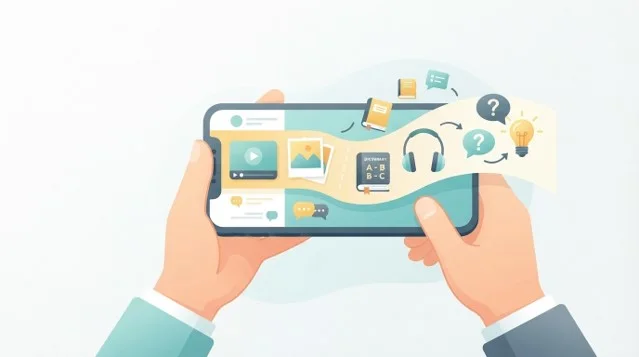
JurnalPost.com - Have we ever realized how much time we spend just scrolling through our phone screens every day? From the moment we wake up until we drift off to sleep, social media seems to be an inseparable part of our lives.
The morning begins with checking WhatsApp messages, viewing the latest posts on Instagram, or searching for interesting videos on TikTok. Even as the night grows late, our fingers remain busy scrolling, as if there is always something interesting to see.
This habit has earned social media the reputation of being a "time thief." Many people spend hours just consuming entertainment content that provides little actual benefit.
However, have we ever considered that this activity, often dismissed as a waste of time, could actually be an opportunity to learn?
Behind the funny videos, memes, and various entertainment content, social media holds great potential as a fun space for learning English. Interestingly, this learning process often happens naturally, even without us realizing it.
When Learning English No Longer Feels Boring
For some students, English is still considered a difficult subject. The many rules of grammar or grammar, the vocabulary that must be memorized, and the pronunciation, which differs from Indonesian, often present their own challenges.
Not to mention the fear of making mistakes when speaking. Some students feel insecure because they worry about constructing sentences incorrectly or mispronouncing words in English.
As a result, English is sometimes viewed as a subject full of rules and pressure, rather than a communication tool that can be used casually.
In reality, learning a language does not always have to be done through textbooks, vocabulary memorization, or classroom exercises.
This is where social media can play a role as an alternative learning medium that is closer to our daily lives.
Through TikTok, Instagram, and YouTube, we can find various English-language content packaged in an engaging way. This ranges from daily conversations, comedy videos, and personal stories to discussions of popular expressions frequently used by English speakers.
Such content provides users with the opportunity to recognize the use of English in more realistic communication contexts.
Learning New Vocabulary from the Content We Watch
One of the benefits of social media in English learning is its ability to introduce new vocabulary and expressions indirectly.
When watching videos or reading English comments, we often encounter words that we have never learned in school.
For example, terms like literally, overthinking, red flag, green flag, and healing often appear in social media conversations.
The expression red flag, for instance, is frequently used to describe a warning sign regarding certain behaviors or situations. Conversely, green flag usually refers to signs or characteristics considered positive.
In addition to popular vocabulary, we can also find various English idioms such as break the ice , which means to ease the tension, piece of cake to describe something very easy, and out of the box , which relates to creative or unconventional thinking.
There are also daily conversational expressions like by the way and on the way that are often found in content or comment sections.
Without realizing it, exposure to these various expressions can help us recognize vocabulary, understand the context of their use, and get accustomed to hearing and reading English.
Interestingly, all of this can be obtained through activities previously done only for entertainment.
This is what makes learning through social media feel different. We do not always feel like we are studying, yet we still gain new knowledge from the content we consume.
Social Media Helps Reduce the Fear of Learning
Beyond enriching vocabulary, social media can also help build the courage to use English.
Watching others speak English in videos, participating in pronunciation challenges, or trying to write simple comments can be a first step toward practicing language skills.
We can also repeat videos multiple times to understand the pronunciation of a word, pay attention to the speaker's intonation, and then try to imitate them.
This process provides a more flexible learning opportunity because everyone can adjust the material and pace of learning to their own abilities.
For students who feel shy about speaking in front of the class, independent practice through digital content can be a way to build confidence before practicing in direct communication.
However, the courage to use English must still be accompanied by consistent practice. Watching videos alone is not necessarily enough to improve speaking skills if it is not followed by practice.
Stay Wise, Not All English on Social Media Is Correct
Although it has many benefits, social media is certainly not a source of learning that can always be trusted.
Not all English usage found in posts or comments adheres to correct grammatical rules.
Some users employ abbreviations, slang, informal sentences, and even mix English with other languages.
Such usage might be understood in daily communication, but it is not necessarily appropriate when applied to academic writing or formal situations.
Therefore, it is important for us to distinguish between formal and informal English, while also double-checking vocabulary or expressions we do not understand using dictionaries and trusted learning sources.
Social media should be utilized as a supporting tool for learning, not as the sole source for understanding English.
School-based learning still plays an important role in providing a systematic foundation for grammar, reading, writing, listening, and speaking skills.
Meanwhile, social media can serve as a complement that helps students see how English is used in everyday life.
From Mere Entertainment to a Learning Habit
Ultimately, the benefits of social media depend on how we use it.
If your free time has been spent only on watching entertainment content without a purpose, there is no harm in starting to insert English educational content into your daily scrolling activities.
We can follow English learning accounts, watch conversation videos, take notes on new vocabulary, or try using newly learned expressions.
It does not have to take hours immediately. Small habits performed consistently can actually be the first step toward developing language skills.
In this way, the act of opening social media not only provides entertainment but also an opportunity to broaden our horizons.
It is time to change our perspective on social media. Digital platforms are not always enemies of education or mere time thieves. If used wisely, social media can become a relaxed, flexible, and fun learning space.
Changing the habit from scrolling to learning does not mean you have to stop enjoying entertainment. We just need to be more selective in choosing content so that the time spent in front of the screen has added value.
Because learning English does not always have to start by opening a textbook. Sometimes, the learning process begins with one simple video that appears on our social media feed.

Comments 0
Write a Comment Share your response