

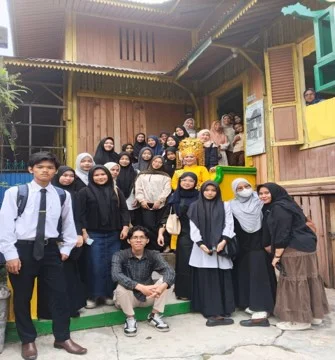
PEKANBARU, JurnalPost.com – Students from the English Language Education Study Program, Faculty of Teacher Training and Education (FKIP), Islamic University of Riau (UIR), conducted an educational visit to the Kampung Bandar Weaving House in Senapelan District, Pekanbaru, on Friday (20/11/2026).
The visit was part of the coursework for News Writing & Reporting which aims to provide students with practical experience in developing journalistic skills, particularly through field observation, interviewing, information gathering, and news writing.
The activity was supervised by lecturer Fitri Wulandari, M.Pd. During the visit, students had the opportunity to learn about the history of the Kampung Bandar Weaving House, the traditional weaving process, and the role of the weaving industry in the lives of the local community.
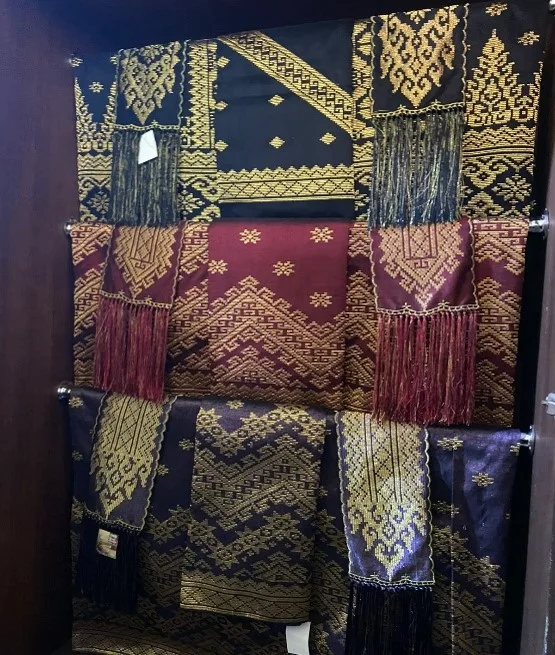
The Kampung Bandar Weaving House is a historic building believed to have been established in 1887 by H. Yahya, a rubber entrepreneur at the time. Over time, the building was repurposed as a production site for traditional Malay woven fabrics. Since 2012, this weaving business has been developed and managed by the Pucuk Rebung Community Self-Reliance Group (KSM).
The development of the business began with the National Program for Community Empowerment (PNPM) Mandiri in 2012, which provided assistance in the form of equipment, raw materials, capital support, and weaving training for the people of Kampung Bandar. This program served as an initial step in empowering the community through traditional weaving skills.
During the visit, students interviewed one of the representatives of the Weaving House, Ibu Rina. She explained that the Weaving House not only plays an important role in preserving Malay culture but also contributes to improving the economic welfare of the surrounding community.
According to her, the weaving business provides opportunities for local residents to earn an income through their skills. Furthermore, community-based management encourages independence, cooperation, and public participation in developing local economic activities.
In its production process, the Kampung Bandar Weaving House maintains traditional techniques, from preparing and dyeing the yarn to the weaving process itself. One of its unique features is the use of natural dyes derived from plants and materials available in the surrounding environment.
Some of the natural materials used include turmeric, jengkol skins, ketapang leaves, and various other natural ingredients. The use of these natural dyes reflects the local wisdom and traditional knowledge that continue to be preserved in the fabric-making process.
Through the interview with Ibu Rina, students also gained information regarding the various challenges faced in the weaving production process. One of the main challenges is the use of traditional weaving equipment, which requires patience, precision, and specialized skills, as the process of making the fabric is quite time-consuming.
Nevertheless, this traditional equipment remains in use as part of an effort to maintain the authenticity of weaving techniques and preserve Malay cultural heritage.
Students were also introduced to various traditional woven products, such as songket fabrics, shawls, tanjak (traditional Malay headgear), bags, and various souvenirs. They also had the opportunity to witness firsthand the weaving process using non-mechanical looms (ATBM).
In addition to learning about the weaving process, this visit provided students with a deeper understanding of the importance of maintaining and preserving local traditions. Students were able to see firsthand how traditional crafts continue to play a role in maintaining cultural identity while supporting the economic welfare of the community.
The activity also served as a valuable learning experience for students in developing journalistic skills, particularly in conducting observations, gathering information, interviewing sources, and composing news based on information obtained directly in the field.
Through this visit, students are expected to have a greater awareness of the importance of local cultural heritage and to understand that cultural preservation is not only about maintaining history and traditions but also about creating social and economic benefits for the community.
The Kampung Bandar Weaving House serves as an example of how Malay cultural heritage can be preserved while providing tangible benefits to the local community. Its existence demonstrates that cultural preservation and community economic empowerment can go hand in hand.



Comments 0
Write a Comment Share your response