

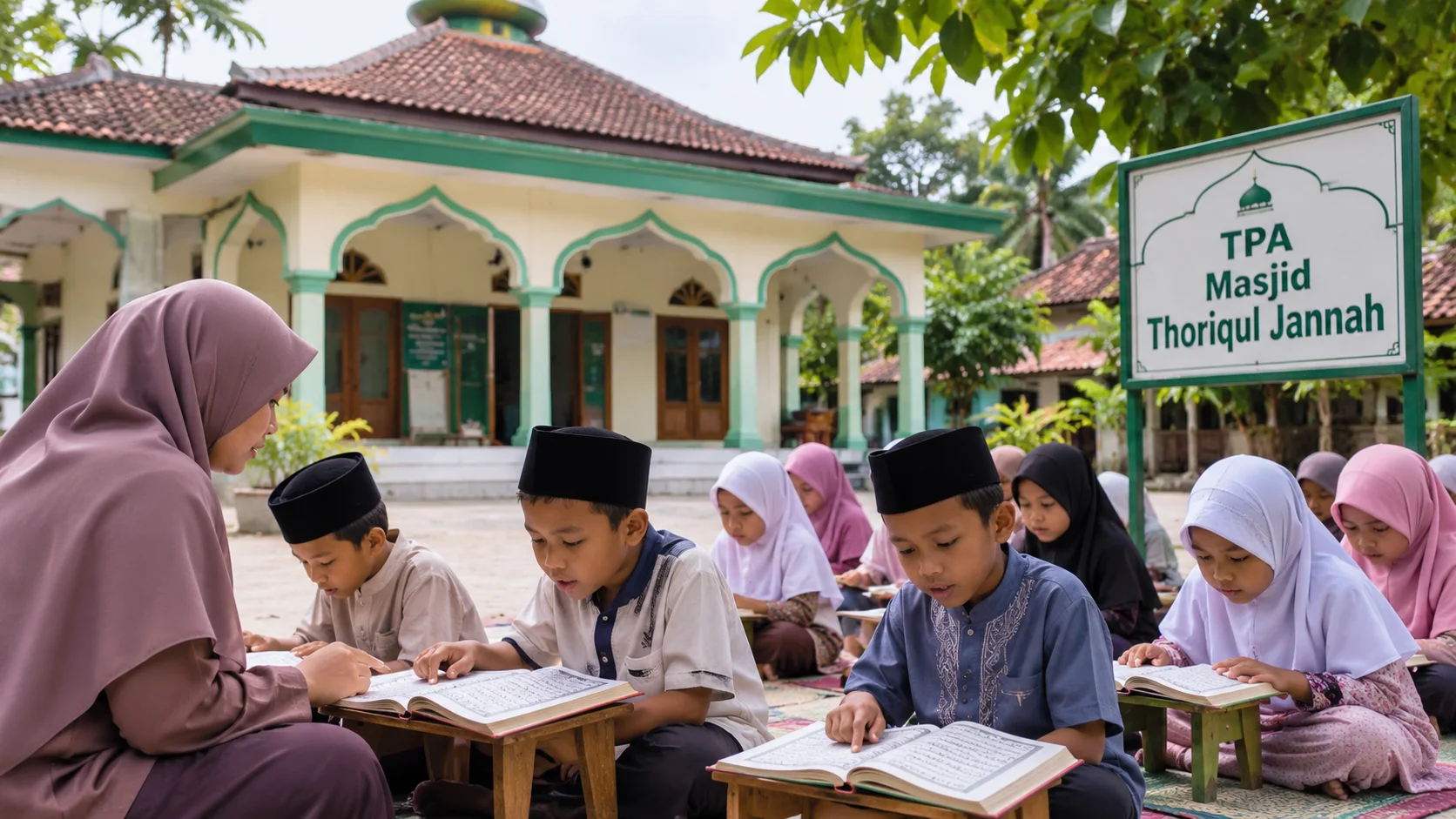
JurnalPost.com -- Historically, mosques have served not only as places of worship but also as centers for community development and Islamic education. Various educational activities, ranging from Quranic instruction for children to the establishment of formal educational institutions, have flourished within mosque environments. However, the growth of these mosque-based educational institutions is not always matched by the development of adequate management systems.
This condition is evident at the Thoriqul Jannah Mosque, located in a remote area of Lamongan Regency, East Java. The mosque was established around 1970 through the initiative of a local community leader. It is situated approximately 10 kilometers from the sub-district center, with road access that remains underdeveloped.
The community's enthusiasm for developing Islamic education was demonstrated by the founding of a Quran Education Center (TPA) in 2000 through a collective effort. Initially, learning activities were conducted by volunteers who were alumni of Islamic boarding schools. Seven years later, specifically in 2007, a private Islamic elementary school was established approximately 200 meters from the mosque.
Both institutions share the same historical roots, having grown from the community's passion for Islamic education. However, they have developed under different management systems. The TPA remains under the management of the mosque committee (takmir), while the elementary school is managed by its own independent governing body.
TPA Sustaining Itself with Conventional Management
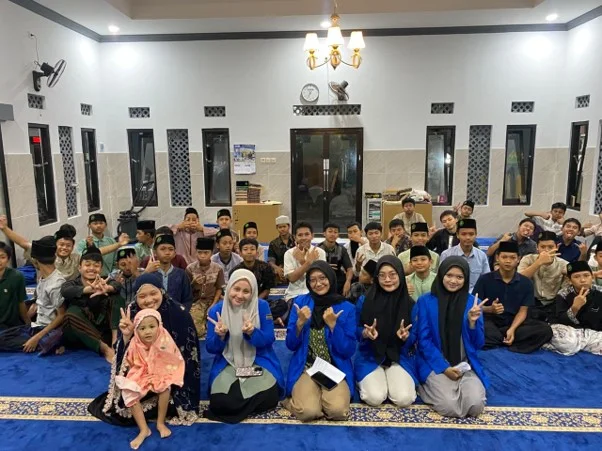
To this day, the Thoriqul Jannah Mosque TPA continues to hold regular learning activities from Saturday to Thursday, from 14.00 to 16.00 WIB. The number of students ranges from 50 to 60, spanning ages from kindergarten (TK) to the sixth grade of elementary school. The students are divided into three learning groups based on age and Quranic reading proficiency.
Group A is intended for children from kindergarten to second grade, with the goal of completing Iqra volumes 1 to 6. Group B consists of third and fourth-grade students with the goal of finishing Iqra and beginning to read the Quran. Meanwhile, Group C is for fifth and sixth-grade students, with the goal of achieving fluent Quranic recitation.
However, these learning targets have not been fully met. After years of attending the TPA, some students are still unable to read the Quran fluently. This issue cannot be attributed solely to the children's or teachers' abilities but must also be viewed through the lens of learning management.
Currently, TPA activities are handled by two teachers, both of whom are Islamic boarding school alumni. One teacher manages Group A, which has about 25 students, while the other teacher handles Groups B and C simultaneously.
Student attendance is not always consistent. Of the total registered students, average daily attendance ranges from 32 to 37 children.
The learning process relies heavily on the experience and guidance of the more senior teacher. There is currently no written curriculum, comprehensive student administration, learning progress records, or periodic evaluations.
While learning activities continue, the progress of each student's ability remains undocumented in a systematic way.
This situation reveals a gap between educational goals and the systems used to ensure those goals are met. While the teachers understand the goal of Quranic literacy, it is not supported by success indicators, progress tracking, or regular evaluations.
When Educational Responsibility Rests Solely on Teachers
From the perspective of the mosque committee, TPA learning activities are entirely the responsibility of the teachers. The committee provides support in the form of honorariums funded by Friday donations, paid every two months. However, the responsibility for implementing the learning process is largely left to the instructors.
This view must be understood within the context of the institution's limited resources. Two teachers must manage three learning groups with a significant number of students. Furthermore, there is no administrative or evaluation system available to help teachers measure student progress periodically.
The issue is not merely about who is responsible for teaching, but how the continuity of education can be maintained through a clear division of roles.
The committee's support should not stop at providing honorariums but could be expanded through training, the provision of learning materials, and simple evaluations of the TPA's operations.
This does not mean the committee must take over the teachers' duties. Teachers remain the primary facilitators of learning, while the committee can perform organizational and supervisory functions to ensure educational activities are more structured.
With a clear division of responsibilities, the educational process does not rely solely on the commitment of individual teachers but gains more sustainable institutional support.
Formal and Non-formal Education: Should They Be Unified?
The existence of a private Islamic elementary school about 200 meters from the mosque presents an opportunity for educational collaboration. Both institutions share the same community background and play a role in educating children.
However, coordination between the TPA and the school remains very limited. Communication usually only occurs during Islamic holiday commemorations. There are no routine collaborative programs.
According to the mosque committee, it is difficult to merge the TPA and the elementary school due to limitations in human resources, facilities, and infrastructure. There is also concern that merging management could lead to financial issues, as the operational needs of the two institutions differ.
This perspective shows that institutional integration is not a simple choice. The school has its own operational needs and management responsibilities, as does the TPA.
Forcing a merger without sufficient resources could potentially increase management burdens and disrupt the continuity of educational activities.
However, not merging the two institutions does not mean they cannot collaborate.
The TPA and the school can continue to operate independently while building coordination in religious education programs, Quranic reading proficiency training, Islamic activities, and communication regarding student learning progress.
Thus, what is needed is not always organizational integration, but rather synergy in programs and inter-institutional communication.
Examining Issues Through the Functions of Educational Management
The management issues at the Thoriqul Jannah Mosque TPA can be analyzed through the four management functions identified by George R. Terry, namely planning, organizing, actuating, and controlling (POAC).
First, planning (planning).
The TPA actually has learning goals based on the age and ability of the students. However, these goals have not been translated into a written program that includes learning stages, time targets, and achievement indicators.
Written planning is necessary so that every teacher has a common guide for conducting lessons and knows the competencies students must achieve at each stage.
Second, organizing (organizing).
TPA activities are not supported by a clear organizational structure or division of administrative tasks. The limited number of teachers also forces one teacher to handle two learning groups simultaneously.
Better organization could help divide responsibilities between the committee and the teachers, including the management of administration, learning schedules, and educational facility needs.
Third, actuating (actuating).
Learning activities continue regularly. This demonstrates the teachers' commitment to maintaining Quranic education within the community.
However, the implementation of learning, which still relies on teacher experience, needs to be supported by more structured learning tools and capacity building for the teaching staff.
Fourth, controlling (controlling).
There are no periodic exams, student progress records, or structured program evaluations. Consequently, the success of the learning process is difficult to measure objectively.
Evaluation does not have to be done through a complex system. Recording reading proficiency, attendance, and the progress of each student can be an initial step toward determining the effectiveness of the learning process.
These four functions show that merely continuing educational activities is not enough. Education also requires a management system capable of ensuring that the learning process proceeds according to established goals.
Strengthening the TPA Without Merging Institutions
Developing the Thoriqul Jannah Mosque TPA does not have to begin with a major change in organizational structure. Improvements can be made gradually according to the institution's capabilities and conditions.
An initial step that can be taken is to establish a simple division of tasks between the committee and the teachers, draft written learning targets for each group, create a master list and student attendance book, and record progress in Quranic reading proficiency.
Simple evaluations every few months can also help identify students who have reached their learning targets and those who still require more intensive support.
Furthermore, communication with parents needs to be strengthened so that Quranic education is not solely the responsibility of TPA teachers.
Consistent student attendance and the habit of practicing Quranic reading at home influence a child's progress. Therefore, family involvement is a crucial part of supporting educational success.
Meanwhile, the elementary school near the mosque can be invited to build cooperation without having to merge institutions.
Joint programs can be organized according to the capabilities and agreements of both parties, for example, through religious guidance activities, Quranic reading assistance, or evaluations of student learning progress.
Such cooperation can be a realistic step to strengthen Islamic education in the community without adding an excessive administrative burden to either institution.
Maintaining the Spirit of Education Through Better Governance
The Thoriqul Jannah Mosque has shown that community spirit can give birth to Islamic educational institutions. The TPA, established in 2000, and the elementary school that followed in 2007 are proof of the community's contribution to providing education for children in remote areas.
However, the spirit of establishing institutions must be followed by a commitment to building better educational governance.
The success of a TPA is not measured solely by how long activities have been running or how many children are enrolled, but also by the progress of student abilities, which must be identified, documented, and evaluated.
A mosque as a center for Islamic education does not need to have a single management system for all institutions that grow around it. What is more important is the existence of a clear division of roles, responsibilities, and healthy cooperation between mosque managers, educators, educational institutions, and the community.
Ultimately, maintaining the continuity of education is not just about establishing institutions, but also ensuring that every child receives a learning process that is structured, sustainable, and yields tangible results for their development.




Comments 0
Write a Comment Share your response