

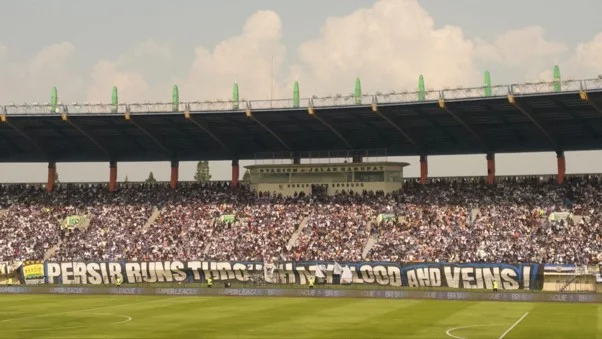
BANDUNG, JurnalPost.com – For the people of Bandung, the calendar is often defined not just by public holidays or workdays, but by the Persib Bandung match schedule. Every time the Maung Bandung take to the pitch, whether making history in the Indonesian League or representing the city on the Asian stage, the pulse of Bandung seems to center on a single point. Once the referee blows the final whistle, the city's atmosphere can shift in a matter of seconds.
If the match ends in victory, major streets like Dago, Asia Afrika, and the Pasupati Bridge can turn into a boisterous sea of blue. Strangers at traffic lights exchange smiles, as if they have just won a battle for survival.
Conversely, when defeat arrives, a strange silence suddenly descends upon the corners of the city. Conversations in coffee shops turn somber, and Monday feels much heavier to endure.
This phenomenon sparks a fundamental question: why can a ninety-minute match played by twenty-two people on a green field influence the moods of so many human beings?
If we view humans solely as rational, calculating creatures, football fanaticism seems nonsensical. A club's win or loss does not immediately increase one's bank balance or pay off installments.
However, for the people of Bandung, Persib has never been just a football club. It has transformed into a symbol of identity and a collective belief system that sustains the city's spirit.
Vitalism: The Will to Power Behind the Cheers
To dissect why the emotions of the Bobotoh burn so intensely, the perspective of vitalist philosophy offers a compelling analytical tool. In the tradition of human philosophy, vitalism challenges the classical assumption that reason is the sole ruler of the human self.
This perspective focuses on the energy, life force, power, and instinctive drives that play a role in maintaining and developing human existence.
The thoughts of German philosopher Friedrich Nietzsche can be read in relation to this life force through his famous concept, will to power or the will to power.
For Nietzsche, life is not a passive or static condition. Life is linked to the drive to grow, transcend limitations, overcome obstacles, and assert one's strength in the world.
At this point, Persib can be understood as an extension of the ego and the collective pride of Bandung's citizens. When Persib makes history as league champions and steps up to challenge Asian football clubs, that will to power finds its channel of expression.
The cheers of tens of thousands in the stands and the singing on the streets become a manifestation of overflowing human vitality. In an instant, the fatigue from work routines, college assignments, or economic pressures dissolves into a feeling of sovereignty.
Victory provides an inner affirmation that we are strong, we are capable of conquering opponents, and life is worth celebrating with passion.
A similar emotional mechanism can work in reverse when defeat strikes.
A contrasting scene is immediately felt at my regular coffee shop when Persib returns empty-handed. As soon as the match ends, the previously boisterous chairs suddenly fall quiet. People rush home without saying much, leaving behind half-finished glasses of coffee.
On my phone screen, my social media timeline instantly turns into an impromptu courtroom. The comment sections are filled with long debates dissecting game tactics, blaming the finishing of the front line, and criticizing the referee's leadership.
It feels as if everyone is trying hard to find the most logical reason to treat the tightness in their chests.
In a reading through the perspective of vitalism, defeat can be felt as a threat to existence and a decline in life force. Thoughts that appear logical sometimes become a form of rationalization for more fundamental emotional drives.
When the inner self refuses to accept feelings of weakness or defeat, reason immediately works to find justification. From pointing to the referee's decisions and blaming the field conditions to criticizing the coach's tactics, everything can be an attempt to protect a wounded collective pride.
Hyperreality and Sacrifice on the Blue Prayer Mat
If vitalism helps explain the emotional fuel in the hearts of the Bobotoh, the thoughts of postmodernist philosopher Jean Baudrillard offer another perspective to understand why the bond with Persib resembles a sacred rite.
In modern society, Baudrillard highlights that an object is no longer defined solely by its physical function, but also through the sign value (sign value) attached to it.
The blue jersey and the Persib emblem on the left chest are not just cloth covering the body. Both are markers of identity, dignity, and brotherhood that transcend social class barriers in Bandung.
When the kickoff whistle is blown, the city's residents seem to enter an experience that can be read through Baudrillard's concept of hyperreality, where representation and reality become increasingly difficult to distinguish.
The drama of the match on the green field, amplified by television broadcasts, social media, and various club identity symbols, can feel more urgent and captivating than daily life.
Furthermore, one indication that Persib has transcended the boundaries of an ordinary sports club can be witnessed through the totality of the Bobotoh's sacrifices.
When Persib plays away matches in Asian competitions, its supporters are willing to cross geographical boundaries as far as South Korea and Australia just to stand in the stands and guard their pride.
From the lens of a market economy that calculates profit and loss, draining savings, using up work leave, and enduring the cold weather of a foreign land just to watch a ninety-minute match might seem like an uneconomical act.
However, through Baudrillard's concept of symbolic exchange (symbolic exchange), such behavior can be understood as a form of social relationship that cannot simply be reduced to monetary value or material calculation.
Symbolic exchange relates to reciprocal relationships through giving, receiving, rituals, and sacrifices that go beyond ordinary economic transactions.
Persib provides pride and history for the land of Pasundan. The Bobotoh reciprocate with loyalty, prayers, and physical presence wherever the Maung Bandung step, even to stadiums abroad.
At this point, football turns into a “belief” in the metaphorical sense, experienced with one's whole soul.
More Than Just Football
Bringing together the perspective of vitalism, Nietzsche's thought, and Baudrillard's symbolic ideas makes us realize that judging the fanaticism of Bandung's residents through the lens of profit and loss will lead to a dead end.
Humans are not calculating machines that can separate themselves from passion, symbols, and the need for a sense of belonging.
Living and going about my daily life in Bandung has made me understand that loving Persib is not just a matter of being a sports fan.
Amidst piles of college assignments and the hustle and bustle of the city streets, I see fellow Bobotoh from various backgrounds willing to set aside money to buy stadium tickets. There are also stories of Bobotoh who travel long distances to guard the team even abroad.
That experience made me realize that such sacrifices are born from an inner bond that transcends material calculation.
At that point, the ninety-minute match becomes a breathing space for many people. A space filled with passion, loyalty, and a sense of belonging, which makes the city's residents feel connected to one another.
Amidst the rhythm of a modern city that is often rigid, cold, and exhausting, the ninety minutes of a Persib match become a symbolic space where the people of Bandung reclaim their vitality while nurturing their communal bonds.
Whether lost in the blue party of victory, traveling thousands of kilometers to foreign lands to guard the emblem on their chests, or sitting in silence swallowing the bitterness of defeat, those emotional surges are proof that Bandung and the people within it are truly alive, believing, and pulsing.
Persib salawasna!





Comments 0
Write a Comment Share your response