

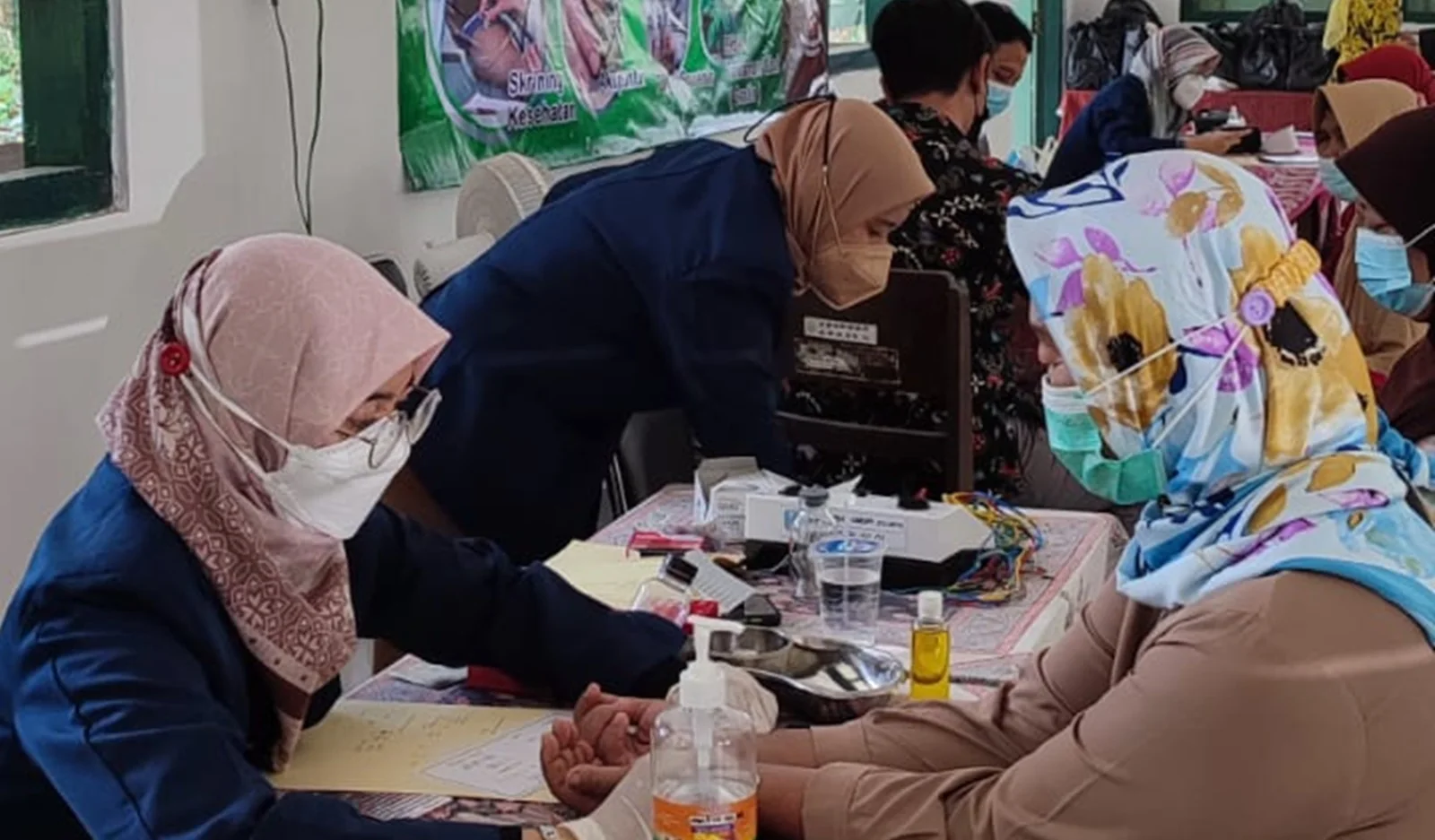
JurnalPost.com – Traditional healthcare services have long been an integral part of life in Indonesia. Practices such as traditional massage, the use of herbal remedies, acupressure, and various other forms of traditional care continue to be utilized to maintain health and address specific ailments.
This utilization is reflected in national health policy. The government regulates the provision of traditional healthcare through Government Regulation Number 28 of 2024 as an implementing regulation for Law Number 17 of 2023 concerning Health.
These regulations govern, among other things, the practitioners permitted to provide traditional healthcare and the obligation to work according to their competence and authority, use safe tools and technology, and follow cooperation and referral pathways with conventional healthcare services (Government of the Republic of Indonesia, 2024).
The significant extent of traditional healthcare utilization is also evident in the 2023 Indonesian Health Survey (SKI). The survey results indicate that the proportion of the population utilizing traditional health efforts reached 32.5 percent (Indonesian Ministry of Health, 2024).
This figure must be interpreted according to the SKI indicator definition, which refers to the utilization of traditional health efforts by household members, and should not necessarily be interpreted as the proportion of the population accessing formal traditional healthcare facilities.
Nevertheless, the data shows that traditional health practices remain a part of public behavior in maintaining or restoring health.
Traditional Healthcare and Public Trust
Public choices in seeking treatment are not always determined by medical considerations alone. Studies on health-seeking behavior in Indonesia have found that public decisions are influenced by a number of interrelated factors, including socio-demographic characteristics, the influence of family or close associates, socio-cultural beliefs, perceptions of illness, accessibility, and service costs (Widayanti et al., 2020).
Therefore, the use of traditional medicine is not only related to the choice of therapy but also to how the public understands health and illness, as well as the experiences that develop within their social environment.
Public acceptance of traditional healthcare services is an important form of social capital. However, high utilization must be accompanied by attention to quality, safety, and the benefits of the service.
Public trust alone is not enough to guarantee that the actions provided are in accordance with the provider's competence, performed with the correct procedures, and supported by an adequate monitoring system.
Therefore, cultural preservation must go hand in hand with the protection of the public as service users.
The Importance of Quality Management in Traditional Healthcare
It is at this point that quality management becomes essential. According to Donabedian, the quality of healthcare can be evaluated through three interrelated components: structure (structure), process (process), and outcome (outcome).
Structure encompasses all resources that enable services to be provided, such as practitioner competence, the availability of facilities and infrastructure, regulations, financing, and organizational governance.
Process describes how services are carried out, including patient assessment, the appropriateness of actions, communication between providers and recipients, adherence to standard operating procedures, and service documentation.
Meanwhile, outcome reflects the results obtained from the service, whether in the form of changes in health status, patient safety, user satisfaction, or quality of life after receiving care (Donabedian, 1988).
The Donabedian model remains one of the most widely used models in measuring healthcare quality because it is capable of explaining the relationship between system readiness, service implementation, and the results achieved.

Research conducted by Yang et al. (2025) shows that the structure-process-outcome approach remains the dominant framework in evaluating the quality of outpatient and nursing care because it provides a systematic basis for continuous quality improvement.
In traditional healthcare, the application of this model is also relevant. Liu et al. (2025) developed a quality indicator system for health tourism services based on Traditional Chinese Medicine (TCM) using the Donabedian framework.
The study demonstrates that the dimensions of structure, process, and outcome can be used to establish service quality standards, ensure user safety, and support more accountable service governance.
In traditional healthcare in Indonesia, the structure aspect can be realized through the availability of traditional health practitioners who possess the education, competence, and practice authority in accordance with regulations, supported by safe facilities and a clear governance system.
The process aspect includes the implementation of services according to standard operating procedures, patient condition screening, identification of indications and contraindications for actions, implementation of referrals when necessary, and adequate service documentation.
The outcome aspect can be measured through the clinical benefits felt by the user, patient satisfaction levels, service safety, adverse events, and the success of follow-up referrals.
Thus, the quality of traditional healthcare is not only assessed by the perception of the patient's improved condition but also by the system's readiness and the quality of the processes underlying the service.
Encouraging Continuous Quality Improvement
Quality improvement should not stop at inspection or supervision at the end of a service. Improvement needs to be an iterative process that begins with problem identification, change planning, implementation, outcome assessment, and adjustment.
One approach that can be used is the Plan–Do–Study–Act (PDSA) cycle, which helps healthcare facilities test changes incrementally and use observation results to determine subsequent improvements.
However, a systematic review by Taylor et al. (2014) reminds us that the application of PDSA in healthcare needs to be carried out carefully and documented. Simply mentioning the PDSA cycle does not automatically guarantee that the quality improvement process will run well.
This direction of strengthening is in line with the World Health Organization (WHO) global strategy on traditional, complementary, and integrative medicine for the 2025–2034 period.
The strategy emphasizes the strengthening of scientific evidence, safety and regulation, and the integration of services into the health system (WHO, 2025).
In the Indonesian context, technical guidelines for the integration of primary healthcare have also opened space for the integration of traditional healthcare, including through self-care education and the utilization of services such as acupressure, acupuncture, and herbal remedies in accordance with the provisions and capacity of the service (Indonesian Ministry of Health, 2023).
This integration must be accompanied by clear standards, role distribution, and referral mechanisms so that it does not stop merely at adding types of services.
Four Agendas for Strengthening Traditional Healthcare
There are several agendas that need to be prioritized in improving the quality of traditional healthcare services.
First, healthcare facilities need to develop and implement standard operating procedures that are appropriate to the type of service, practitioner competence, and available scientific evidence.
Second, capacity building for practitioners must be carried out continuously, accompanied by verification of qualifications and practice authority.
Third, local governments and healthcare facilities need to develop monitoring and evaluation that includes compliance with standards, documentation completeness, adverse events, referral implementation, and user experience.
Fourth, research on the effectiveness, safety, and quality of traditional healthcare services needs to be strengthened so that policies and service practices do not rely solely on popularity or individual experience.
Preserving Cultural Heritage, Ensuring Public Safety
Ultimately, the future of traditional healthcare is determined not only by the strength of cultural roots in society but also by the health system's ability to ensure the quality of its implementation.
Culture is an important part of the identity of Indonesian public health. However, its preservation must go hand in hand with the strengthening of scientific evidence, user safety, practitioner competence, and service governance.
With quality management that is planned and evaluated continuously, traditional healthcare can develop as part of an Indonesian health system that is safer, higher quality, and oriented toward the needs of the community.
Bibliography
Donabedian, A. (1988). The quality of care: How can it be assessed? JAMA, 260(12), 1743–1748. DOI: 10.1001/jama.1988.03410120089033.
Ministry of Health of the Republic of Indonesia. (2024). Indonesian Health Survey (SKI) 2023 in numbers. Health Development Policy Agency.
Ministry of Health of the Republic of Indonesia. (2023). Decree of the Minister of Health Number HK.01.07/MENKES/2015/2023 concerning Technical Guidelines for Primary Healthcare Integration.
Liu, T., Zhang, X., Liu, Y., Yan, Y., & Zhang, D. (2025). Evaluation Indicators System of Traditional Chinese Medicine Health Tourism Institutions Based on the Donabedian Model. Tsinghua Shenzhen International Graduate School. DOI: 10.22541/au.174281596.60054106/v1.
Government of the Republic of Indonesia. (2024). Government Regulation Number 28 of 2024 concerning the Implementing Regulation of Law Number 17 of 2023 concerning Health.
Taylor, M. J., McNicholas, C., Nicolay, C., Darzi, A., Bell, D., & Reed, J. E. (2014). Systematic review of the application of the plan–do–study–act method to improve quality in healthcare. BMJ Quality & Safety, 23(4), 290–298. DOI: 10.1136/bmjqs-2013-001862.
Widayanti, A. W., Green, J. A., Heydon, S., & Norris, P. (2020). Health-seeking behavior of people in Indonesia: A narrative review. Journal of Epidemiology and Global Health, 10(1), 6–15. DOI: 10.2991/jegh.k.200102.001.
Yang, J., Liu, F., Yang, C., Wei, J., Ma, Y., Xu, L., Xie, J., & Wang, J. (2025). Application of Donabedian Three-Dimensional Model in Outpatient Care Quality: A Scoping Review. Journal of Nursing Management, 2025, Article ID 6893336. DOI: 10.1155/jonm/6893336.
World Health Organization. (2025). Global traditional medicine strategy 2025–2034. World Health Organization.



Comments 0
Write a Comment Share your response