

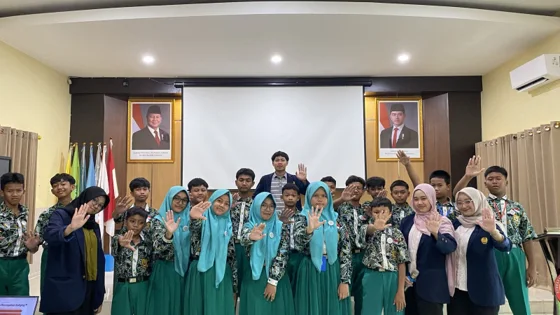
SIDOARJO, JurnalPost.com – A total of 18 seventh-grade students at SMP Negeri 1 Gedangan were appointed as Mini Anti-Bullying Ambassadors following a psychoeducation session on bullying prevention held by Guidance and Counseling (BK) students from the State University of Surabaya (UNESA) on Thursday (19/11/2026).
The activity was facilitated by four UNESA Guidance and Counseling students: Talitha Hasnabila Firjatullah, Laura Maulita Agustin, Mohammad Rizky Adi Syahputra, and Tharifah Haibaty Kurniawan. The participants consisted of two representatives from each seventh-grade class.
The program was initiated at the request of the school's guidance counselors, who recognized the importance of supporting seventh-grade students during their transition from elementary to junior high school. During this phase, students face various challenges in adapting to new social circles, including the risk of bullying in group chats and on social media.
This activity aligns with the spirit of the Regulation of the Minister of Basic and Secondary Education (Permendikdasmen) Number 6 of 2026 regarding a Safe and Comfortable School Culture.
Recognizing the Forms and Impacts of Bullying
The psychoeducation session opened with a mutual agreement to respect and listen to one another, to avoid using real names when sharing stories, and to allow participants the freedom to opt out of sharing personal experiences.
The students were then guided to understand the differences between bullying, joking, and ordinary conflict. Bullying is defined as the intentional and repeated act of harming others, characterized by an imbalance of power between the perpetrator and the victim.
Forms of bullying include physical, verbal, and social aggression, as well as cyberbullying.
Students were also introduced to the three roles in a bullying incident: the perpetrator, the victim, and the bystander. Bystanders play a crucial role, as they can either exacerbate the situation or help put an end to the bullying.
The impact of bullying is not only felt by the victim, who may experience anxiety, fear of attending school, and difficulty concentrating. Perpetrators also risk facing disciplinary sanctions and experiencing difficulties in their social relationships with peers.
Learning Through Interactive Games
To deepen the participants' understanding, the UNESA students organized the material through three educational game stations.
At the first station, students were asked to sort cards containing various scenarios to distinguish between joking and bullying.
Next, participants practiced how to help a friend who is being teased. They also took part in a simulation where they had to smooth out crumpled paper, illustrating the lasting impact that hurtful words can have on a person's feelings.
Through this interactive approach, students not only gained theoretical understanding but also learned to develop empathy and skills for handling bullying situations.
The session continued with a reflection on the most memorable parts of the material and one concrete action each participant would take in their respective classrooms.
Stop, Support, Report: Tools for Mini Ambassadors
The 'Stop, Support, Report' strategy served as the primary tool provided to the Mini Anti-Bullying Ambassadors.
Students were encouraged not to join in laughing or ignore bullying, to provide support by approaching and accompanying the victim, and to report incidents to guidance counselors, homeroom teachers, parents, or trusted adults.
“Reporting is not 'tattling,' but rather having the courage to help,” the facilitators emphasized during the session.
In an effort to prevent cyberbullying, students were also taught to ask four simple questions before sending or posting anything online: Is the information true, kind, necessary, and safe?
Participants were reminded not to spread photos, videos, or conversations that could embarrass others. If they encounter cyberbullying, students were advised to save screenshots as evidence to be presented to the appropriate authorities.
Ambassadors Are Not 'Classroom Police'
During the activity, the UNESA students clarified the role of the Mini Anti-Bullying Ambassadors.
They are not 'classroom police' tasked with judging peers, punishing perpetrators, or handling bullying cases on their own.
Instead, the ambassadors are expected to be role models in their behavior, reach out to friends who feel isolated, share positive messages in the classroom, and forward reports of bullying to the guidance counselor.
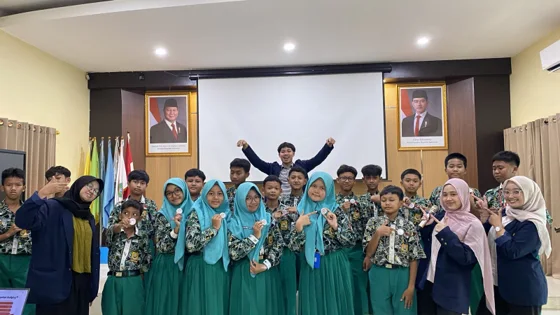
The appointment was marked by a joint pledge. The ambassadors committed to refraining from any form of bullying, including online, to have the courage to say 'stop,' to embrace friends in need, and to report incidents to teachers.
Each participant then received a pin as a symbol of their commitment and responsibility in carrying out their role as a Mini Anti-Bullying Ambassador.
Encouraging Concrete Action in the School Environment
As a follow-up, each class was asked to implement one concrete anti-bullying action over the next month.
These actions could include creating classroom posters, providing a 'safe box' for reports, or implementing a 'Kind Words Friday' program to build positive communication habits.
The program's implementation will be supported by the guidance counselor through bi-weekly evaluations.
Through the formation of these Mini Anti-Bullying Ambassadors, the UNESA students and SMP Negeri 1 Gedangan aim to encourage active student involvement in building a school culture that is safe, comfortable, and free from bullying.
The activity concluded with the simple message that a safe school starts with ourselves.



Comments 0
Write a Comment Share your response