

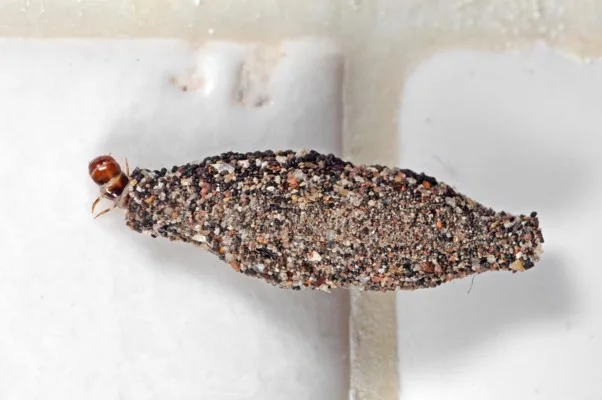
JAKARTA, JurnalPost.com — Have you ever noticed a tiny object resembling a sunflower seed stuck to your walls, ceiling, or the corners of a cupboard? At a glance, this grayish-brown object looks like a simple clump of dust. However, if you look closer, you might see it moving slowly.
This small creature is known as a household casebearer. Often overlooked, this insect is quite common in homes, particularly in areas that are humid, dusty, and rarely cleaned.
Although it is only about one centimeter in size, the casebearer is frequently associated with complaints of itching, bumps, and skin redness. Many people mistakenly believe the insect bites or releases toxins.
So, what exactly is a household casebearer, how dangerous is it to humans, and how can you remove it from your home?
Getting to Know the Household Casebearer: The Tiny Larva Behind the Dust Pouch
The term "kamitetep" is commonly used to refer to the larvae of case-bearing moths, such as the species Phereoeca uterella from the Tineidae family.
In entomological literature, this insect is known as the household casebearer or plaster bagworm.
The uniqueness of the casebearer lies in the protective pouch it carries. This oval-shaped case is constructed from silk threads produced by the larva, which are then coated with surrounding materials such as dust, fine sand, hair, and fabric fibers.
This coating makes the casebearer resemble a small piece of debris stuck to a wall surface.
Entomologist Sukirno from Universitas Gadjah Mada (UGM) explains that the casebearer is part of a group of moths that undergo metamorphosis. The larvae live inside their protective pouches before developing into adult moths.
These insects are generally found in humid locations with suitable food sources, such as bathrooms, storage rooms, behind cupboards, under beds, or in areas filled with spider webs.
Does the Household Casebearer Bite and Is It Poisonous?
A common misconception is that casebearers bite humans and cause prolonged itching.
However, expert explanations suggest otherwise. The casebearer is not a blood-sucking insect and is not known to bite humans.
Complaints of itching after contact with a casebearer are thought to be related to an irritation or allergic reaction to the materials attached to its protective pouch.
Sukirno explains that individuals with certain sensitivities may experience skin issues after coming into contact with the pouch.
"For people with allergies, contact with this larval pouch can cause itching due to the debris attached to it," Sukirno explained in his statement in July 2025.
This condition should also be distinguished from dermatitis caused by rove beetles (tomcat). The two come from different insect groups and have different exposure mechanisms.
Therefore, the appearance of bumps or a rash after cleaning the house does not automatically mean it was caused by a casebearer.
Research 2026 Reveals Interesting Findings About the Casebearer
Discussions regarding the casebearer are not limited to the public; they have also attracted the attention of researchers.
A study published in the scientific journal PLOS ONE on 9 April 2026 examined the molecular identity and bacterial communities found on Phereoeca larvae in Malaysia.
The research, led by Salmah Yaakop from Universiti Kebangsaan Malaysia, used DNA analysis to identify the insects and map the groups of bacteria living with them.
The study results identified the samples as Phereoeca sp. and found several groups of bacteria, including Cutibacterium acnes, Enterobacter, and Pseudomonas.
Some of these bacterial groups are known to be associated with skin irritation or opportunistic infections under certain conditions.
However, the study has not proven that the bacteria found on casebearer larvae directly cause skin diseases in humans.
These findings still require further research, particularly to confirm the link between insect exposure and skin health issues.
Thus, complaints of itching after contact with a casebearer cannot be immediately concluded as the result of toxins or bacterial infection.
Signs of Skin Irritation
Skin complaints associated with casebearer exposure can vary from person to person.
Some people may only experience mild itching. Meanwhile, individuals with sensitive skin may experience redness, small bumps, or swelling.
Symptoms to watch for include itching on the exposed skin, the appearance of a red rash, discomfort, and irritation that worsens after scratching.
However, these symptoms are not specific to casebearer exposure.
Allergies to cleaning products, bites from other insects, and contact dermatitis can also cause similar complaints.
Therefore, medical examination is necessary if the cause of the complaint is unclear or if the skin condition continues to worsen.
How to Treat Itching Caused by Casebearers
If your skin accidentally comes into contact with a casebearer, the first step is to clean the area using water and a mild soap.
After that, a cold compress can help reduce itching and skin discomfort.
Avoid scratching the irritated area, as this can potentially worsen inflammation and cause wounds.
The American Academy of Dermatology also recommends cold compresses as a step to help relieve contact dermatitis symptoms.
For certain conditions, the use of topical anti-inflammatory medication may be necessary as advised by a healthcare professional.
The public should not indiscriminately apply garlic, hot oil, or other substances that have not been proven safe. Using such materials risks further irritating the skin.
If severe swelling, a spreading rash, signs of infection, or symptoms that do not improve occur, a doctor's visit is the appropriate step.
Meanwhile, difficulty breathing or swelling of the face and throat requires emergency medical attention.
How to Remove Casebearers from Your Home
Controlling the presence of casebearers does not necessarily require the use of insecticides.
According to a University of Florida entomology publication, the larvae of Phereoeca uterella can utilize old spider webs as a food source. These insects also have the potential to damage wool materials.
Therefore, maintaining home cleanliness is an important step in reducing their presence.
Room corners, the backs of furniture, ceilings, and storage areas should be cleaned regularly.
Any casebearer pouches found can be removed using a cleaning tool or tissue, then disposed of in a closed trash bin without touching them directly.
Cleaning spider webs, reducing dust accumulation, storing clothes properly, and improving ventilation can also help create an environment less conducive to the development of these insects.
If the number of casebearers continues to increase despite regular cleaning, consider investigating the source of the infestation or seeking professional pest control assistance.
Small, But Still Worth Watching
Casebearers may not be as conspicuous as cockroaches, mosquitoes, or ants. Their presence is often only noticed when someone finds a small, moving pouch on a wall.
Nevertheless, this animal is not a major threat that needs to be feared excessively.
The most important thing is to recognize its characteristics, avoid direct contact if you have sensitive skin, and maintain a clean home environment.
By understanding the facts about the household casebearer, the public can distinguish scientific information from unproven assumptions while taking safer preventive measures.










Comments 0
Write a Comment Share your response