

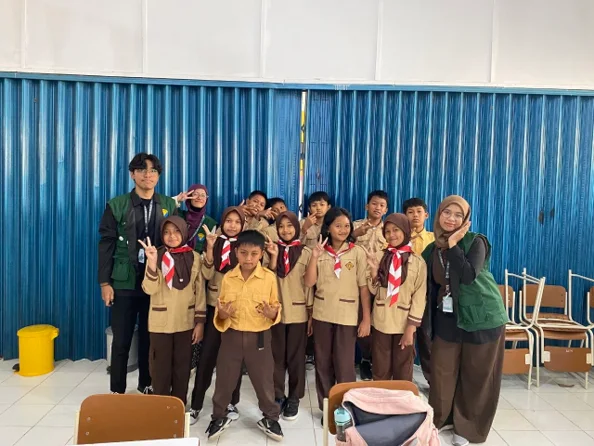
SLEMAN, JurnalPost.com — Writing poetry does not always have to start with searching for beautiful words. Even a simple image can serve as a source of inspiration for crafting poetic verses. This learning method was introduced by students from the Universitas Negeri Yogyakarta (UNY) Independent Community Service Program (KKN) to sixth-grade students at SD Negeri Srowolan, Sleman, Yogyakarta Special Region.
Through a literary adaptation workshop held on August 14, 2026, KKN Group 30487 invited students to transform images into poetry. The activity took place at SD Negeri Srowolan in Sembung, Purwobinangun, Pakem, Sleman, as part of the students' community service program based in Gandok Kadilobo Hamlet.
This training was designed to help students develop their imagination, language skills, and creativity through a learning approach closer to their own experiences.
Instead of immediately asking students to write poetry, the university students first introduced images as a source of ideas. Students were invited to observe objects, note the atmosphere, and understand the messages captured in the images before translating them into written form.
From Observing Images to Crafting Poetry
The activity began with an introduction to the concept of literary adaptation, which is the process of converting one form of work or medium into another form of expression. In this workshop, images were used as a visual medium that was then translated into a literary work in the form of poetry.
The university students also provided an explanation of what poetry is and its structural elements. The material was delivered using learning aids tailored to the comprehension level of elementary school students.
After receiving the explanation, the students began practicing the material using prepared worksheets. They were given the opportunity to choose an image, observe its visual elements, and develop ideas based on their own imagination.
During the writing process, the KKN students provided guidance to those who had difficulty finding words or arranging sentences into poetic stanzas.
The activity did not stop at the writing process. Several students were also given the opportunity to read their work in front of their classmates.
Through this session, students not only learned to express ideas through writing but also practiced public speaking and appreciating the work of others.
Learning Literature Through Direct Practice
This training applied a learning by doingapproach, which emphasizes the experience and direct involvement of the learners.
This approach provided space for students to understand poetry through the process of creation, rather than just memorizing definitions or elements.
The use of images was a crucial part of the activity because it helped students find initial ideas. For children not accustomed to writing poetry, visual media can provide a concrete picture of the objects, atmosphere, or events they wish to describe.
However, the implementation of the training also revealed several challenges.
Based on the activity evaluation, some students tended to follow the examples provided by the university students. As a result, several poems produced were similar in terms of word choice and idea development.
Differences in literacy levels among students also affected the learning process. Some students were able to compose poetry independently, while others still required more intensive guidance.
Additionally, the fact that some students were easily distracted posed a challenge in maintaining participant engagement throughout the activity.
Time constraints were also a point of evaluation. The process of deepening the material, developing imagination, and editing the resulting poems could not be fully maximized.
This experience highlights the importance of providing broader exploration time and guidance methods tailored to each student's abilities.
Encouraging Creativity and Literacy from Elementary School
This literary adaptation workshop is also linked to the Sustainable Development Goals Sustainable Development Goals (SDGs), specifically the fourth goal regarding Quality Education.
This goal emphasizes the importance of providing inclusive, equitable, and quality education, while expanding learning opportunities for all.
In the context of elementary education, learning literature through visual media can be an alternative for developing language skills, creative thinking abilities, and students' courage in expressing ideas.
The support from SD Negeri Srowolan helped ensure the program's success, from providing the venue to facilitating the learning activities.
The involvement of university students and the school demonstrates that community service activities can be directed toward providing beneficial learning experiences for students.
Through this activity, poetry was introduced not as a difficult writing assignment, but as a means to convey feelings, experiences, and imagination in a creative way.
Although its implementation still had some limitations, the training provided a unique learning experience for the sixth-grade students of SD Negeri Srowolan.
Moving forward, similar approaches could be developed through the selection of more diverse images, discussion opportunities, and additional time to refine written work.
Thus, literature learning in elementary schools should not only focus on the ability to understand text but also provide opportunities for students to create and appreciate their own work.







Comments 0
Write a Comment Share your response