

MALANG, JurnalPost.com – The vast savanna of Mount Bromo in East Java offers more than just breathtaking landscapes for tourists. Beneath the expansive grasslands lies a wealth of biodiversity, including various plant species capable of adapting to extreme environmental conditions.
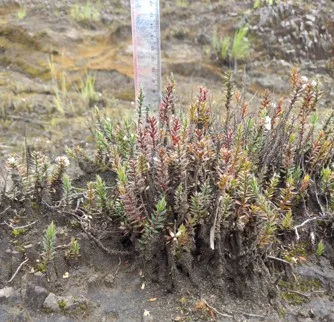
One such plant that has garnered attention is Styphelia javanica, a small shrub known to the Tengger community as 'Suket Melelo' or 'Ladingan.' This plant, native to mountainous regions, possesses unique characteristics that allow it to survive when the savanna experiences drought.
Styphelia javanica belongs to the Ericaceae family, a group of plants that includes various shrubs and small trees. Members of this family are known for having adaptive traits that allow some species to grow in environments with relatively nutrient-poor soil.
The presence of S. javanica has been recorded in several mountainous areas of East Java, including Mount Arjuno, Mount Penanggungan, Mount Kawi, the Iyang Mountains, and the Bromo Tengger Semeru National Park (TNBTS).
In the Bromo Savanna, this plant serves as a compelling example of how local vegetation can cope with changing environmental conditions.
Surviving the Bromo Savanna Drought
The Mount Bromo savanna has a distinct environment. During certain periods, the area receives relatively high humidity, which supports the growth of various types of vegetation.
However, these conditions can shift when the dry season arrives. Reduced water availability causes parts of the savanna to dry out, while many plants face stress due to limited resources.
Amidst these conditions, Styphelia javanica possesses characteristics that support its ability to survive.
This ability is linked to the shape and structure of its organs, from roots and stems to leaves. Each organ plays a role in helping the plant acquire resources while minimizing water loss.
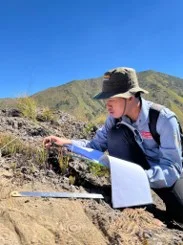
This phenomenon is the focus of research conducted by a team from the State University of Malang.
Through the 2026 State University of Malang Research and Community Service Program, Dr. Vivi Novianti, S.Si., M.Si., and her team are studying the morphological and anatomical characteristics of Styphelia javanica in the Mount Bromo Savanna, TNBTS.
The research focuses on understanding the plant's adaptation strategies by observing its external form and internal tissue structure.
This study is expected to provide scientific information on how S. javanica responds to environmental changes, while also serving as a foundation for supporting local vegetation conservation efforts in the TNBTS area.
Taproots Help Reach Water Sources
One characteristic of Styphelia javanica can be observed through its relatively low growth habit.
This plant has many branches, with heights ranging from 10 to 30 centimeters. Its small size makes it less conspicuous compared to other vegetation growing in the savanna.
Nevertheless, this growth form is an interesting morphological characteristic to study.
Underground, S. javanica possesses a taproot system.
This root structure allows the plant to reach water and nutrients in deeper soil layers, depending on root development and soil conditions in its habitat.
The ability to obtain resources from deep within the soil is a crucial aspect for plants living in environments where water availability fluctuates seasonally.
In addition to its roots, the plant's stem also shows distinct growth characteristics.
Creeping Stems as a Population Survival Strategy
The stems of the 'Suket Melelo' have the ability to creep beneath the soil surface and spread in various directions through structures called stolons.
A stolon is a creeping stem that, in certain plants, can form new individuals vegetatively.
The presence of this structure allows Styphelia javanica to expand its growth area while supporting the continuity of its population.
Through vegetative growth, the plant can potentially maintain its presence even if parts of the parent plant are disturbed or damaged.
This characteristic is vital for plants living in habitats with various environmental pressures, including seasonal changes and competition with surrounding vegetation.
Thus, the root system and stem growth pattern play complementary roles in supporting the survival of S. javanica.
Small, Pointed Leaves: A Trait of Xerophytic Plants
Another unique feature of Styphelia javanica is seen in its leaf shape.
The leaves are small, lanceolate, and have pointed tips resembling thorns. Their color varies from green to reddish-green.
These characteristics are related to its xerophytic nature, which is the ability of a plant to adapt to environments with limited water availability.
In xerophytic plants, relatively small leaf size can be a mechanism to reduce water loss through transpiration or evaporation.
The smaller the leaf surface area exposed to the environment, the lower the potential for water loss under certain conditions.
This trait helps the plant use its water reserves more efficiently when facing the dry season.
Beyond the external shape of the leaves, their internal tissue structure is also an important part of the adaptation study.
The epidermis acts as a protective layer, while the palisade tissue is one of the primary sites for photosynthesis.
The characteristics and thickness of these tissues are aspects being researched to understand how S. javanica adjusts its physiological functions to the savanna environment.
Through anatomical observation, researchers can gain deeper insights into the relationship between plant organ structure and its ability to withstand environmental stress.
Facing Competition with Invasive Plants
The challenges faced by Styphelia javanica are not limited to drought.
The Mount Bromo Savanna also faces ecological issues regarding the presence of invasive plants that could potentially affect the composition and balance of local vegetation.
Several plant species of concern in the area include Verbena brasiliensis, Pteridium aquilinum, and Imperata cylindrica.
The presence of aggressively spreading plants can increase competition for sunlight, water, growing space, and nutrients.
This condition potentially places additional stress on local vegetation, especially when resource availability becomes increasingly limited during the dry season.
In such situations, morphological and anatomical characteristics become important factors to study to understand a species' ability to maintain its presence.
For S. javanica, the root system, creeping stem growth, and relatively small leaf shape are several traits that may be linked to its adaptation strategy.
However, the relationship between these traits and the plant's success in facing competition and drought still requires in-depth scientific observation and study.
Research as a Step to Support Local Flora Conservation
The existence of Styphelia javanica shows that the biodiversity of the Mount Bromo Savanna is not just about the beauty of its landscape.
Small plants that are often overlooked can actually hold important information regarding adaptation processes, ecological interactions, and the dynamics of mountain vegetation.
Through the research conducted by the State University of Malang team, the characteristics of S. javanica are being studied to understand how this plant is able to adjust to its environmental stressors.
The results of this study are expected to enrich information regarding the diversity of mountain flora in East Java, particularly in the Bromo Tengger Semeru National Park area.
Knowledge of local plant adaptation traits is also significant in supporting ecosystem management, monitoring vegetation changes, and developing conservation strategies.
Amidst various environmental challenges, including seasonal changes, vegetation competition, and potential habitat degradation, the presence of local plants needs continuous attention.
Styphelia javanica serves as a reminder that survival ability is not always demonstrated through large body size or dominant growth.
This small shrub growing in the middle of the Bromo Savanna shows how plant organ characteristics can play a role in facing challenging environmental conditions.
By understanding these unique traits, efforts to maintain biodiversity in mountainous areas can be carried out based on increasingly robust scientific knowledge.










Comments 0
Write a Comment Share your response