

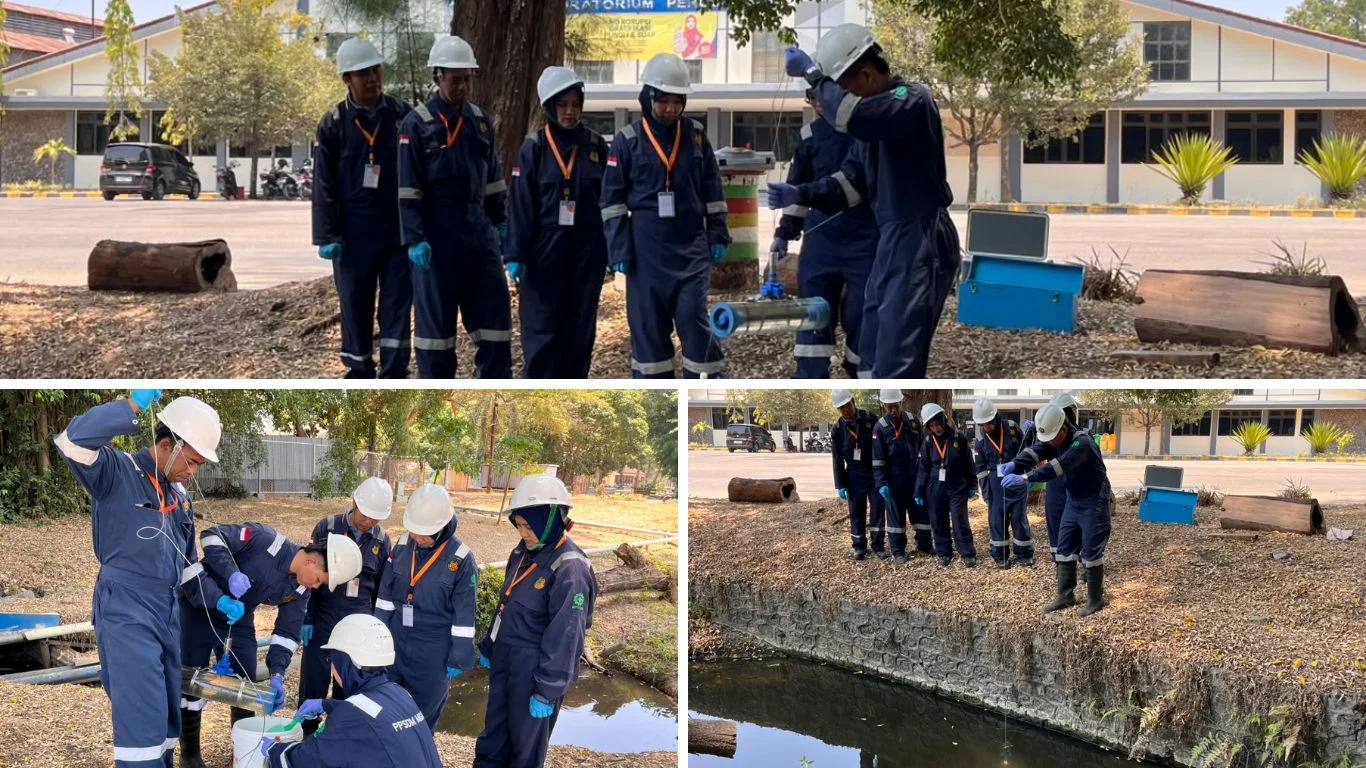
Pamekasan, JurnalPost.com — Staff from the Pamekasan Regency Environmental Agency (DLH) in East Java have participated in technical water sampling training organized by the Human Resources Development Center for Oil and Gas (PPSDM Migas). This activity aims to enhance the capabilities of officials in ensuring the precision of the water sampling process for quality testing.
The Water Sampling Officer (PPC) training took place over three days, from 19 to 21 October 2026. Participants received both theoretical and practical instruction on water sampling procedures in accordance with environmental testing standards.
Improving the competence of officers is considered crucial because sampling is the initial stage that determines the reliability of laboratory test results. Errors in this process can potentially lead to data that does not accurately reflect the actual water quality conditions.
PPSDM Migas instructor Rieza Mahendra Kusuma explained that the training was designed to provide participants with a comprehensive understanding, ranging from occupational safety aspects to practical field sampling.
“The material provided to participants included K3LL Sampling Applications, Knowledge of Environment & Regulations, Planning & Cooperation in Water Sample Collection, Preparation for Water Sample Collection, Water Sample Collection Methods, and PPC Air practice,” said Rieza.
The material covers the implementation of Occupational Health, Safety, and Environmental Protection (K3LL), understanding environmental regulations, activity planning, and the use of water sampling methods.
Sampling Accuracy is a Critical Factor
According to Rieza, laboratory test results do not depend solely on analytical capabilities and the equipment used. Field sampling procedures also have a significant influence on data validity.
He emphasized that errors in applying sampling methods can affect test results and potentially cause issues when that data is used as a basis for environmental oversight.
“Delivering this material is very important because the accuracy of laboratory test results depends heavily on the initial sampling process. If the sampling procedure, application of K3LL, and understanding of the regulations are not precise, the resulting data will not be valid,” he explained.
Rieza added that mastering sampling procedures is necessary so that officers can carry out their oversight duties with results that are accountable.
“Mastering this competence ensures that every water sample taken by the Pamekasan DLH can be legally and scientifically accounted for in environmental monitoring efforts,” he added.
Supporting Regional Water Quality Monitoring
For the Pamekasan Regency DLH, the ability of officers to collect and handle water samples is a vital aspect of implementing environmental oversight.
Test data can be used to assess water quality conditions, identify potential pollution, and support monitoring steps for activities that may impact the environment.
However, the reliability of such data requires that the sampling process be conducted correctly, including site selection, equipment usage, sample handling, and the application of safety procedures.
Through the training organized by PPSDM Migas, Pamekasan DLH staff are expected to be able to consistently apply operational procedures in their water quality monitoring activities.
This improvement in technical capability is also expected to help the local government obtain more accurate environmental data as a basis for decision-making in pollution control and water resource protection.
Thus, water quality monitoring does not rely solely on laboratory examinations but is also supported by the competence of the officers who perform the sampling directly in the field.




Comments 0
Write a Comment Share your response