


JurnalPost.com - The “out of stock” label on a desired item is a familiar sight for online shoppers. This condition is often immediately attributed to a system error. However, such accusations may mask more fundamental issues in Operations and Production Management, particularly regarding inventory planning and control.
Technology Can Indeed Be Flawed
Technology can certainly be a cause of inventory issues. Delayed stock data updates on an application or discrepancies with actual warehouse conditions can lead to information mismatches between sellers and buyers.
However, it must be understood that systems essentially only display data entered and managed by humans. The accuracy of these inventory figures depends heavily on stock management decisions made long before a buyer clicks the purchase button.
Thus, the problem of out-of-stock items cannot always be solved simply by fixing an application or updating a system.
Out-of-Stock Is Not a New Problem
The issue of inventory depletion has long been a concern in the retail world.
Cross-country research on product availability in physical retail, particularly for fast-moving consumer goods, shows that stockouts are a recurring problem with little sign of improvement.
The research identifies the supply chain as a source of the problem, while management at the store level is a crucial part of the solution. It also notes the tendency of consumers to switch to other stores when the desired item is unavailable, with the potential of not returning (Corsten & Gruen, 2003).
In my view, these findings are increasingly relevant in online commerce. If consumers previously had to physically move to find items in other stores, they now only need a few taps to find alternative sellers.
The Root Cause Lies in Planning
In Operations and Production Management, inventory planning plays a vital role in maintaining the balance between demand and product availability.
Demand forecasting that is too low can lead to stock shortages, while estimates that are too high risk causing inventory accumulation.
Inventory control that relies solely on experience or estimates without calculating safety stock also increases the risk of running out of items when demand rises (Kusuma & Nuha, 2026).
Similar issues were found in research on drug inventory control at Damhil Pharmacy, Gorontalo. Suboptimal inventory management led to stock levels that sometimes exceeded needs, but at other times failed to meet demand. This situation potentially causes customers to switch and reduces business profits (Padiku et al., 2023).
Meanwhile, research on restaurants serving both offline and online channels shows the challenge of demand fluctuations from both channels.
Inventory control that still relies on observation, without safety stock, service levels, or measurable inventory targets, is an issue that needs improvement (Kusuma & Nuha, 2026).
Big Promotions Are a Forecasting Test
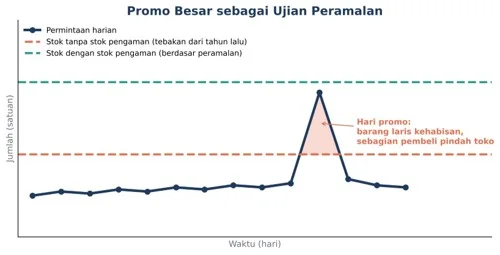
In my opinion, the surge in orders during double-date promotions or national shopping days is one of the greatest tests of a seller's ability to forecast demand.
Sellers who rely only on memory or estimates based on the previous year's sales risk experiencing two conditions simultaneously: running out of the most popular items and accumulating products that are less in demand.
This situation shows that increased transactions do not always go hand-in-hand with successful inventory management.
Technology as an Assistant, Not a Suspect
Technology remains important, especially for sellers marketing products through multiple marketplaces simultaneously.
Cross-channel inventory synchronization systems can help prevent an item from being sold twice due to conflicting stock information.
However, technology should be viewed as a decision-support tool, not a substitute for planning.
Even sophisticated systems will not fully resolve issues if decisions regarding inventory levels, reorder points, and demand forecasts are still made without adequate calculation.
In other words, technology can accelerate the execution of correct decisions, but it does not automatically fix flawed stock management decisions.
Steps Sellers Can Take
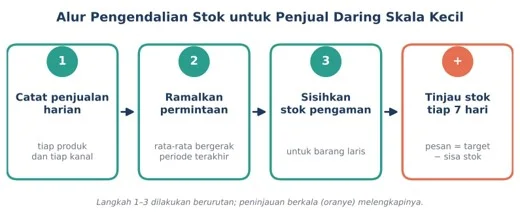
Small-scale online sellers can actually start inventory control through three simple steps.
First, record daily sales by product type and sales channel. This recording is necessary so that sellers understand the demand pattern for each item.
Second, forecast demand using the moving average method from several previous periods. This method can help sellers make forecasts based on data, not just intuition.
Third, provide safety stock, especially for products with high demand levels or those requiring relatively long procurement times (Padiku et al., 2023; Kusuma & Nuha, 2026).
These three steps can be complemented by periodic inventory reviews, for example every seven days, then placing orders based on the difference between the inventory target and the stock still available.
This periodic review approach is also proposed in research on inventory control for restaurants with a dual-channel sales system (Kusuma & Nuha, 2026).
For products with long procurement times, a pre-order system pre-order can be an alternative so that sellers have an overview of product needs before procurement.
Additionally, sellers should not rely solely on successful transaction data.
Unmet demand also needs to be monitored, for example through the number of visits to an out-of-stock product page or a list of potential buyers requesting notifications when stock is back.
This information can help sellers understand the gap between the number of items successfully sold and the actual potential demand when the product is unavailable.
Prepare Goods Before Buyers Arrive
Out-of-stock items in online stores are sometimes caused by system errors. However, in my opinion, these issues often reflect immature inventory planning.
Successful stock management does not depend only on technological sophistication, but also on the accuracy of forecasting, the availability of safety stock, and discipline in reading sales data.
Ultimately, the superior store is not the one that hoards the most goods or is the fastest to display an “out of stock” label, but the one capable of estimating needs and preparing products before buyers arrive.
Bibliography
Corsten, D., & Gruen, T. (2003). Desperately seeking shelf availability: An examination of the extent, the causes, and the efforts to address retail out-of-stocks. International Journal of Retail & Distribution Management, 31(12), 605–617. https://doi.org/10.1108/09590550310507731
Kusuma, H. C., & Nuha, H. (2026). Analysis of perishable raw material inventory control in a dual-channel supply chain system using the periodic review system method (Case study: Mie Paus Restaurant). Populer: Student Research Journal, 5(2), 198–211. https://doi.org/10.58192/populer.v5i2.4552
Padiku, I. R., Hadjaratie, L., Papeo, D. R. P., & Walahe, M. F. F. (2023). Application of WMA and EOQ methods in the drug stock inventory control information system at Damhil Pharmacy. Technical Journal, 21(2), 155–167. https://doi.org/10.37031/jt.v21i2,419










Comments 0
Write a Comment Share your response