

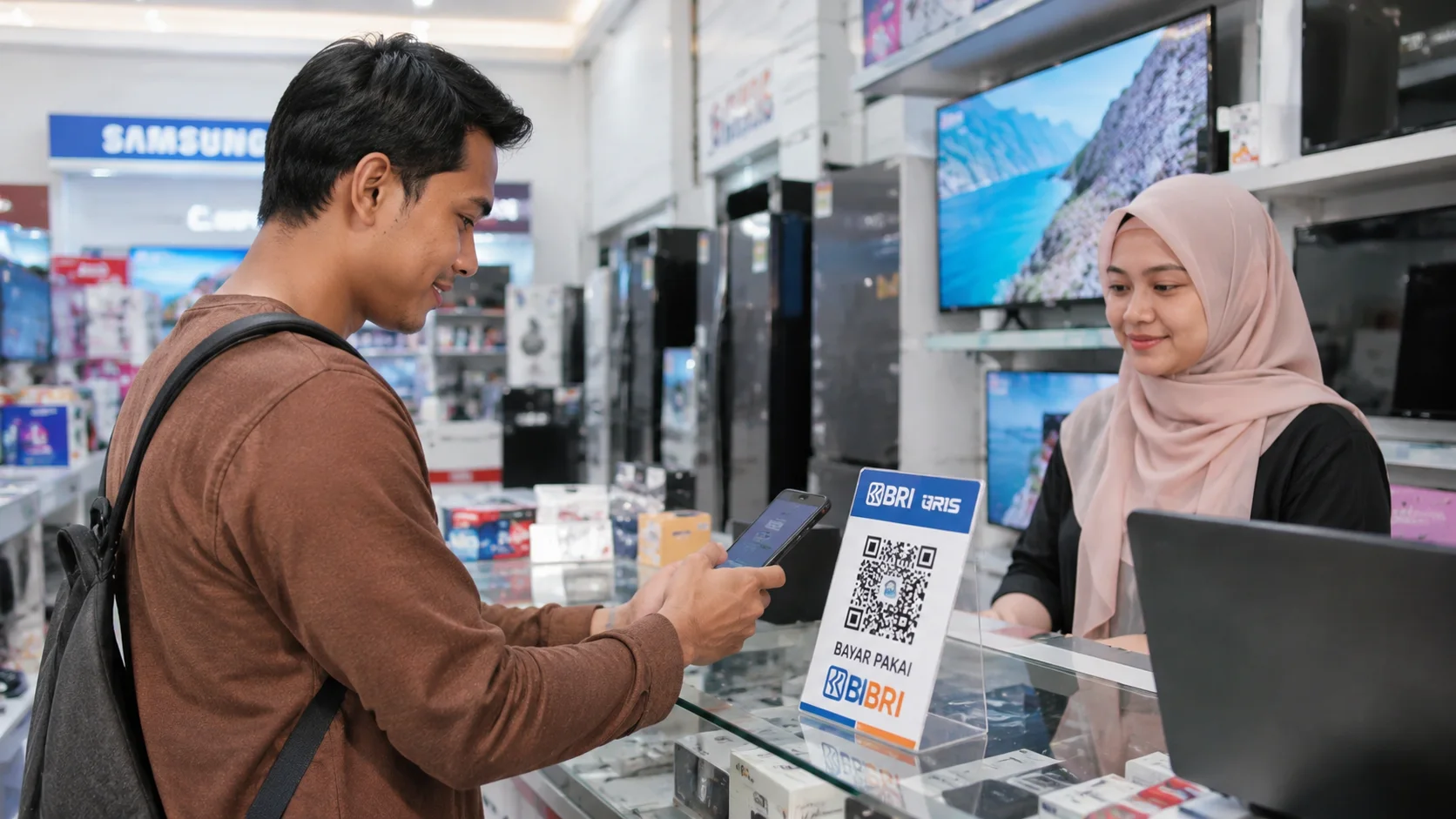
BOJONEGORO, JurnalPost.com — Purchasing electronics worth millions of rupiah no longer requires consumers to carry large amounts of cash. The availability of digital payment services via the Quick Response Code Indonesian Standard (QRIS) is making it increasingly easy for the public to conduct transactions, including when shopping at electronics stores.
This convenience is being felt by Eko, a Bank Rakyat Indonesia (BRI) customer in Bojonegoro Regency, East Java. He admits he is becoming increasingly accustomed to using QRIS to pay for various needs, including when buying electronic goods.
For Eko, using digital payments makes shopping much more practical. Consumers simply need to use their mobile phones and a payment application that supports QRIS to complete the transaction.
He considers this method simpler than having to prepare cash in advance, especially when the value of the items being purchased is quite high.
No More Need to Withdraw Cash at ATMs
Eko shared that before he became accustomed to using digital payment services, he had to prepare cash whenever he wanted to buy electronics.
This situation sometimes required him to visit an ATM or a bank branch first before going shopping.
However, that habit has slowly changed as more businesses provide payment options via QRIS.
"Now, if I want to buy electronics, I don't have to struggle with carrying cash. Especially if the item is quite expensive, it is certainly more practical to use QRIS. Just open the application, scan the QR code, enter the payment amount, and the transaction is complete," Eko explained.
According to him, cashless payments offer convenience because the transaction process can be done directly via a mobile phone.
Consumers also do not need to count stacks of cash or wait for change from the cashier.
This convenience is one of the reasons Eko is increasingly comfortable utilizing digital banking services for his daily needs.
BRI QRIS Simplifies Payments at Electronics Stores
The use of QRIS is no longer limited to transactions for food, beverages, or small-value household needs.
This payment method can also be used to purchase various higher-value items, including electronic devices, as long as the transaction meets the applicable terms and nominal limits.
QRIS itself is a QR code-based payment standard developed by Bank Indonesia in collaboration with the payment system industry. Through this standard, consumers can make payments using banking applications or digital wallets that support QRIS.
BRI is one of the banks that provides QRIS services for business owners, including through digital payment facilities for merchants.
For consumers like Eko, the presence of this facility provides a more flexible payment method option.
"As a BRI customer, I feel helped by this service. I don't always have to withdraw money at an ATM first when I want to shop. As long as the balance is sufficient and the store provides QRIS, payment can be made immediately," he explained.
In addition to being practical, digital transactions also allow consumers to view their payment history through the application used.
Thus, transaction proof can be checked again if needed, for example, to match the payment with the purchase receipt.
Hoping for More Merchants to Use QRIS
Eko hopes that the use of QRIS will become more widespread in Bojonegoro Regency, not only in electronics stores but also among small businesses and traditional market traders.
According to him, the more business owners who provide digital payments, the greater the convenience that the public can experience.
Consumers do not need to rely on a single payment method because they can choose to use cash or cashless options according to their conditions and needs.
On the business side, the use of QRIS can also help the payment acceptance process without having to provide change for every transaction.
However, digital transactions still require attention, especially in ensuring that the payment is made to the correct recipient.
Users Reminded to Check Merchant Name and Payment Amount
Behind the various conveniences offered, Eko reminds the public to remain cautious when conducting transactions using QRIS.
One important thing is to ensure that the merchant name or payment recipient appearing on the application matches the store where the consumer is shopping.
In addition, users need to check the payment amount before giving final approval.
Consumers should also ensure that the transaction has truly succeeded through a notification or payment history in the application, rather than just relying on the display of the scanned QR code.
This step is important to avoid transfer errors or payments to incorrect recipients.
If an issue occurs, consumers can save the transaction proof and contact the customer service of the payment application used.
Digital Payments Support Bojonegoro's Economic Activity
The utilization of QRIS in electronics purchase transactions shows that digital payments are increasingly relevant to the diverse needs of consumers.
The service provides an alternative for people who want to transact without having to carry large amounts of cash.
For business owners, the availability of cashless payment options can also be part of improving service to customers.
Eko's experience is one example of how banking technology can be utilized in daily economic activities.
From simple transactions to purchasing electronic goods, the public now has more choices to complete payments practically.
Moving forward, the wider use of QRIS in stores and trade centers is expected to support the development of digital transactions while strengthening the cashless economic ecosystem in Bojonegoro Regency.







Comments 0
Write a Comment Share your response