


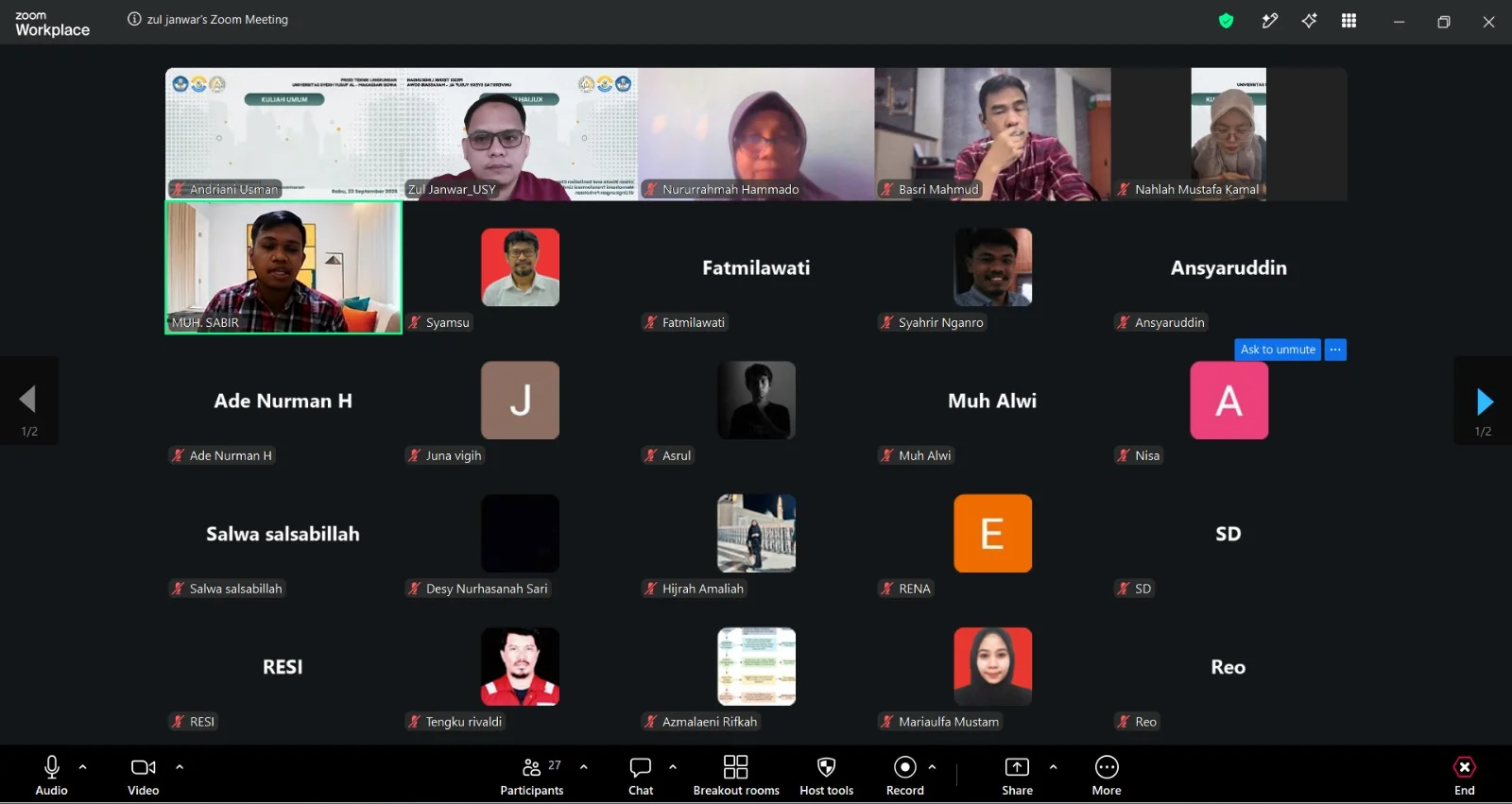
Gowa, JurnalPost.com — The Environmental Engineering Study Program at Universitas Syekh Yusuf Al Makassari (USY Al Makassari) Gowa held a public lecture themed “Urban Waste and Sanitation Chemistry: Understanding Waste Transformation and Pollution Risks in Urban Environments”, on Wednesday (9/23/2026).
The event was held virtually via Zoom and featured two speakers who discussed waste management issues, sanitation, and the importance of collaboration between the community, universities, and the government.
The public lecture was opened by the Rector of Universitas Syekh Yusuf Al Makassari Gowa. In his remarks, the rector emphasized that the Environmental Engineering Study Program plays a vital role in responding to various environmental issues emerging within society.
“The Environmental Engineering program has a high sensitivity to environmental phenomena. This public lecture is one manifestation of that sensitivity,” he said.
Waste Management Must Start at the Source
The first speaker, Basri Mahmud, S.KM., M.Kes., Ph.D., C.EIA, highlighted the importance of waste management starting directly at the source.
According to him, household waste that still holds economic value needs to be sorted from the beginning so it does not mix with other waste. This sorting not only helps reduce waste volume but can also provide added economic value for the community.
Basri explained that waste management in Makassar City needs to be carried out through a five-pillar approach.
The first pillar is mapping, which aims to build a baseline of data regarding waste conditions. This data is necessary so that waste management can be carried out based on real conditions in the field.
The second pillar is education and behavioral change, primarily to increase literacy and public awareness regarding the importance of sorting and managing waste.
The third pillar is processing systems, which include handling organic, inorganic, and residual waste separately.
Next is circular economy, which is an effort to transform environmental management activities into economically valuable endeavors, including through the development of waste banks.
The fifth pillar is integrated monitoring. Periodic monitoring is needed to evaluate waste management programs, one of which is through the use of data dashboards.
This approach is expected to make waste management more measurable, integrated, and impactful for the community.
Campuses Must Serve as Examples for Waste Management
The second speaker, Dr. Nururrahmah, M.Si., emphasized the importance of the university's role as a model for implementing good waste management.
According to her, universities do not only function as centers for education and research but can also serve as testing grounds for various environmental management methods.
When universities are able to implement effective waste management systems, the results and experiences can become a source of information for the government in formulating policies that meet community needs.
Campuses are also considered to have a strategic position because they can bring together academic aspects, research, innovation, and community service within a single ecosystem.
Through this role, solutions developed within the university environment are expected not to stop as academic studies but to be applied in real life within the community.
Waste Management is a Shared Responsibility
The public lecture also affirmed that waste issues are not solely the responsibility of individuals or the government.
Waste management requires the involvement of all stakeholders, ranging from the community and campuses to businesses and the government.
The community plays a key role in sorting waste at the source. Universities can contribute through research, innovation, and education. Meanwhile, the government holds the authority to build regulations, infrastructure, and more integrated management systems.
Collaboration between these elements is essential because waste problems in urban areas continue to grow alongside population growth, changing consumption patterns, and increasing economic activity.
Without a good management system, waste can cause various pollution risks, ranging from soil and water contamination to the degradation of residential environmental quality.
Through the public lecture organized by the Environmental Engineering Study Program at Universitas Syekh Yusuf Al Makassari Gowa, students and participants are expected to gain a broader understanding of urban waste management and sanitation.
This activity is also expected to encourage participants to apply the knowledge gained, both within the campus environment and in their daily lives.






Comments 0
Write a Comment Share your response