

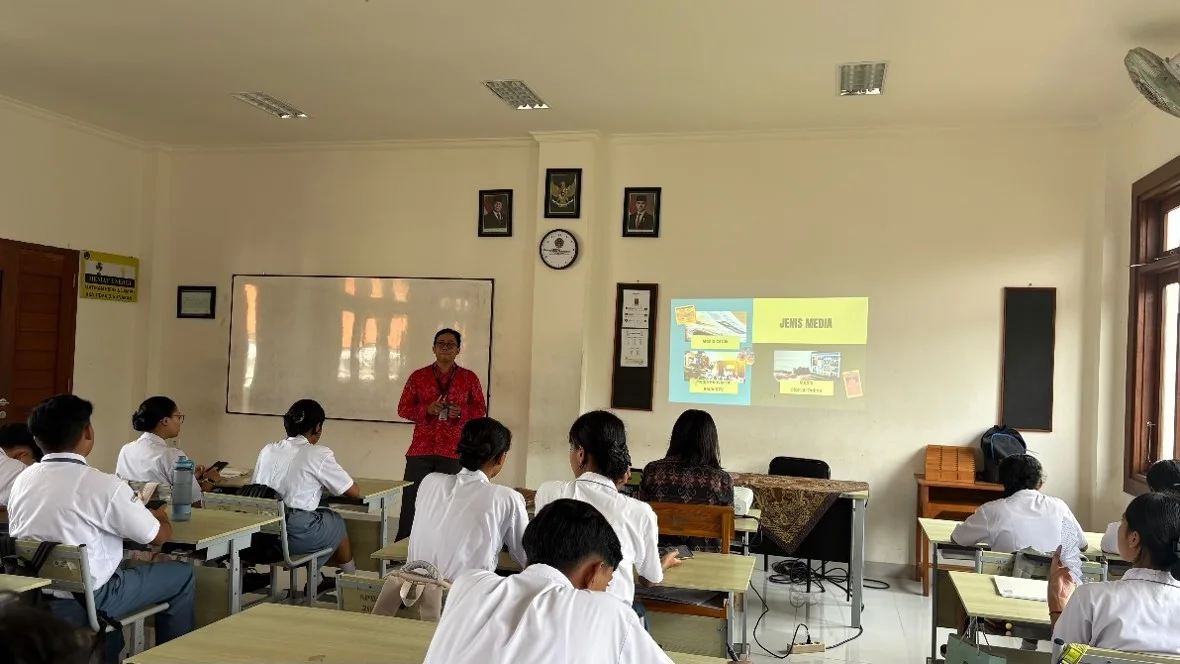
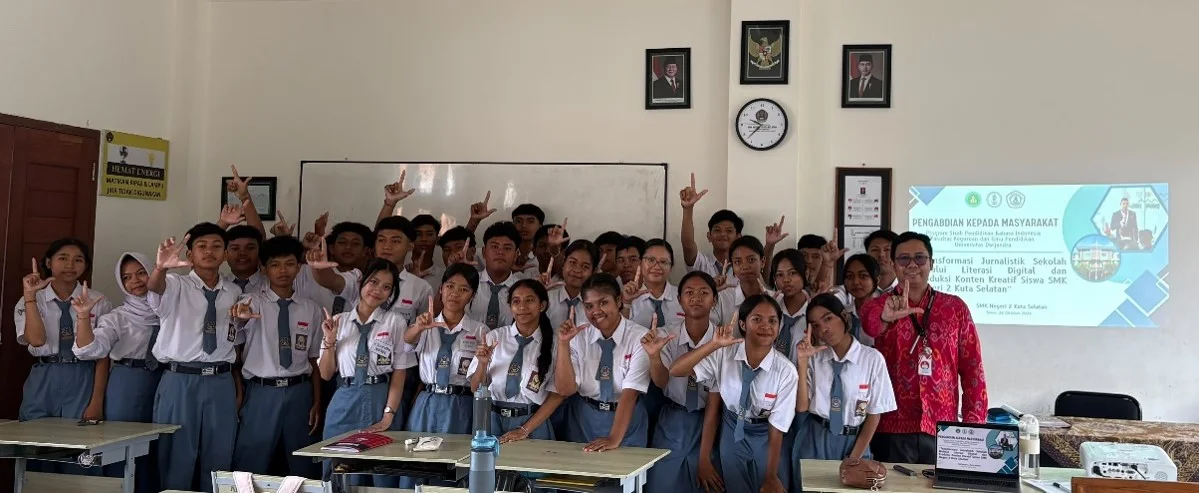
KUTA SELATAN, JurnalPost.com – The ability to write news and process information into digital content is becoming increasingly vital amid rapid technological advancements. To equip students with these skills, the Indonesian Language Education Study Program at the Faculty of Teacher Training and Education (FKIP), Universitas Dwijendra, held a journalism workshop at SMK Negeri 2 Kuta Selatan, Bali, on Monday (10/26/2026).
This community service activity was themed “From Pen to Screen: Transforming School Journalism through Digital Literacy and Creative Content Production for SMK Negeri 2 Kuta Selatan Students.”
The training was designed to enhance students' skills in news writing, interviewing, information processing, and utilizing various digital platforms as a means to disseminate informative, educational, and responsible content.
The event featured the Head of the Indonesian Language Education Study Program at Universitas Dwijendra, Dr. Ida Bagus Made Wisnu Parta, S.S., M.Hum.,as the speaker.
In his presentation, Wisnu Parta introduced the fundamentals of journalism, ranging from identifying news values and structuring information using the 5W+1H method to applying interview techniques and developing articles into engaging digital content for readers.
Equipping Students with Digital Journalism Skills
The development of digital media has transformed how society obtains and disseminates information. While school journalism was previously limited to wall magazines or bulletins, students now have the opportunity to publish their work across various digital platforms.
However, this convenience also presents challenges. The sheer volume of information circulating requires digital media users to be more diligent in distinguishing between facts, opinions, and unverified information.
Through this training, students were introduced to the importance of information accuracy and the responsibility of delivering news to the public.
The material provided did not focus solely on technical writing skills but also encouraged participants to understand the journalistic workflow, from finding story ideas and gathering facts to identifying sources and organizing information systematically.
Understanding the 5W+1H elements was a core component of the training, ensuring students could produce news that answers the fundamental questions of an event.
Additionally, interview skills were highlighted as a crucial part of obtaining information directly from relevant sources.
Through this understanding, students are expected to develop school journalism as both a learning platform and a medium for channeling their creativity.
Fostering Creativity and Critical Thinking
Throughout the session, students showed great enthusiasm for the material presented. Participant interest was particularly high when the discussion shifted to utilizing digital technology to produce creative content.
Students were encouraged not to be mere social media users, but to produce information that provides educational value and benefits to the community.
Journalistic activities are considered an effective learning tool that combines various skills, such as communication, critical thinking, teamwork, and the ability to structure ideas.
By writing news and conducting interviews, students can also learn to build self-confidence while increasing their sensitivity to events in their surrounding environment.
These skills serve as essential preparation for vocational high school students who will eventually enter the workforce or pursue higher education.
Furthermore, the training emphasized the importance of ethics in the use of information technology.
Participants were taught that every piece of published information must be fact-checked. Respecting the privacy of sources, accuracy in data usage, and responsibility for content are inseparable parts of journalistic practice.
Consequently, the ability to produce digital content is expected to be grounded not only in creativity but also in the principles of accuracy, balance, and communication ethics.
Universitas Dwijendra and SMK Negeri 2 Kuta Selatan Strengthen Partnership
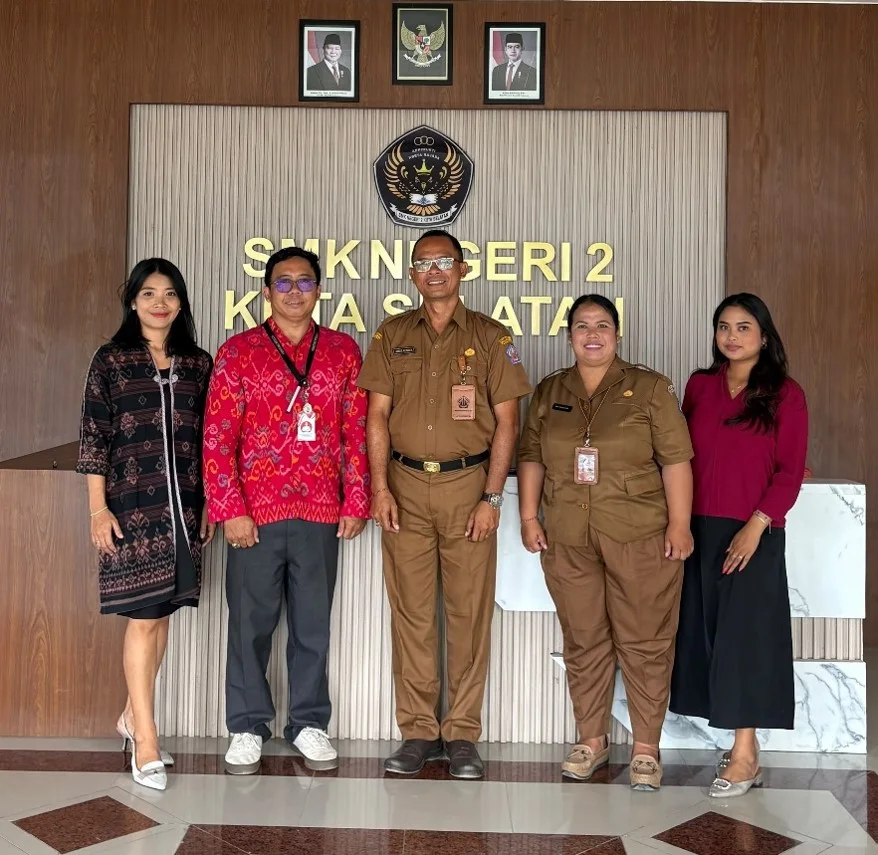
In addition to the journalism training, this community service activity included the signing of a Memorandum of Agreement (MoA) and an Implementation Agreement (IA) between Universitas Dwijendra and SMK Negeri 2 Kuta Selatan.
The cooperation documents were signed by the Dean of FKIP Universitas Dwijendra, Dr. I Wayan Aryawan, S.Si., M.Pd., and the Principal of SMK Negeri 2 Kuta Selatan, I Made Kondra, S.Pd., M.Pd.
This agreement serves as a step toward strengthening institutional ties while opening opportunities for collaborative educational programs.
Through this partnership, both institutions aim to develop various activities that support the improvement of student competence, the strengthening of digital literacy, and the development of skills relevant to modern educational needs.
Collaboration between universities and schools is considered vital for bridging academic knowledge with practical learning requirements.
For Universitas Dwijendra, this activity is part of the implementation of the Tri Dharma Perguruan Tinggi (Three Pillars of Higher Education), specifically community service.
For the school, the partnership is expected to provide students with broader opportunities to gain learning experiences beyond routine classroom activities.
Hoping for Continued Growth in School Journalism
Through the “From Pen to Screen” program, the Indonesian Language Education Study Program at Universitas Dwijendra hopes the skills acquired by students will be applied to journalism activities within the school.
Students are expected to become more accustomed to observing events, gathering information from reliable sources, writing fact-based news, and developing work in digital formats that are easily understood by the public.
This training is also intended to be an initial step in building a more active culture of literacy at SMK Negeri 2 Kuta Selatan.
The presence of school journalism can provide a space for students to document educational activities, highlight school potential, and share positive information with the community.
Furthermore, strengthening digital literacy is expected to help students navigate the overwhelming flow of information with a more critical and responsible attitude.
Universitas Dwijendra hopes that the established partnership will continue through mentoring programs and other educational activities.
With ongoing collaboration between the university and the school, the development of journalism and digital literacy skills is expected to contribute to improving the quality of education and preparing a generation that is creative, adaptive, and capable of using technology wisely.





Comments 0
Write a Comment Share your response