

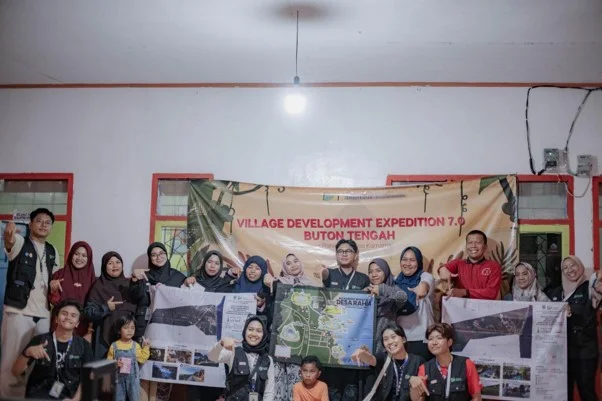
CENTRAL BUTON, JurnalPost.com - Students from the Economics Study Program at Universitas Airlangga (UNAIR) carried out a community service project in Rahia Village and Kamama Mekar Village, Gu District, Central Buton Regency, Southeast Sulawesi, from July 18–24, 2026.
The activity was part of the Community Service Program (KKN-BBK) equivalent through the Village Development Expedition 7.0 (VDE 7.0), organized in collaboration with the Barakati Indonesia Foundation.
This service program had been in preparation since May 5, 2026, utilizing a multisectoral approach focused on increasing nutritional awareness, developing village tourism potential, and strengthening the community's social and cultural ties.
The selection of this program was driven by several development challenges in Central Buton Regency, particularly issues regarding poverty and public health.
Based on 2024 data from the Central Statistics Agency (BPS) cited by the organizers, the poverty rate in Central Buton Regency reached 15.43 percent, which is higher than the national poverty rate.
Meanwhile, data from the 2023 Indonesian Health Survey (SKI) showed a stunting prevalence of 36.8 percent in Central Buton Regency, the highest rate in Southeast Sulawesi Province during that period.
These conditions influenced the students' decision to design three main programs aligned with the Sustainable Development Goals Sustainable Development Goals (SDGs), specifically SDG 3 on good health and well-being, SDG 8 on decent work and economic growth, and SDG 11 on sustainable cities and communities.
Nutritional Education and Local Food Cooking Competition
One of the core activities of this community service was nutritional education, aimed at improving residents' understanding of the importance of meeting family nutritional needs, especially for children.
Based on the results of a community needs assessment, the students organized a healthy and nutritious food workshop attended by 35 participants.
The session featured Wiranto, S.Gz., a dietitian, who explained the principles of the Balanced Nutrition Guidelines (PGS), food ingredient selection, and the importance of monitoring nutritional content in daily meals.
To reinforce the participants' understanding, the activity continued with a nutritious cooking competition involving 24 residents.
Unlike typical cooking competitions, participants were encouraged to utilize ingredients easily found in their surroundings, such as moringa leaves, cassava, tofu, tempeh, fish, eggs, and noodles.
The use of local food ingredients was a key focus of the activity, as it demonstrated that residents can prepare nutritious meals without relying on expensive or hard-to-find items.
In the competition, the dishes were judged based on taste, suitability of portion sizes for children, and nutritional content.
Through this activity, the students hope that the community will better understand that meeting balanced nutritional needs can be achieved by utilizing food sources available within the village.
Village Tourism Training to Develop Local Economic Potential
In addition to health, UNAIR students and the Barakati Indonesia Foundation also focused on developing the community's economic potential through a village tourism training program.
This program was designed to help residents identify tourism potential in their area while improving skills that could support community-based tourism development.
A total of 10 residents participated in activities divided into three segments: village tourism socialization, walking tour, and bead-making training.
During the socialization session, participants were introduced to the concept of village tourism, destination branding strategies, and how to identify local assets that could be developed as tourist attractions. Meanwhile, the branding
activities provided participants with the opportunity to practice tour guiding techniques, identify potential objects, and learn how to take appealing photos for promotional purposes. walking tour The bead-making training was also introduced as a creative skill development activity with the potential to support local handicraft products.
Through this program, the students aimed to provide basic knowledge and skills so that the community could develop village tourism potential gradually and sustainably.
Strengthening Community Bonds Through Socio-Cultural Activities
The third program focused on strengthening social ties and preserving culture through activities involving residents of various age groups.
A total of 60 residents participated in a series of competitions and cultural performances organized as part of the service project.
Various competitions were designed to suit different participant groups so that all segments of the community could take part.
Children participated in a sarong relay race, the women's group took part in a bucket-carrying relay, while the men's group competed in a nailing contest.
The sense of togetherness was further enhanced when the activities continued with cultural performances by local village children.
Participants from the Barakati Indonesia Foundation also enlivened the event by wearing traditional clothing from their respective regions of origin.
These performances served as an effort to introduce cultural diversity while strengthening the relationship between the service participants and the communities of Rahia and Kamama Mekar villages.
The residents' enthusiasm was evident from their active involvement in the various activities held throughout the program.
Appreciation from the Village Government
The implementation of the community service program received a positive response from the local village government.
The Head of Rahia Village expressed his appreciation to the Barakati Indonesia Foundation and the participants who traveled to carry out activities with the community.
“The Barakati Foundation and its participants came all this way to bring an extraordinary program,” said the Head of Rahia Village.
Based on the organizers' observations and documentation, the service activities received a positive response from the community. The residents' participation in the various programs served as an early indicator of the initiative's acceptance.
However, the long-term impact of the nutritional education, village tourism development, and socio-cultural activities will still require further follow-up and evaluation.
Through the
Village Development Expedition 7.0 , UNAIR students hope that the service activities will not only serve as a means to apply knowledge gained during their studies but also contribute to increasing knowledge, skills, and community empowerment.The collaboration between students, the foundation, the village government, and the community is expected to be a first step toward encouraging more sustainable development of local potential in Central Buton Regency.
Author Profile
Imam Maulid
is a student at Universitas Airlangga (UNAIR) who participated in community service through the Village Development Expedition 7.0 (VDE 7.0) program in collaboration with the Barakati Indonesia Foundation in Central Buton Regency, Southeast Sulawesi.



Comments 0
Write a Comment Share your response