

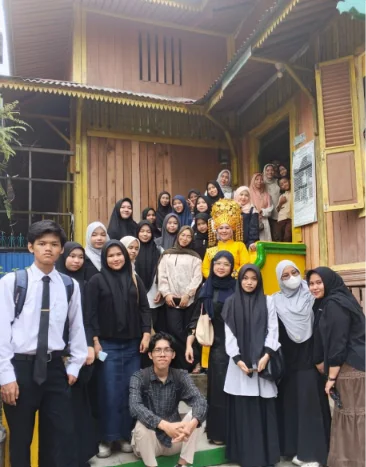
PEKANBARU, JurnalPost.com – Learning about local culture does not always have to take place inside a classroom. Students from the English Education Study Program at the Faculty of Teacher Training and Education (FKIP), Islamic University of Riau (UIR), gained firsthand experience in Malay cultural heritage through an educational visit to the Kampung Bandar Weaving House in Pekanbaru, Riau, on Friday (20/11/2026).
The visit was part of the News Writing and Reporting course taught by Fitri Wulandari, S.Pd., M.Pd. This activity provided students with the opportunity to practice journalistic skills through direct observation, interviewing sources, and gathering information to draft news reports based on their field experience.
During the visit, students interviewed Ibu Rina, a representative of the Kampung Bandar Weaving House. She provided insights into weaving activities, the production process, and the efforts of local artisans to preserve traditional Malay weaving.
Exploring the History of the Kampung Bandar Weaving House
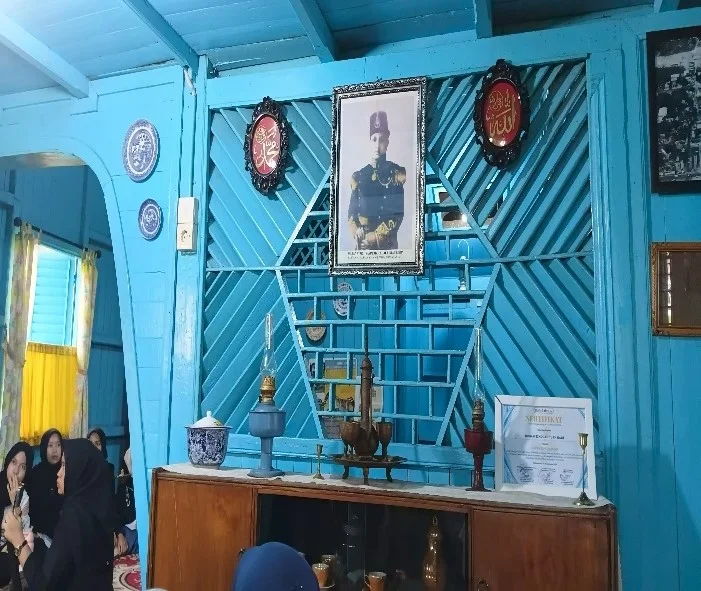
The Kampung Bandar Weaving House is located in the Senapelan District of Pekanbaru. The historic building used as the weaving house has stood since 1887 and is associated with H. Yahya, a prominent rubber entrepreneur of that era.
The weaving craft business was later developed in 2012 and is managed by the Pucuk Rebung Community Self-Reliance Group (KSM).
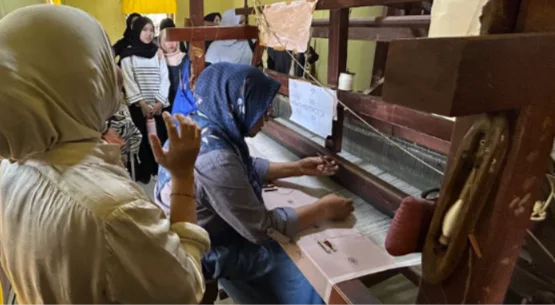
Its development received support from the National Program for Community Empowerment (PNPM) Mandiri through the provision of equipment, raw materials, capital assistance, and weaving skills training for the local community.
One aspect that caught the students' attention was the number of artisans involved in the weaving production.
According to Ibu Rina, the group has 14 members. However, only about four people typically work directly at the weaving house, as other members have household responsibilities. Some members continue to weave from their own homes.
Utilizing Natural Dyes in Fabric Production
Another interesting aspect of the visit was the use of natural materials in the fabric dyeing process.
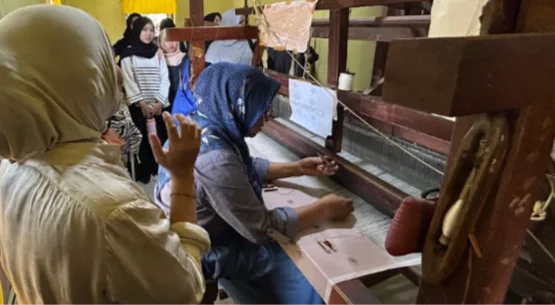
Artisans utilize jengkol skins, ketapang leaves, and turmeric to produce various natural colors for the woven fabric. These materials serve as an alternative to synthetic chemical dyes, demonstrating the artisans' commitment to maintaining tradition while prioritizing environmental sustainability.
Ibu Rina explained that the use of natural dyes was introduced around 2018, before the COVID-19 pandemic. The artisans also received support from Bank Indonesia to develop their production activities.
Previously, they underwent training for approximately one month to learn and improve their weaving skills.
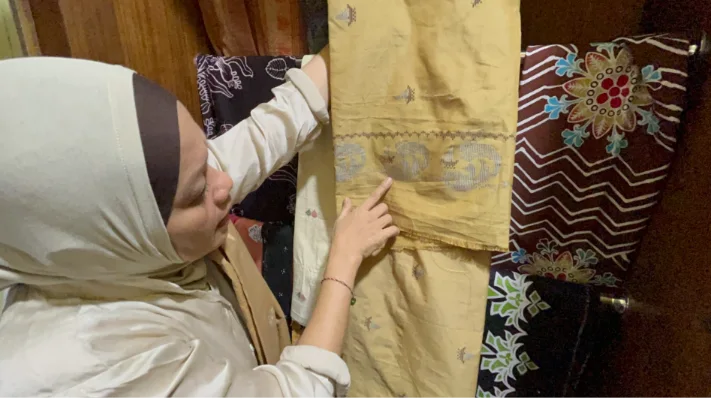
Students also learned that the process of creating fabric with natural dyes requires patience and precision.
According to Ibu Rina, the dyeing process takes about one day. Afterward, the fabric is dried indoors at a controlled temperature.
Direct exposure to sunlight is avoided because excessive heat can affect the quality of the fabric's color.
Preserving Traditional Weaving Techniques
Despite continuous technological advancements, the artisans at the Kampung Bandar Weaving House maintain traditional weaving methods.
They use non-mechanical weaving equipment known as ATBM (Non-Machine Weaving Tools). Each room can accommodate two looms.
However, the production process sometimes takes longer if the equipment encounters technical issues and requires repairs.
Interestingly, the artisans continue to produce woven fabric even when they are not receiving customer orders. This activity is done to maintain weaving skills while ensuring the continuity of traditional craft production.
Various products produced include songket fabric, shawls, tanjak (traditional Malay headgear), bags, and various souvenirs.
Through interviews and direct observation, students understood that weaving is not just about turning thread into fabric. The activity requires patience, creativity, precision, and traditional knowledge passed down through generations.
Weaving activities also open opportunities for the local community, especially women, to develop skills and earn additional income.
Journalistic Learning and Local Cultural Preservation
The educational visit was a meaningful learning experience for the UIR English Education students.
This activity helped students understand how to obtain information directly from sources, identify key facts, and process observations into a journalistic report.
Beyond course requirements, the visit introduced students to the importance of upholding local traditions and supporting community-based cultural preservation efforts.
The Kampung Bandar Weaving House proves that traditional crafts can remain a part of community life amidst modern developments.
Through the dedication of local artisans, the tradition of Malay weaving is preserved while providing economic opportunities for the surrounding community.
The existence of the weaving house serves as a reminder that preserving cultural heritage is not only about maintaining regional identity but also plays a role in community empowerment and creative economy development.



Comments 0
Write a Comment Share your response