


BANYUWANGI, Indonesia, JurnalPost.com — The Indonesian Red Cross (Palang Merah Indonesia/PMI), in partnership with Atma Connect, officially launched the pilot Resilient Community Coach (RCC) program in Banyuwangi, East Java, on Tuesday, September 1, 2026.
The six-month initiative combines artificial intelligence (AI), local knowledge, and community-based disaster preparedness practices to help communities better understand risks, improve access to critical information, and strengthen their ability to respond before disasters occur.
The launch is being marked by a two-day Kick-off Meeting on September 1–2, bringing together PMI, Atma Connect, local government agencies, humanitarian partners, and community volunteers involved in the pilot.
Banyuwangi Deputy Regent and Chairman of the PMI Banyuwangi Chapter, H. Mujiono, said effective disaster preparedness ultimately depends on communities being able to act when risks emerge.
“Preparedness ultimately depends on the ability of communities to act when risks arise. We hope RCC will expand access to information needed by volunteers and residents while strengthening the capacity that has already grown at the village level,” Mujiono said.
Technology Built Together With Communities
Atma Connect Field Director Alfan Kasdar said RCC has been developed using a community-centered approach, ensuring that technology responds to conditions and needs on the ground.
Rather than developing the platform remotely and introducing it to communities afterward, Atma Connect intends to involve volunteers and residents throughout the pilot and development process.
“We do not want to build technology for communities from a distance. We want to build it together with them. Volunteers’ experience, community knowledge, and conditions on the ground will be part of the RCC development process from the very beginning,” Alfan said.
Manager of the Global Disaster Preparedness Center (GDPC) Program, Dedi Junadi, similarly emphasized that technological innovation in disaster preparedness must address practical community needs.
“Innovation in disaster preparedness is not simply about introducing new technology. It is about ensuring that solutions address real needs, strengthen local capacity, and work within systems that are already in place,” Dedi said.
According to him, the Banyuwangi pilot will allow RCC to be tested directly alongside PMI, volunteers, and local communities.
“The RCC pilot gives us an opportunity to test the innovation directly with PMI, volunteers, and communities. This allows us to learn what actually works and how RCC can sustainably strengthen community preparedness,” he said.
Strengthening SIBAT Volunteers Through Digital Tools
Head of PMI Central Headquarters Arifin M. Hadi said the digitization of disaster risk assessment data developed through collaboration between PMI and Atma Connect could deliver strategic benefits at the community level.
These include accelerating emergency response, strengthening early warning systems, and increasing village communities’ ability to independently identify and mitigate disaster risks.
“The digitization of disaster risk assessment data and information developed through the collaboration between PMI and Atma Connect can bring significant benefits in accelerating emergency response, strengthening early warning systems, and building the self-reliance of village communities in disaster mitigation in real time,” Arifin said.
PMI is also committed to strengthening the role of Community-Based Disaster Preparedness Volunteers, locally known as SIBAT, who serve on the front line in conducting rapid assessments and supporting disaster response.
Arifin said improving the digital capabilities of SIBAT volunteers is becoming increasingly important as communities face more complex disaster risks.
“The RCC program, supported by Atma Connect and the American Red Cross through GDPC, is expected to strengthen the capacity of SIBAT volunteers in the use of digital technology,” he said.
Digitized disaster risk assessments could also provide village governments with stronger evidence for planning and budget decisions.
“Digitized disaster risk assessment documents can provide a scientific basis for village governments to develop contingency plans, determine infrastructure priorities, and allocate village budgets based on identified risks,” Arifin said.
He added that integrating disaster risk information with effective early warning systems would help communities and local governments better identify potential threats and determine appropriate mitigation measures.
“Ultimately, this technology must serve one main purpose: building better-prepared communities, more capable volunteers, and village governments equipped with strong data to make informed decisions,” he said.
Four Communities Selected for RCC Pilot
The RCC pilot will run for six months, with the PMI Banyuwangi Chapter serving as the local implementation partner.
Four villages and urban villages have been selected as pilot locations:
Tamanbaru
Mojopanggung
Bakungan
Pengatigan
Atma Connect and PMI Banyuwangi also formalized their partnership during the Kick-off Meeting through the signing of a cooperation agreement for local implementation of the RCC pilot.
The two-day meeting brings together representatives from PMI Central Headquarters, PMI East Java Chapter, PMI Banyuwangi, the American Red Cross through GDPC, Atma Connect, local government institutions, and community organizations.
Other stakeholders include the Regional Disaster Management Agency (BPBD), Social Affairs Office, Communications and Information Office, Meteorology, Climatology and Geophysical Agency (BMKG), facilitators, and SIBAT volunteer representatives.
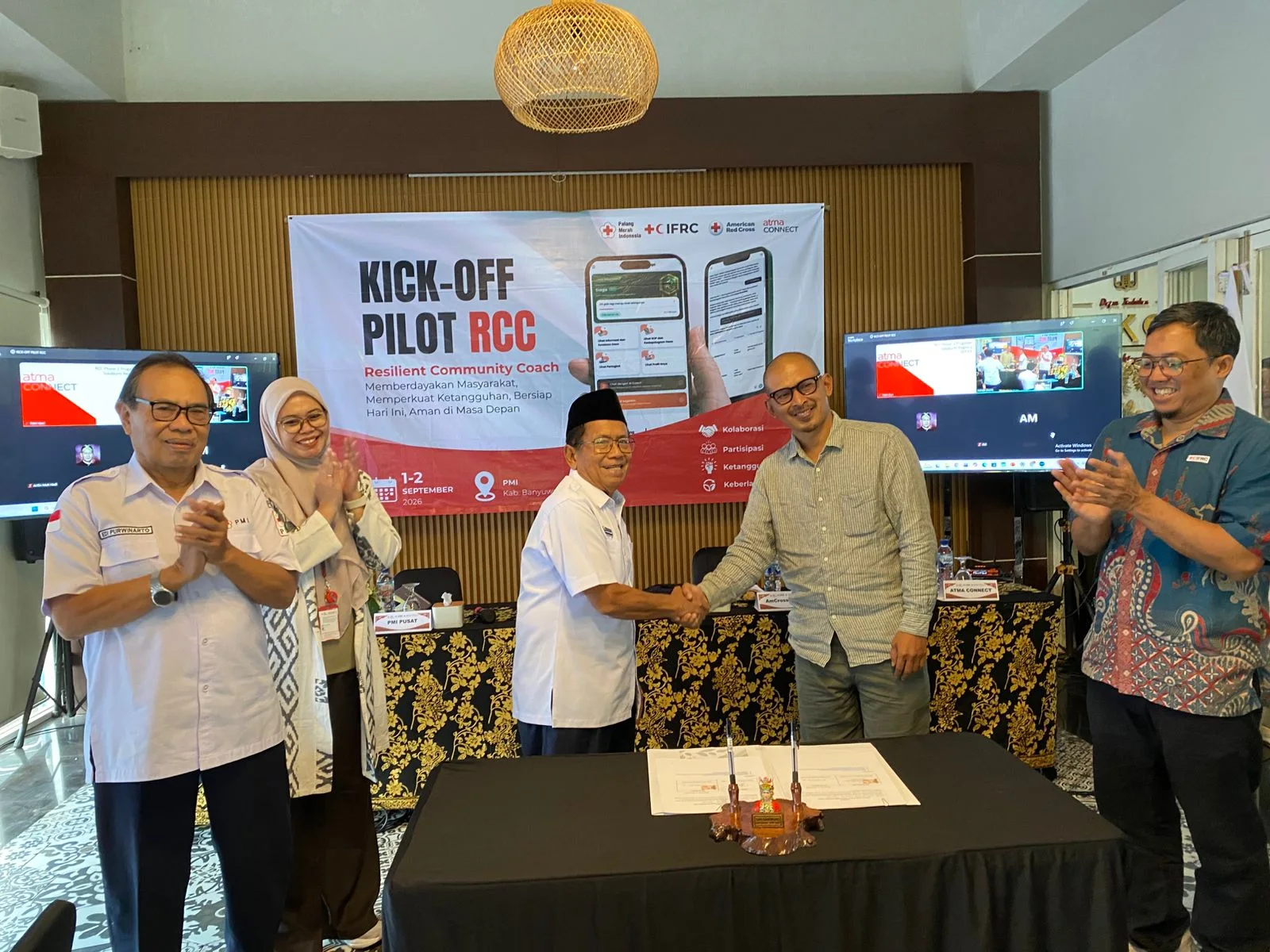
The meeting also marks Milestone 1 of the RCC Pilot Project Schedule.
This initial phase includes the establishment of a Steering Committee and Technical Committee, development of project governance mechanisms, agreement on the six-month implementation Scope of Work, and preparation of a work plan for the first 90 days.
AI Coach to Provide Village-Level Disaster Information
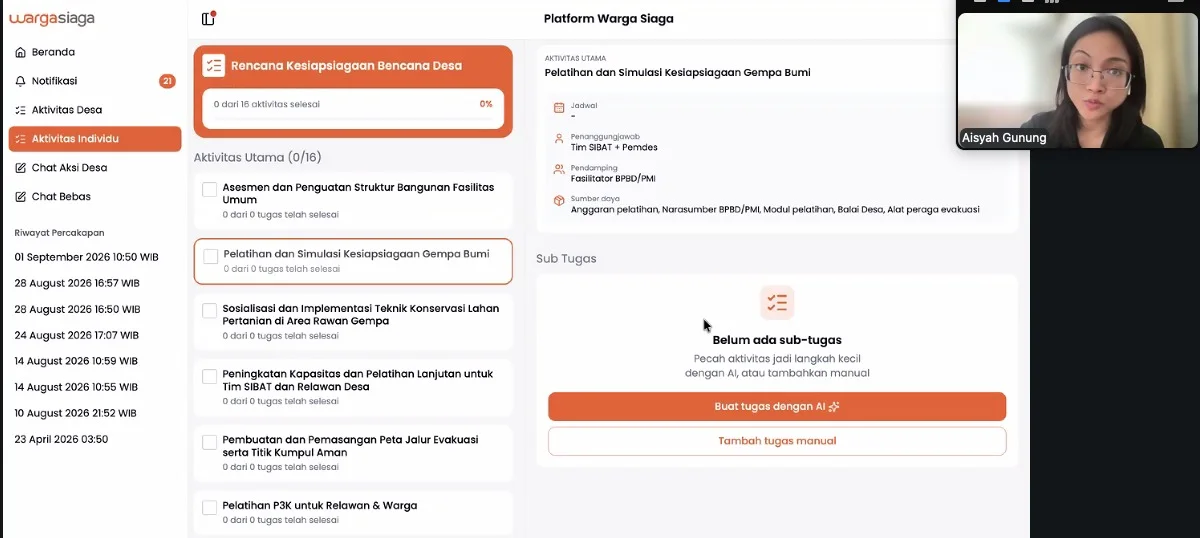
A central component of the pilot is the Resilient Community Coach application, designed to provide volunteers and community members with easier access to village-level disaster preparedness information.
The application combines AI technology with local knowledge, findings from the Enhanced Vulnerability and Capacity Assessment (EVCA), and PMI disaster preparedness standard operating procedures.
Through the platform, users can access information about disaster risks in their area, preparedness procedures, and other practical guidance relevant to local conditions.
An AI Coach feature will also provide consultation support, helping users navigate preparedness information and identify actions that may be appropriate to specific disaster risks.
The application is expected to help communities monitor their preparedness, understand local vulnerabilities, and identify more targeted mitigation measures.
However, RCC is not intended to replace volunteers, established disaster preparedness mechanisms, or local community knowledge.
Instead, the technology is positioned as a supporting tool designed to strengthen systems and capacities that already exist at the community level.
Throughout the six-month pilot, PMI personnel, SIBAT volunteers, and participating community members will test the platform, provide feedback, and contribute to its further refinement.
Evaluation Will Focus on Community Impact
Evaluation of the pilot will not be limited to measuring how many people use the technology.
The project will also examine whether RCC improves access to disaster information, increases preparedness knowledge, supports better volunteer practices, and strengthens communities’ ability to make decisions based on identified risks.
Lessons from Tamanbaru, Mojopanggung, Bakungan, and Pengatigan will be used to refine the RCC model and assess whether similar approaches could eventually be adapted for other communities.
The pilot forms part of the 2026 QBE AcceliCITY Humanitarian Challenge, in which Atma Connect was selected as one of the winners to develop and test innovative humanitarian solutions.
For the Banyuwangi implementation, Atma Connect is collaborating with PMI, the American Red Cross through the Global Disaster Preparedness Center, and Australian Red Cross Humanitech.
The partners are testing RCC in a real-world community-based disaster preparedness environment to determine how digital tools, particularly AI, can complement local knowledge and existing preparedness systems.
Ultimately, the pilot’s success will not be measured solely by technology adoption.
Its main measure will be whether RCC enables PMI, volunteers, local governments, and communities to access more useful information, make better-informed decisions, and take more effective action before disasters occur.
Technology remains a supporting tool, while local knowledge, volunteer experience, and community resilience continue to serve as the foundation of effective disaster preparedness.







Comments 0
Write a Comment Share your response