

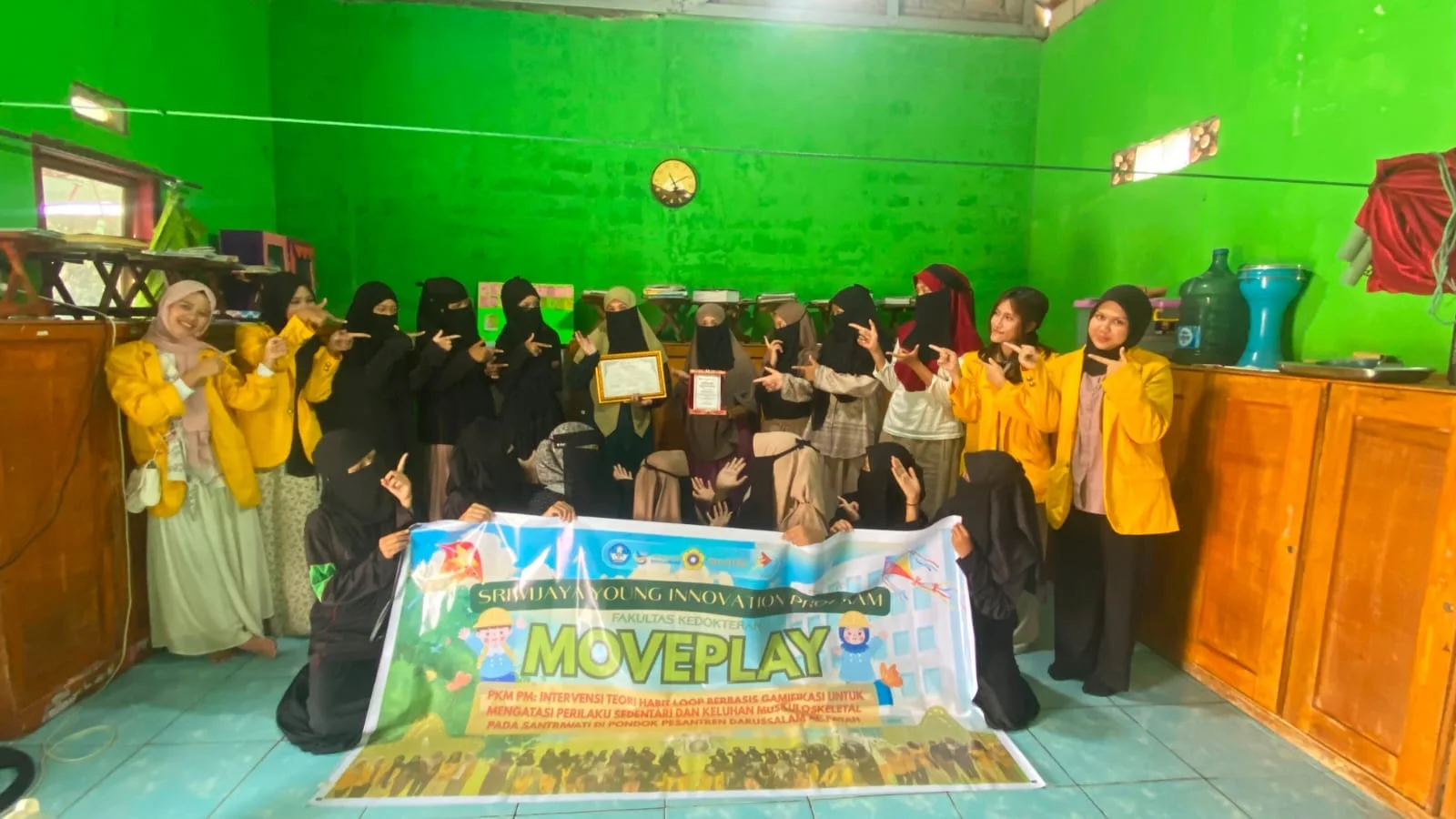
INDERALAYA, SOUTH SUMATRA, JurnalPost.com — Prolonged sitting and a lack of physical activity can trigger musculoskeletal issues, such as muscle soreness and general physical discomfort. Addressing this, a team from the Sriwijaya Young Innovation Program (SYIP) at the Faculty of Medicine, Universitas Sriwijaya (Unsri), has introduced the MOVEPLAY program.
The program, implemented at the Darussalam Al-Fatah Islamic Boarding School in Tanjung Pering, South Sumatra, was initiated by Kirania, Cia, Alya, Aisyah, and Natasya.
Running from August to October 2026, MOVEPLAY is designed to improve students' understanding of ergonomic posture while encouraging regular stretching and physical activity.
Long hours of studying and religious recitation in non-ergonomic positions can lead to soreness, muscle stiffness, and neck and back pain.
Based on an initial assessment with partners, the students had limited knowledge regarding ergonomic study positions and simple stretching exercises.
This condition highlighted the need for education that not only increases knowledge but also fosters active habits.
MOVEPLAY Combines Health Education and Gamification
MOVEPLAY was developed as a health education approach that integrates the concept of Habit Loop with gamification.
This approach utilizescues,routines,andrewards to help participants build active habits.
By packaging education through games and simple challenges, students are expected to learn active living behaviors through a more engaging experience rather than just traditional lectures.
The program introduces four innovative, complementary media tools.
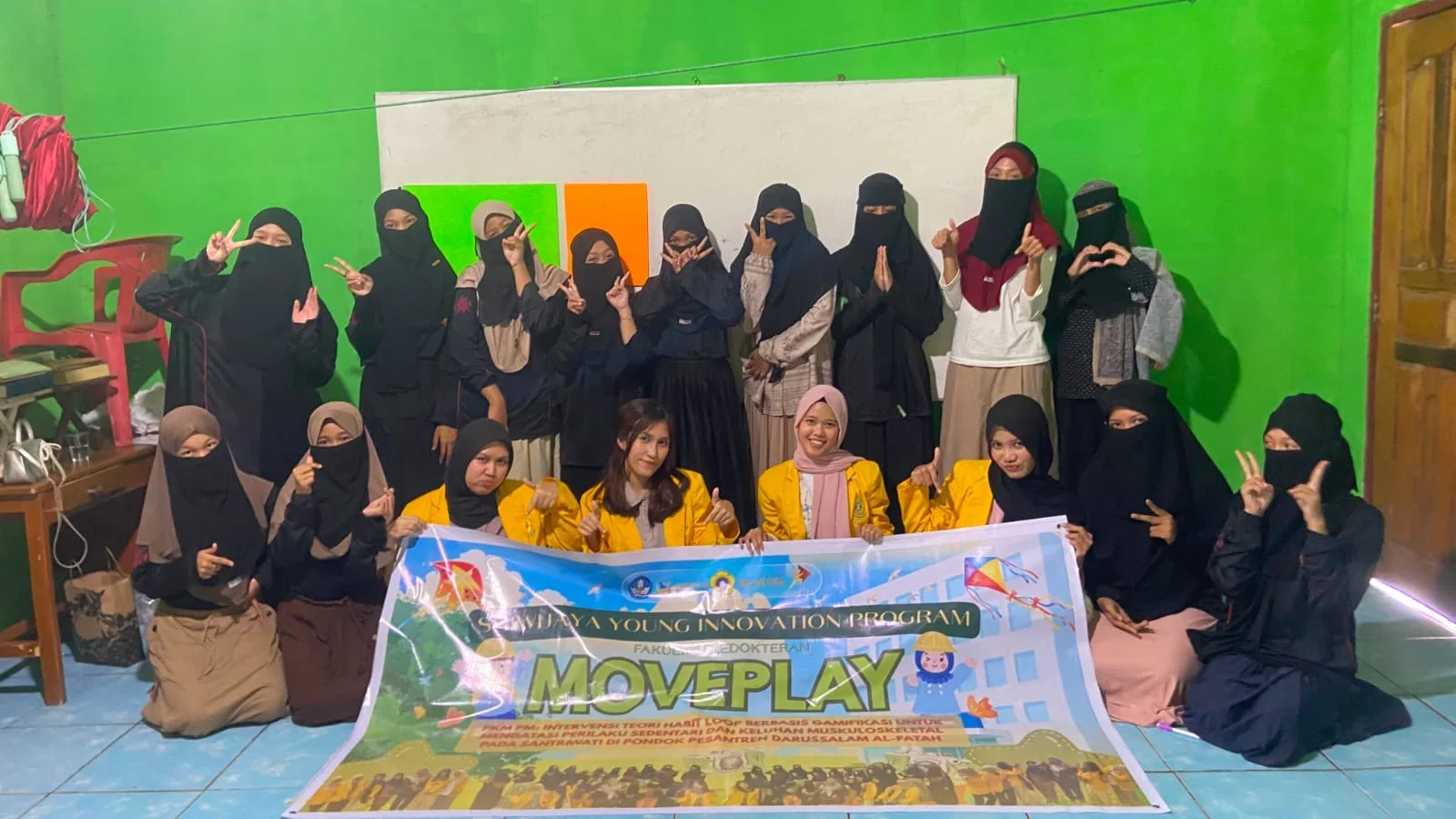
Monolarga is an educational board game that combines health information, movement challenge cards, and puzzles.
Furthermore, GAOL (Gacha) presents stretching challenges through a random selection system, allowing participants to try different movements.
Meanwhile, TrackMov is used to record activity and physical condition, as well as to reflect on movement habits.
All these tools are supported by a guidebook containing instructions for use and maintenance.
Students Encouraged to Learn Through Play
To introduce these tools, the MOVEPLAY team invited students at the Darussalam Al-Fatah Islamic Boarding School to learn through play.
Through Monolarga, students were encouraged to learn health information while completing challenges together.
The excitement continued as they tried GAOL, picking capsules containing stretching challenges to practice.
Students were also introduced to TrackMov as a means to monitor their daily activities.
Beyond involving the students, the team provided training to supervising teachers so that MOVEPLAY tools could be utilized to support physical activity within the boarding school environment.
For the students, this activity was not just an opportunity to play, but an experience to recognize the importance of maintaining physical comfort amidst their study and recitation routines.
Galuh, one of the students, shared that MOVEPLAY helped her understand how to manage the soreness she often felt after sitting for long periods.
“The program brought by these students is beneficial because we now know how to deal with back pain. We often experienced lower back pain from studying and reciting while sitting on the floor for long hours. After participating in this program, we learned that when our bodies start to feel sore, we can take a short break to stretch and move. We also learned the correct movements to make our bodies feel more comfortable,” Galuh said.
Boarding School Positively Welcomes MOVEPLAY
The benefits of the program were also recognized by the boarding school administration.
Umi Nikmah, a representative of the Darussalam Al-Fatah Islamic Boarding School, welcomed the presence of MOVEPLAY, which provides additional activities for students while introducing health knowledge through games.
“Alhamdulillah, this program is very helpful for the students because they now have additional activities that keep them moving. The games brought by the team also help them learn and gain useful knowledge. Previously, students were accustomed to studying on the floor, which sometimes caused back pain. With this program, they are learning the correct body posture for studying and are becoming more enthusiastic about physical exercise,” said Umi Nikmah.
Responding to the participants' experiences and the school's support, Kirania Alliyu Putri, the head of the MOVEPLAY team, explained that the program was designed to connect health education with simple practices that can be integrated into daily life.
“Through MOVEPLAY, we want to show that health education does not always have to be delivered through lectures, but can also be conveyed through games and fun activities. We hope students not only understand the importance of maintaining physical health but also start applying it in their daily lives, such as correcting their posture while studying and stretching when their bodies feel sore. We hope these habits will continue even after our program concludes,” said Kirania.
Encouraging Sustainable Active Habits
The students' experiences and the support from the boarding school are vital parts of the MOVEPLAY implementation.
However, the program's success is measured not only by enthusiasm during the activities but also by how active habits are applied in daily life.
Through the use of Monolarga, GAOL, and TrackMov, students are expected to become more accustomed to recognizing their body's needs, stretching when they feel sore, and monitoring their physical activity independently.
Evaluation through comprehension tests, movement observations, and activity logs are part of the effort to monitor this progress.
The sustainability of MOVEPLAY is also supported by the involvement of supervising teachers and the continued use of the provided media.
Stretching activities are expected to continue during regular exercise times at the boarding school and through light independent activities.
Thus, MOVEPLAY is not just a one-time activity but can become a part of the students' daily routine.
Through MOVEPLAY, the team hopes that simple steps—such as adjusting body position, taking breaks for stretching, and paying more attention to physical condition—can develop into sustainable habits.
Because an active life does not always have to start with major activities. Sometimes, change begins with small movements performed consistently.



Comments 0
Write a Comment Share your response