


JurnalPost.com Packaging is no longer just a means of product protection. Amidst increasingly fierce business competition, packaging design has become a vital element in building product image, capturing consumer attention, and increasing sales value.
This issue was addressed by a team of lecturers from the Industrial Engineering Department, Faculty of Engineering, Universitas Mercu Buana, during their 2026 Community Service (PKM) program. Through a project titled “Leveraging Digital Applications for Packaging Design in Tofu SMEs”the team provided guidance to the Tofu Awang SME on developing packaging designs using digital technology.
The activity, which took place from August 13–15, 2026, was conducted by a team of lecturers consisting of Raden Adriyani Oktora, ST., MT., Dr. Defi Norita, ST., MT., and Bethriza Hanum, ST., MT.
This program stems from the importance of a product's ability to adapt to market changes. Beyond product quality, visual aspects and design functionality determine how consumers perceive and accept the products offered.
Effective design can help a business increase product appeal, expand its market, build positive consumer perception, and strengthen brand identity. In a market filled with similar products, packaging can serve as a differentiator that provides a unique identity to a product.
Therefore, the development of product and packaging design can be viewed as a form of long-term investment for business owners, including micro, small, and medium enterprises (MSMEs).
Utilizing Canva for Packaging Design
During this community service activity, the Universitas Mercu Buana team introduced the use of Canva as a digital application to assist SME owners in creating packaging designs.
The application was chosen because it is relatively easy to use and provides various design features suitable for users with varying skill levels.
Canva offers a wide range of templates, images, shapes, fonts, videos, audio, and graphic elements that can be customized as needed. For packaging design purposes, the final designs can be saved as image files, which can then be used as samples or prototypes before printing.
The guidance was aimed at improving the partner's ability to develop tofu product packaging that is more attractive, efficient, functional, and value-added.
In addition to the digital approach, the activity combined technical and managerial aspects so that the use of technology would not stop at design creation but also support broader business development.
Starting with Discussion and Application Introduction
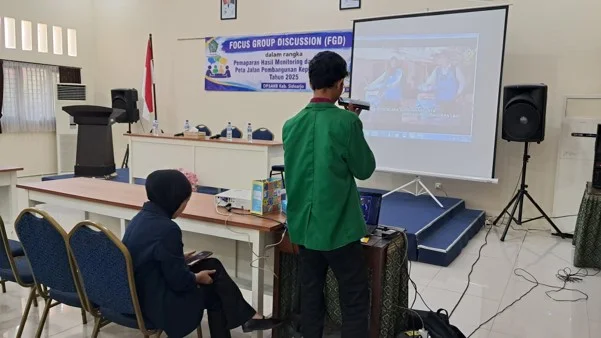
The activity was carried out in several stages. The first stage was a Focus Group Discussion (FGD) regarding the use of Canva and the various functions available to support product packaging development.
The service team explained how the application works to the SME owner, including how digital design technology can simplify the process of creating more attractive packaging.
This guidance is crucial because one of the challenges still faced by SMEs is the limited availability of human resources with specialized skills in business development.
These limitations are not only related to design but also involve material planning, production processes, distribution, and packaging.
To help overcome these obstacles, the team also provided several alternative packaging designs that could be developed and adapted to the characteristics of the Tofu Awang SME products.
Designing New Packaging Specifications
The next stage was the design of the packaging itself. The PKM team and the SME owner held discussions to determine the shape and specifications of the packaging deemed suitable for the product's needs.
Based on the FGD results, the packaging was designed using clear, plain vacuum plastic measuring 14 x 20 centimeters with a product capacity of approximately 300 grams.
The material used is 85-micron clear Nylon Vacuum plastic. For the exterior, a sticker made of 7 x 5 centimeter Vinyl BOPP with matte laminationwas designed.
The selection of this concept considered the need for packaging that is not only visually appealing but also capable of supporting product storage functions.
Once the specifications were agreed upon, the team created a visual sample of the packaging design using Canva. This process provided the SME owner with a clear picture of how a design concept can be developed digitally before entering the production or printing phase.
Helping to Increase Product Value
From this guidance, the SME owner gained new experience and knowledge regarding the use of digital applications in product development.
The business owner noted that the activity provided new insights into how to increase the value of the product through better packaging.
Based on the results of the activity and partner observations, the proposed packaging concept is also considered to have the potential to help extend the product's shelf life. Previously, the product had a shelf life of about one to two days; with the packaging system developed during this activity, the shelf life is reported to reach approximately four to five days at room temperature.
These results illustrate that innovation in an SME does not always have to start with complex technology. Utilizing easily accessible digital applications can be a first step toward improving visual quality, product management, and the business's ability to face market competition.
Through this Community Service activity, the team from the Industrial Engineering Department, Faculty of Engineering, Universitas Mercu Buana, hopes that SME players will be increasingly capable of utilizing digital technology independently, particularly in developing packaging that is more functional, attractive, and value-added.
The guidance also demonstrates the importance of collaboration between universities and MSME players in providing solutions that can be applied directly to meet business needs.




Comments 0
Write a Comment Share your response