


Nadya Ulya Arifviandy
Student, Faculty of Psychology, Tarumanagara University
Meike Kurniawati
Lecturer, Faculty of Psychology, Tarumanagara University
JurnalPost.com - Have you ever seen content about mental health on social media and felt that some of the things described were similar to the condition you are currently experiencing?
The development of digital technology has changed how individuals obtain health information. The internet allows people to search for information regarding symptoms, conditions, and even health treatments quickly without having to consult a healthcare professional first (McMullan et al., 2019).
In Indonesia, internet usage continues to grow. The Indonesian Internet Service Providers Association (APJII) reported that internet penetration in 2026 reached 81.72 percent, or approximately 235 million users (APJII, 2026). This condition makes the digital space an important source of health information. However, ease of access to information is not always followed by adequate information quality (Naslund et al., 2020).
Basch et al. (2022), for example, found that most videos with the hashtag #mentalhealth on social media are created by ordinary users, with only a small fraction originating from healthcare professionals. These findings indicate that mental health information on social media is not always delivered by sources with credibility and competence in the health field.
While some content is created based on scientific information, quite a bit is sourced from personal experiences, individual opinions, or unverified information. Therefore, the quality and source of the information received by users should be a concern.
Individuals who consume mental health content on social media can obtain information in two ways: by actively searching for it or through exposure to content that appears while using social media (Lim et al., 2022).
When content feels very relevant to one's own condition, a person may be driven to search for more information. One search leads to the next. The more information found, the more potential conditions or diagnoses emerge.
Instead of gaining certainty and feeling calmer, such searches can actually make a person increasingly worried about their health condition.
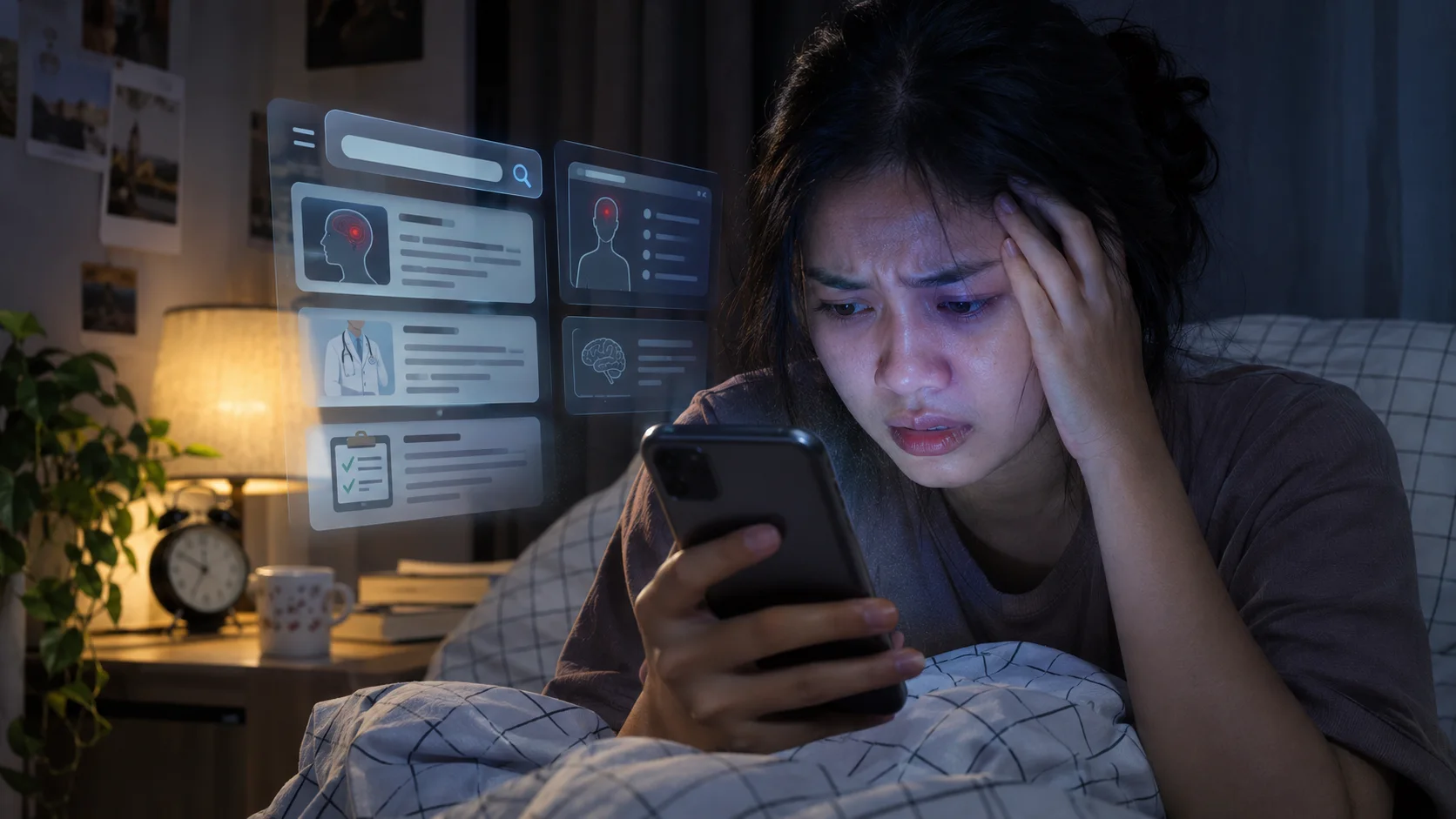
The phenomenon of repeated and excessive health information searching via the internet that actually increases anxiety is known as cyberchondria.
The term cyberchondria was introduced by White and Horvitz (2009) to describe the increase in health-related anxiety that arises due to repeated health information searches on the internet.
White and Horvitz (2009) explained that individuals often start searches based on symptoms that are actually mild or common. However, internet search results can display various possible diagnoses, including serious illnesses.
This information can then drive a person to interpret their symptoms excessively. As a result, worry or anxiety regarding their health condition actually increases.
So, why does someone keep searching for information even though the search makes them more anxious?
One factor that can play a role is intolerance of uncertainty, which is a person's difficulty in accepting uncertain situations. When feeling unsure about a condition they are experiencing, a person may be driven to keep searching for various information in the hope of gaining certainty.
The problem is that information on the internet does not always provide a definitive answer. The more information found, the more possibilities must be considered. This situation can trigger a cycle of information searching and recurring anxiety.
The habit of searching for health information is not actually a bad thing. The internet and social media can even help the public obtain knowledge about mental health more easily and quickly.
However, it is important to remain mindful of the source, credibility, and context of the information obtained. Mental health content on social media should be used as a source of initial knowledge, not as a basis for self-diagnosis.
Recognizing one's own condition through available information can be a first step toward increasing mental health awareness. However, if there are persistent complaints that interfere with daily activities or cause excessive worry, consulting a professional remains a more appropriate choice than continuing to seek certainty through social media.









Comments 0
Write a Comment Share your response