


BOGOR, JurnalPost.com — Plastic waste remains a significant challenge for environmental management at the community level. To encourage the habit of sorting waste from home, the Computer Engineering Technology Study Program at IPB University's Vocational School held training on plastic waste sorting and processing for residents of RW 08, Mulyaharja Village, Bogor City, on Saturday (9/19/2026).
This activity is a continuation of a community service program that has been running since 2025. Through this program, residents have previously received guidance and facilities in the form of Internet of Things (IoT)-based pyrolysis equipment to support the processing of plastic waste into useful products.
Although processing technology is available, public understanding of how to sort waste is a crucial factor for the optimal use of the equipment.
The Head of RW 08 in Mulyaharja Village, Lia Sukmadi, stated that education on waste management is still needed to build the community's habit of separating waste by type.
"Education regarding waste sorting and processing is very important in RW 08. We already have the IoT-based pyrolysis equipment from the Computer Engineering Technology Study Program at IPB Vocational School, so with this activity, the community can better understand how plastic waste can be processed using technology," said Lia.
Waste Sorting Starts at Home
During the training, residents received an explanation regarding the importance of sorting household waste before it reaches the collection and processing stages.
The event speaker, Arief N. Nur Prasetyo, S.Hut., M.Si., explained that sorting at the source can simplify the waste management process in subsequent stages.
"Sorting waste is very important to do starting from home so that waste does not get mixed. When waste is mixed, the sorting process becomes more difficult," explained Arief.
In addition to the presentation, the training opened a discussion space between the speaker and the community. Residents shared their experiences regarding waste disposal habits and the obstacles faced when sorting in their households.
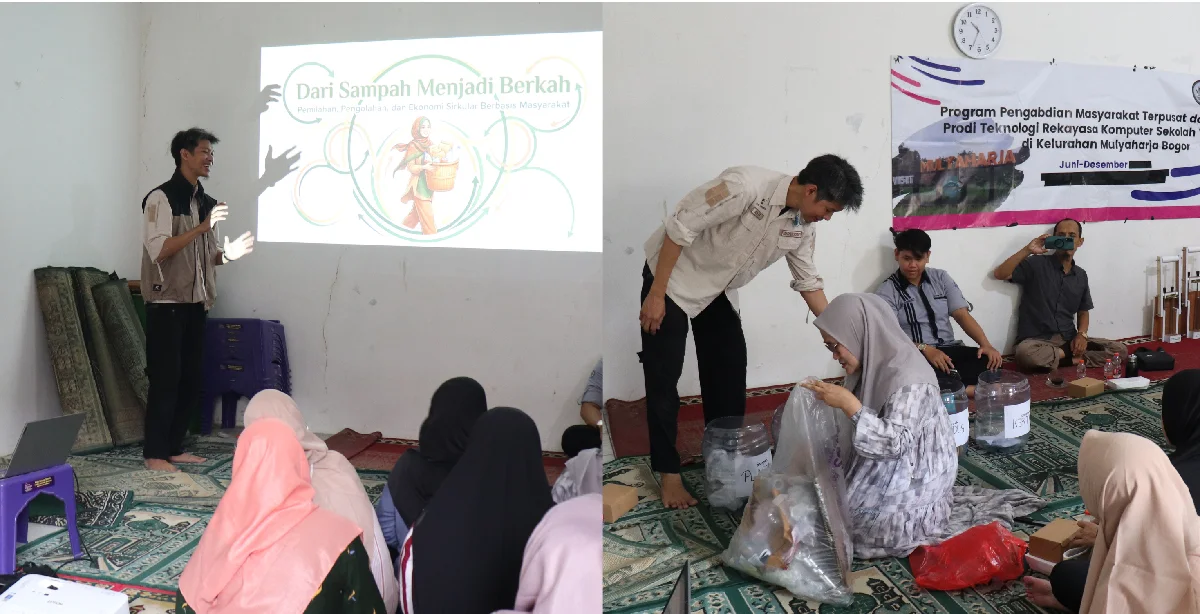
The discussion served as an opportunity to identify the problems faced by residents while also discussing steps that can be taken to ensure waste management activities remain sustainable.
Village Government Encourages the Formation of a Waste Bank
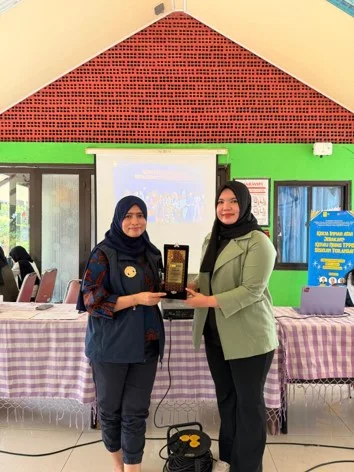
The activity was also attended by the Head of Mulyaharja Village, Muslim Yuliantono, S.Sos., M.Si., who expressed his support for community-based waste management.
Muslim encouraged the residents of RW 08 to form a waste bank as a means for organized collection, sorting, and management of waste.
According to him, the existence of a waste bank can help the community carry out management activities routinely, ensuring that efforts to maintain environmental cleanliness do not stop after the training concludes.
"A waste bank can be one of the steps to ensure that these waste sorting and processing activities can continue to run," said Muslim.
The formation of a waste bank is also expected to increase resident involvement in managing household waste while supporting the utilization of the available processing technology.
IoT-Based Pyrolysis Technology for Waste Management
One of the important aspects of this mentoring program is the utilization of the IoT-based pyrolysis equipment previously provided to the RW 08 community.
Pyrolysis technology works through a process of heating materials in low-oxygen conditions. In processing plastic waste, this technology can be used to convert certain types of plastic into processed products, depending on the material characteristics and process conditions.
Meanwhile, the application of IoT allows for the use of digital technology to support monitoring or process control according to the features of the device used.
However, the utilization of this technology still requires appropriate material sorting, safe operational procedures, and proper management of process outputs and emissions.
The Head of the Computer Engineering Technology Study Program at IPB University's Vocational School, Dr. Inna Novianty, stated that this mentoring activity is a form of the university's contribution to helping the community face environmental issues through the application of technology.
"Hopefully, the contribution of the Computer Engineering Technology Study Program in RW 08 Mulyaharja can provide a positive impact on the community and help support the creation of a healthier environment," said Inna.
Planning Weekly Waste Sorting
As a follow-up to the training, the IPB University team and residents discussed plans to implement routine plastic waste sorting once a week.
Through this activity, the community is expected to begin the habit of separating waste from home before it is collected at the agreed-upon location.
The collected plastic waste can then be selected based on its suitability for use as material in the processing process using the pyrolysis equipment available in the RW 08 area.
This step is part of an effort to build a waste management system that does not rely solely on the availability of equipment but also involves active community participation.
Collaboration between the university, the village government, and the residents is an essential element in maintaining the program's continuity.
Through the mentoring that has been ongoing since 2025, the Computer Engineering Technology Study Program at IPB University's Vocational School strives to bridge the application of technology with the community's needs in environmental management.
Moving forward, the success of this program will depend on the consistency of waste sorting, the safe management of facilities, and the involvement of the community in carrying out activities routinely.
With this approach, RW 08 Mulyaharja is expected to develop more organized plastic waste management practices while becoming a learning space for the application of appropriate technology at the community level.


Comments 0
Write a Comment Share your response