


LEBAK, JurnalPost.com — The Bocah Gunung Forest Farmers Group (KTH) in Cileles District, Lebak Regency, Banten, serves as a prime example of a community that has implemented an integrated farming system by utilizing land for crops, trees, and livestock. This practice was highlighted during the 2026 'Dosen Pulang Kampung' (Dospulkam) program organized by IPB University.
Through this program, IPB University is encouraging the development of agroforestry as an approach to increase land productivity, expand farmers' income sources, and maintain environmental sustainability.
The event, held on Wednesday, September 30, 2026, is part of IPB University's Dospulkam program facilitated by the Institute for Agromaritime Development and Innopreneurship Acceleration (LPA2I). The program connects academics with the community to share knowledge, research findings, and innovations that can be applied according to regional potential.
The activity was led by Prof. Dr. Ir. Noor Farikhah Haneda, M.Si., from the Department of Silviculture, Faculty of Forestry and Environment, IPB University.
Prof. Noor Farikhah explained that the Dosen Pulang Kampung program is a form of higher education community service. Through this initiative, lecturers do not merely convey academic knowledge but also strive to provide solutions tailored to the community's needs.
"Through this activity, we want the research results and innovations developed at the university to provide tangible benefits to the community," said Prof. Noor.
According to her, community involvement is a crucial part of implementing agricultural innovation. Knowledge developed in universities must be adapted to field conditions to be utilized sustainably.
Agroforestry as an Alternative for Farm Diversification
One of the main topics in the activity was titled "Agroforestry Systems: Efforts for Farm Diversification and Improving Community Welfare."
The material was presented by Dr. Adisti Permatasari Putri Hartoyo, M.Si., along with Elisabeth Violetta Kasih Dewanti.
In the presentation, agroforestry was defined as a land management system that integrates trees with agricultural crops, fisheries, and/or livestock. This system allows the community to obtain various economic benefits while maintaining the ecological functions of the land.
Unlike farming patterns that rely on a single commodity, agroforestry provides opportunities for farmers to produce several types of products from the same land.
For example, farmers can cultivate food crops among trees while utilizing part of the land to grow forage for livestock. In this way, income sources are not solely dependent on the harvest of the main crop.
During the activity, participants were introduced to several forms of agroforestry, including agrisilviculture, which combines trees and agricultural crops; silvopasture, which integrates trees with livestock; and agrosilvopasture, which combines all three in one management system.
Additionally, participants received an explanation of silvofishery, the integration of woody vegetation with fishery activities, and apiculture, or beekeeping, which can be developed as part of land-based business diversification.
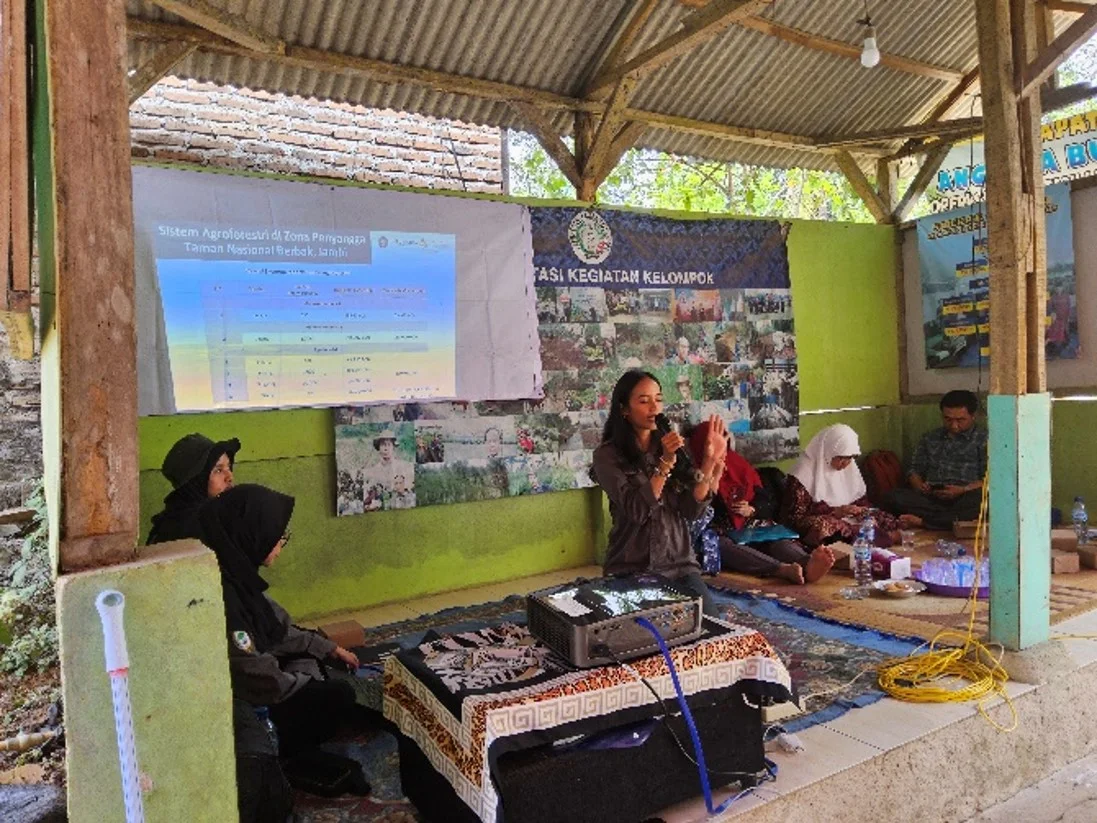
To provide an overview of its application, the speakers also shared several examples of agroforestry practices from various regions in Indonesia.
Some of these include the combination of sengon trees and cassava in Bogor, cocoa and rice in Palu, and mangroves and shrimp in Lampung.
These diverse examples demonstrate that agroforestry development can be adapted to the geographical conditions, land characteristics, and resources possessed by the local community.
Bocah Gunung Farmers Have Implemented Integrated Farming
During the Dospulkam activity, it was noted that the community members of KTH Bocah Gunung have already been carrying out practices aligned with the principles of agroforestry.
In addition to managing agricultural crops and trees, the farmer group members also run livestock businesses involving goats, sheep, and cattle as part of their economic activities.
To support their livestock business, the community utilizes the space between trees as a location for planting grass and various types of forage.
This land-use pattern allows several production activities to take place side-by-side without having to completely separate land use for crops and livestock.
The practices carried out by KTH Bocah Gunung align with the concept of agrosilvopasture, a system that combines forestry, agricultural, and livestock components.
The presence of livestock provides additional income opportunities for farmers, while crops and trees remain essential parts of land utilization.
This community experience serves as a foundation for developing a more planned agroforestry system. Through mentoring and knowledge strengthening, the practices already in place are expected to be improved to provide more optimal economic and environmental benefits.
Strengthening Farmer Economy and Environmental Sustainability
Agroforestry development is not only related to increasing agricultural yields but also to the community's ability to manage land resources sustainably.
In the economic aspect, farm diversification can help reduce farmers' dependence on a single commodity. When the yield or price of one product declines, the presence of other commodities can serve as an alternative source of income.
Meanwhile, from an environmental perspective, the presence of trees in a farming system can help protect the soil, support water cycles, and maintain the ecological functions of the land if managed correctly.
Thus, the application of agroforestry offers an approach that combines agricultural production interests and environmental protection within a single management system.
Through the 2026 Dospulkam program, IPB University seeks to strengthen practices already developed in the community with the support of scientific knowledge and relevant innovations.
Direct interaction between lecturers and the farmer group also opens space for the exchange of experiences. Academics can understand the conditions and challenges faced by farmers, while the community gains additional knowledge to develop their business activities.
This approach is expected to encourage the formation of a more productive, adaptive, and responsive agricultural system that meets the community's needs.
For KTH Bocah Gunung, strengthening agroforestry practices is an opportunity to optimize land potential while developing more diverse sources of livelihood.
Moving forward, the collaboration between the university and the farmer group is expected to continue so that the application of innovation does not stop at socialization activities but is realized through land management practices that provide tangible benefits.
IPB University's Dosen Pulang Kampung program serves as an effort to bridge research results with community needs, while supporting sustainable agriculture, food security, and the improvement of farmer welfare.







Comments 0
Write a Comment Share your response