

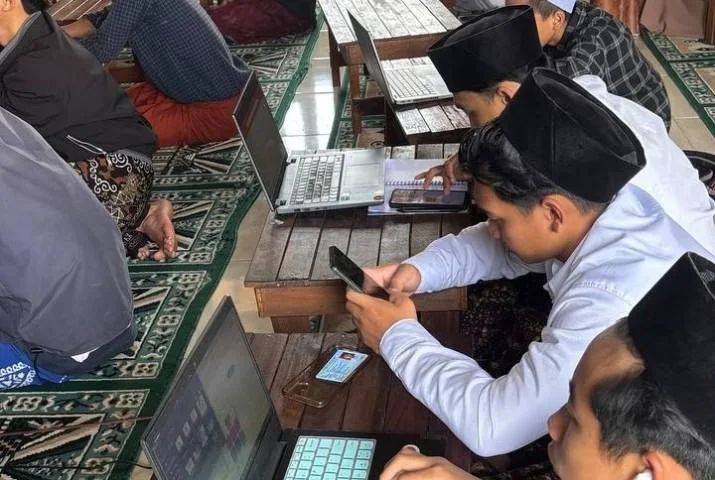
JurnalPost.com - The changing times have brought shifts to various aspects of life, including Islamic education. Generation Z (Gen Z) has grown up amidst the rise of digital technology, resulting in habits, communication styles, and learning needs that differ from previous generations. For Islamic boarding schools (pesantren), which not only teach religious knowledge but also shape the character and morality of their students (santri), this change presents a challenge that requires attention.
Pesantren are known for an educational system that emphasizes discipline, role modeling, habitual worship, and communal living within the boarding environment. These values remain relevant and worth preserving. However, a question arises: is the current mentoring model sufficient to address the needs of today's students?
This question does not imply that pesantren should abandon tradition or replace their entire educational system. Rather, it suggests that pesantren need to re-examine how Islamic educational values are conveyed so they can be understood and applied by the current generation of students.
Challenges in Character Development for Gen Z Students
Character development is a vital component of pesantren education. Students are not only directed to understand religious material but are also accustomed to applying Islamic values in their daily lives, such as discipline, responsibility, politeness, empathy, and the ability to live communally.
Challenges arise because Gen Z students have grown up in the midst of technological development and the flow of digital information. They have access to various information sources and diverse ways of learning and communicating. This condition requires pesantren to better understand the students' needs in receiving guidance and building awareness of the values being taught.
Research by Husni and Az-Zuhdy (2026) at the An-Nur 2 Al-Murtadlo Islamic Boarding School addresses this issue. The study, titled "Moral Formation for Generation Z and Alpha at An-Nur 2 Al-Murtadlo Islamic Boarding School," discusses the challenges of learning for the younger generation and the importance of adaptive strategies. This research used a qualitative approach with a case study method, involving interviews and document analysis. Although it cannot yet be used as proof of the effectiveness of a specific approach, the study shows that the need for mentoring the younger generation has become an issue that requires the attention of Islamic educational institutions.
In other words, mentoring students is not enough if it is only oriented toward delivering material and enforcing rules. Students also need to be helped to understand the reasons behind the rules, realize the importance of the values being taught, and apply them in their daily lives.
Local Wisdom as a Character Education Approach
One approach that can be developed in mentoring students is character education based on local wisdom. Local wisdom consists of values, habits, and traditions that grow within the life of a community and are passed down through generations. Within it are values of togetherness, mutual cooperation (gotong royong), social concern, respect for others, and environmental responsibility.
The application of this approach can be seen in the research of Muhammad Fatwa (2026) at the Darul Amanah Kendal Islamic Boarding School. This study examines the integration of the local wisdom of Ngadiwarno Village into the character education of students. Several activities discussed include mujahadah, manaqiban, reading the Maulid Diba', khataman Al-Qur'an, mutual cooperation, and sambatan.
These activities serve as a means of habituating religious and social values. Through joint activities, students not only carry out traditions but also gain experience in building togetherness and concern for others. According to the author, mutual cooperation, for example, can train responsibility and teamwork, while joint religious activities can strengthen the habit of worship and social relationships among students.
Fatwa's research does not specifically discuss Gen Z. However, according to the author, the practice of education based on local wisdom is relevant to mentoring today's students. In the midst of a life increasingly influenced by technology and digital spaces, communal activities can be a space for students to interact directly, work together, help each other, and learn to appreciate differences.
Of course, not all local traditions are automatically in accordance with Islamic educational values. Pesantren still need to consider their compatibility with Islamic creed, sharia, and morality. Thus, local wisdom is not just a tradition to be maintained, but positive values that can be utilized as a means of character education.
Maintaining Tradition, Adjusting Approaches
In Islamic education, character formation cannot be separated from moral education. Surah An-Nahl verse 125 teaches the principle of conveying da'wah with wisdom and good instruction:
اُدْعُ اِلٰى سَبِيْلِ رَبِّكَ بِالْحِكْمَةِ وَالْمَوْعِظَةِ الْحَسَنَةِ وَجَادِلْهُمْ بِالَّتِيْ هِيَ اَحْسَنُ
"Invite (people) to the way of your Lord with wisdom and good instruction and argue with them in a way that is better." (QS. An-Nahl [16]: 125)
The verse speaks about how to perform da'wah. However, the principles of wisdom and good instruction can also be a source of reflection in the process of education and mentoring. This means that education is not only related to what is conveyed, but also how those values are conveyed to the students.
Pesantren can continue to maintain the habit of worship, discipline, and respect for teachers. However, the way of conveying and applying mentoring can be adjusted to the needs of the students. Some steps that can be considered include:
- Explaining the reasons behind the rules. Students need to be invited to understand the purpose of a rule, for example through short dialogues during assemblies or study sessions. That way, obedience is expected to grow from awareness, not just because they feel watched.
- Developing personalized mentoring. Caregivers, ustaz, ustazah, or student mentors can provide communication spaces periodically. Students are not only noticed when they commit violations, but are also accompanied in facing difficulties and their personal development.
- Developing interactive learning. Discussions, case studies, and the use of visual media can complement lecture and memorization methods. Such approaches do not have to replace traditional pesantren methods like sorogan and bandongan, but rather serve as complements so that learning is more diverse.
- Guiding digital literacy and student da'wah. Social media can be utilized as a space for learning and conveying Islamic messages creatively. However, its use needs to be accompanied by guidance so that the material conveyed has a scientific basis that can be accounted for and still pays attention to adab (etiquette).
Changing the mentoring model does not mean replacing the identity of the pesantren with digital culture. Technology and interactive approaches are only supporting tools, while Islamic values remain the main foundation of education.
Student Mentoring Requires Adaptive Management
Adjusting the mentoring model will not work without good management. In educational management, management functions generally include planning, organizing, implementation, and supervision (Winoto, 2020). These four functions can be applied in the preparation of student mentoring programs so that they run in a directed and sustainable manner.
First, the pesantren needs to plan a mentoring program based on the needs and conditions of the students. Second, organizing is needed to divide tasks and responsibilities between caregivers, ustaz, ustazah, and administrators. Third, the program is implemented through habituation, mentoring, and learning activities. Finally, supervision and evaluation are carried out to determine the extent to which the program is running and which parts need to be improved.
Caregivers, ustaz, ustazah, and administrators play an important role in this process. They are not only tasked with ensuring the rules are followed, but also serve as role models and mentors for the students. The combination of firmness, role modeling, habituation, and good communication can help create an educational environment that supports character formation.
Mentoring evaluation should not stop at the level of student compliance with regulations. Pesantren need to pay attention to whether the values taught are starting to be reflected in daily life, such as responsibility, empathy, discipline, and the attitude of respecting others. The success of character education is not sufficiently measured by the behavior of students when they are under supervision. These values should still be reflected when students are outside the pesantren environment and interacting with the community.
Pesantren Do Not Have to Change, but Need to Continue to Develop
Gen Z students do indeed grow up in social conditions and technological developments that are different from previous generations. These differences need to be understood by educational institutions, including pesantren. However, the change in generation is not an excuse to ignore discipline or reduce the importance of moral education.
The strength of the pesantren lies in its scholarly tradition, habit of worship, teacher role modeling, and communal life. This strength can actually be developed through a more contextual mentoring model, including the wise use of local wisdom and technology.
Ultimately, pesantren do not need to change their identity to educate Gen Z. What needs to be continuously developed is the way of managing and conveying mentoring so that Islamic values can be understood, internalized, and applied by students in their lives.
Because the goal of pesantren education is not just to produce students who are obedient to rules, but to form individuals who are knowledgeable, moral, and capable of bringing Islamic values into the community. Traditions are maintained, but the way of educating also needs to continue to develop according to the needs of the times.
References
- Fatwa, M. (2026). Character education based on local wisdom in building the personality of students at Darul Amanah Kendal Islamic Boarding School. LEARNING: Journal of Educational Research and Learning Innovation, 6(1), 537–547. https://doi.org/10.51878/learning.v6i1.9593
- Husni, M., & Az-Zuhdy, A. H. (2026). Moral formation for Generation Z and Alpha at An-Nur 2 Al-Murtadlo Islamic Boarding School. Al-Zayn: Journal of Social Sciences & Law, 4(2), 1123–1127. https://doi.org/10.61104/alz.v4i2.4471
- Winoto, S. (2020). Fundamentals of Educational Management. Yogyakarta: CV. Bildung Nusantara.
- Ministry of Religious Affairs of the Republic of Indonesia. The Qur'an and its Translation, Surah An-Nahl [16]: 125.





Comments 0
Write a Comment Share your response