

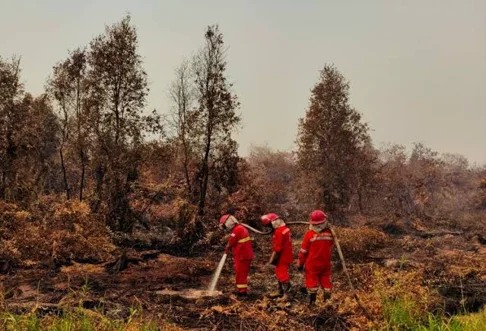
JurnalPost.com - Every time the dry season arrives, Indonesia seems trapped in the same scenario. Reports of fire hotspots begin to emerge, fire-prone area maps are updated, regional officials hold coordination meetings, joint teams are put on standby, and the public is urged not to burn land. However, only when smoke finally blankets the sky and spreads to urban areas does the state mobilize various efforts to extinguish the flames.
The problem is that these measures are often taken only after the damage has been done.
The recurring nature of forest and land fires (karhutla) shows that Indonesia still faces fundamental issues in environmental management. These fires are not sudden events but the result of a combination of dry weather conditions, peatland degradation, land clearing activities, weak oversight, and a tendency to act only after fires escalate into disasters.
Since early 2026, the Meteorology, Climatology, and Geophysics Agency (BMKG) has issued warnings regarding the potential for a drier and longer dry season than normal. The threat of El Niño, declining rainfall, and an increase in the number of hotspots are factors that require vigilance.
These warnings should serve as a basis for the government to strengthen preventive measures, especially in areas with a history of recurring fires.
Preparedness cannot be achieved merely through coordination meetings, public appeals, or data presentations. These efforts must be translated into field patrols, supervision of corporate activities, protection of peat ecosystems, and consistent law enforcement.
As long as policies remain oriented toward suppression rather than prevention, forest fires will likely continue to recur. The losses are not limited to the area of burned land but also include health disruptions, ecosystem damage, economic losses, and a decline in public trust in the state's ability to protect the environment.
Smoke Obscuring Fundamental Issues
In October 2026, smoke from forest fires was still reported in several regions of Sumatra and Kalimantan, even extending to parts of Sulawesi, Maluku, and Papua. Haze was also reported in the Greater Jakarta area.
The government has implemented various handling efforts, including weather modification operations to help control the impact of fires and haze.
Such steps are important to reduce threats to public health. However, emergency response cannot replace addressing the root causes of the fires.
Smoke originates from burning vegetation and land, including peat, which can burn beneath the soil surface. When smoke spreads to areas far from the fire source, the problem is no longer limited to the location where the fire started.
This condition highlights the importance of early response. Hotspots must be addressed immediately, drying peatlands require management, and high-risk activities must be strictly supervised.
Ultimately, forest fires are not just an environmental issue. They involve spatial planning, licensing, natural resource management, law enforcement, and the state's responsibility to protect its citizens.
Law Enforcement Figures That Cannot Be Ignored
Data released by the National Police's Criminal Investigation Department (Bareskrim Polri) at the end of October 2026 shows the magnitude of the challenge in enforcing the law against forest fire cases.
The National Police reported the naming of 245 individual suspects and 20 corporations in the handling of forest fire cases across various regions of Indonesia.
In handling individual cases, there were 287 police reports with approximately 5,859.12 hectares of burned land. Meanwhile, cases related to corporations involved 104 police reports with burned land reaching 29,168.78 hectares.
Of the 20 corporations named as suspects, four are foreign investment companies and 16 are domestic companies.
These figures show that the issue of forest fires cannot be solely attributed to land-clearing practices by local communities or small-scale farmers.
Burning practices by individuals must still be addressed through legal approaches, education, and the provision of alternative land management methods. However, attention to corporate responsibility must not be ignored.
The area of burned land recorded in corporate cases indicates a structural dimension to the forest fire problem. Plantation management, land ownership, licensing systems, and business activity oversight require serious attention.
Land clearing by burning is often considered a practical and cheap method. Fire can clear shrubs, plant debris, and vegetation in a relatively short time. However, these economic benefits can lead to far greater social and ecological losses.
If land burning is still considered profitable while the sanctions imposed do not provide a sufficient deterrent effect, the practice will likely continue.
Therefore, law enforcement must not stop at the perpetrators in the field. Authorities need to trace the parties who issued orders, control the land, derive economic benefits, and hold responsibility for the management of the burned areas.
Peatlands and the Threat of Recurring Fires
One of the reasons forest fires in Indonesia are difficult to control is the characteristic of peatlands.
Peat is an ecosystem capable of storing large amounts of water and carbon. However, when it undergoes degradation or drying, peat becomes highly susceptible to fire.
Fire on peatlands can spread beneath the soil surface. This type of fire is difficult to extinguish because embers can persist even if the surface fire appears to be out.
This condition causes peat fires to potentially produce thick smoke for a long time. The smoke can then be carried by the wind to reach areas far from the fire location.
The BMKG has emphasized the importance of strengthening forest fire management, especially in peat areas. Information regarding fire-prone areas should be used as a basis for decision-making.
Fire risk maps need to be used to determine patrol priorities, the placement of firefighting personnel, the supervision of land clearing activities, and the control of fire sources.
In addition, peat restoration must be carried out sustainably.
Rewetting peatlands, building and maintaining boreholes, controlling canals, and supervising drainage are part of efforts to maintain the hydrological balance of the ecosystem.
Peat with maintained moisture levels has better resistance to fire. Conversely, peat that is continuously drained can become a source of recurring fires.
The Impact of Forest Fires on Public Health
Discussions about forest fires often focus on the number of hotspots or the area of burned land. Yet, the impact closest to people's lives is the threat to health.
Fire smoke contains various air pollutants, including fine particulate matter PM2.5, which can enter deep into the respiratory system.
The Ministry of Health explains that exposure to forest fire smoke can cause eye irritation, coughing, shortness of breath, respiratory tract disorders, and exacerbate pre-existing illnesses.
Children, pregnant women, the elderly, and those with respiratory diseases are groups that require special protection.
For people living near fire locations, smoke is not just a temporary nuisance. Exposure can last for days or even weeks.
In these conditions, many residents must still carry out their daily activities. Farmers must work, laborers seek income, and children still need access to education.
The use of masks and air quality monitoring are important protective steps. However, they do not completely eliminate the risk of exposure.
Not all members of the public have access to adequate masks, air purifiers, or safer temporary housing.
This situation reveals an inequality in the impact of forest fires. Communities not involved in burning activities can be the ones who bear the most losses.
Forest fires are thus also an issue of environmental justice. The fundamental question is who benefits from land management and who bears the costs of health and environmental damage.
A Health Crisis That Should Not Be Underestimated
Forest fire smoke is often seen as a nuisance that will end when rain falls or the sky clears.
In reality, the health impacts do not always stop when the smoke disappears.
Short-term exposure can cause irritation, coughing, and respiratory distress. Meanwhile, repeated exposure has the potential to worsen health conditions, especially in vulnerable groups.
In children, air pollution can interfere with lung function development. In the elderly and those with chronic diseases, such exposure can increase the risk of health deterioration.
Several studies also show a link between exposure to particulate pollution from fires and an increased risk of serious health problems, including premature death.
Therefore, public health protection should not only be carried out when the number of patients begins to rise.
Community health centers (Puskesmas) and hospitals in fire-prone areas need to receive support early, including the availability of medicines, oxygen, personal protective equipment, and health workers.
Schools also need to have clear procedures to adjust learning activities when air quality worsens.
Health protection must be an important part of the strategy for preventing and handling forest fires, not just an additional measure after a disaster occurs.
When Fires Disrupt the Economy
Forest fires also have broad economic impacts.
Haze can disrupt flights, hinder outdoor activities, reduce worker productivity, and affect education, agriculture, and tourism.
For people who rely on daily activities for income, these disruptions can directly affect their ability to meet their family's needs.
Economic losses due to forest fires are often spread across various sectors, so they are not all captured in a single official report.
However, the impact remains real for people who lose income, suffer health problems, or have to spend extra money to protect themselves from the smoke.
Therefore, forest fire prevention needs to be viewed as a long-term investment.
Budgets for patrols, peat restoration, corporate oversight, and community empowerment can help reduce the potential for much larger losses due to firefighting, healthcare, transportation disruptions, and environmental recovery.
The problem is that political and budgetary attention often increases only when a crisis has occurred.
This pattern needs to change. Prevention must be a policy priority before the dry season, not just a response when fires have spread.
Local Government as the Front Line
The central government has responsibility for national policy formulation, law enforcement, data provision, and inter-agency coordination.
However, local governments play a crucial role in the implementation of forest fire prevention.
Provincial and regency/city governments have proximity to field conditions. They can identify vulnerable areas, monitor land management activities, and understand the social characteristics of local communities.
Unfortunately, the level of preparedness between regions is not always the same.
There are regions that are active in carrying out patrols and oversight, but there are also challenges in the form of limited budgets, personnel, and coordination.
Local governments need to receive adequate support. However, that support must be accompanied by evaluation and accountability mechanisms.
When a region continues to experience recurring fires, an assessment of the effectiveness of oversight, licensing management, peat protection, and community involvement is necessary.
Forest fires cannot be solved through circular letters alone. Prevention requires the real and sustainable presence of the government in the field.
The Community Must Be a Partner in Prevention
The approach to handling forest fires should not just place the community as the party being restricted.
Local communities have knowledge about land conditions, seasonal changes, vegetation, and regional characteristics that can support prevention efforts.
Indigenous communities, farmers, and residents around forest areas need to be involved in early monitoring, sustainable land management, and environmental restoration.
This involvement must also consider aspects of economic justice.
The ban on burning land needs to be followed by the provision of alternatives that allow communities to cultivate land without using fire.
The government can strengthen no-burn agriculture programs, provide land cultivation equipment, support the use of compost, and provide technical assistance to farmers.
Incentives for communities that successfully protect forest areas also need to be considered.
Forest fire prevention will be more effective when communities have the ability and economic interest to protect the environment.
Corporate Responsibility Does Not End with Naming Suspects
Naming 20 corporations as suspects in forest fire cases is an important step in the law enforcement process.
However, naming suspects is not the end of the effort to achieve environmental justice.
The legal process must be transparent, objective, and respect the presumption of innocence.
The public has the right to obtain information regarding case developments, alleged violations, legal process stages, as well as verdicts and sanctions that have legal force, in accordance with information disclosure provisions.
Law enforcement against corporations must also consider the magnitude of the environmental damage caused.
In addition to criminal and administrative sanctions according to legal provisions, environmental restoration is an aspect that must not be ignored.
The principle of polluter pays principle or the polluter-pays principle confirms that parties responsible for environmental pollution or damage need to bear the costs of mitigation and restoration in accordance with applicable law.
In the context of forest fires, this approach is important so that environmental losses are not entirely borne by the state and the public.
Corporations must understand that land management is not only related to production and profit but also carries the responsibility to maintain the safety of the environment and the community.
Integrating Data to Strengthen Policy
Indonesia has various data sources that can support forest fire prevention.
The BMKG provides weather information and the potential for fire-prone areas. The police have case handling data. The Ministry of Forestry manages information related to forest areas, while the National Disaster Management Agency (BNPB) has disaster data.
Local governments also collect information regarding field conditions and community activities.
The challenge is to ensure that this data can be utilized in an integrated manner.
When information between agencies is not well connected, the response to fire threats can be slow and uncoordinated.
Data integration regarding hotspots, air quality, peat conditions, land management permits, public reports, and fire handling status needs to be strengthened.
An integrated information system can help the government determine action priorities while increasing transparency.
Public access to information that can be disclosed according to regulations is also important to encourage social oversight and strengthen environmental management accountability.
Shifting Orientation from Suppression to Prevention
The success of handling forest fires is often seen from the number of hotspots successfully extinguished or the area of land secured.
Yet, a more fundamental measure of success is the ability to prevent fires before they occur.
Prevention does not always result in activities that look dramatic.
There are no helicopters dropping water, no firefighting teams struggling against flames, and no large-scale emergency operations when fires are successfully prevented.
However, that is precisely the main goal of disaster risk management.
Prevention budgets must be available before the dry season. Patrols need to be increased before hotspots increase. Peat restoration must take place before land dries out, while oversight of business activities needs to be carried out consistently.
This approach requires long-term commitment, inter-agency coordination, and continuous evaluation.
Breaking the Cycle of Impunity
Forest fires have the potential to recur if the responsible parties do not face legal consequences commensurate with the proven violations.
Law enforcement must be able to provide certainty while preventing recurrence.
When environmental violations are proven to lead to effective sanctions, restoration obligations, and other legal consequences, business actors have a stronger incentive to improve their land management.
However, law enforcement must also be carried out fairly.
The state should not only focus on individual actors with limited economic means while the alleged involvement of parties with greater capital power is not thoroughly investigated.
The principle of equality before the law must be applied in every case handling process.
At the same time, law enforcement needs to be accompanied by strengthening the oversight system so that violations can be prevented from the start.
Forest Fires Are Not a Fate to Be Accepted
Weather changes, long dry seasons, and the El Niño phenomenon can indeed increase the risk of forest and land fires.
However, natural conditions are not the only factor that determines the occurrence of disasters.
Human activity, land management, licensing policies, oversight, and the quality of law enforcement also influence the level of vulnerability and the magnitude of fire impacts.
Therefore, forest fires should not be considered an annual event that cannot be avoided.
Fires can be prevented through responsible environmental management, protection of peat ecosystems, community involvement, and consistent law enforcement.
Indonesia is not lacking information regarding forest fire risks. Various agencies have provided early warnings, mapping of vulnerable areas, and environmental monitoring data.
The biggest challenge is ensuring that all this information is truly translated into action.
Law enforcement is still necessary, but it is not enough if it stands alone. The state must also build a strong prevention system, improve land governance, and ensure that all parties carry out their responsibilities.
Ultimately, the state's success in handling forest fires is not measured only by how quickly fires are extinguished, but by how capable it is of preventing the public from becoming victims again.
Forest fires are not fate. They are a problem that can be prevented through the right decisions, the courage to enforce the law, and a commitment to place human safety and environmental sustainability above short-term interests.
References
National Police Public Relations. Bareskrim Polri Names 245 Individual Suspects and 20 Corporations in Forest Fire Cases. https://humas.polri.go.id/news/detail/2647043-bareskrim-polri-tetapkan-245-tersangka-perorangan-dan-20-korporasi-dalam-kasus-karhutla
Ministry of Health of the Republic of Indonesia. Health Minister: Wear Masks and Monitor Air Quality to Prevent the Impact of Forest Fire Smoke. https://kemkes.go.id/eng/menkes-pakai-masker-dan-pantau-kualitas-udara-untuk-cegah-dampak-asap-karhutla
Jurnal Justitia. https://jim.stebisigm.ac.id/justitia/article/view/1020
Ministry of Forestry. Government Strengthens Integrated Forest Fire Operations in Kalimantan, Increases Air Support and Ground Suppression.
Author Identity
Name: Rts Naila Rahmawati
Place, date of birth: Sembubuk, 17 November 2007
Institution: Jambi University
Faculty: Law
Study program: Law
Status: Student








Comments 0
Write a Comment Share your response