

JurnalPost.com - Turnover is up and orders are pouring in, yet business profits remain stagnant. This scenario is a common challenge for Micro, Small, and Medium Enterprises (SMEs). When this happens, rising raw material costs are usually the first suspect.
However, not all profit issues stem from external factors. Unbeknownst to many, a portion of business costs arises from inefficient production activities, ranging from excessive raw material usage and inventory buildup to wasted work time caused by disorganized equipment layouts.
The problem is that many SME owners are too busy with daily operations to evaluate their production processes. Small instances of waste are eventually accepted as normal. If left unchecked, these accumulated costs can significantly erode business profits.
One approach that can be used to address these issues is Lean, a process management method that emphasizes efficiency, waste reduction, and increasing value for customers.
Understanding Lean and Its Core Principles
The Lean concept has historical roots in the Toyota Production System (TPS), a production system developed by Toyota in Japan, primarily through the contributions of Taiichi Ohno and several other figures.
In the post-World War II era, the Japanese automotive industry faced limited resources and the need to produce goods efficiently. This condition drove the development of a production system capable of minimizing waste without sacrificing quality.
The core principle of Lean is actually quite simple: maximize activities that provide added value to the customer while reducing unnecessary activities.
In the context of SMEs, this approach is highly relevant because most small businesses operate with limited capital, labor, and production facilities.
For example, a customer buying bread does not really care how many times a worker has to walk to fetch a tray or how long flour has been stored in the warehouse. Customers care more about taste, quality, price, and the timeliness of product delivery.
This means that every activity consuming resources without providing added value needs to be evaluated. However, not all activities that do not directly provide value to the customer can be eliminated, especially those necessary to maintain safety, quality, and business compliance.
Seven Types of Waste in Production Processes
In the Lean concept, waste is known by the term muda. Traditionally, there are seven types of waste frequently found in production processes.
1. Overproduction
Waste occurs when a business produces goods exceeding customer needs or demand. For food SMEs, this condition can lead to unsold products, loss of freshness, and eventual disposal.
2. Waiting
Workers must stop activities because raw materials are unavailable, machines are still in use, or the previous process is not yet complete. This waiting time causes productivity to decline.
3. Transportation
Excessive movement of raw materials or products can prolong work processes. For instance, workers may repeatedly carry materials from the warehouse to the kitchen because the production layout is ineffective.
4. Overprocessing
Waste arises when work is performed excessively without increasing the product's benefit to the customer. An example is repeating work stages that could actually be simplified.
5. Inventory
Purchasing raw materials in large quantities sometimes offers price advantages. However, without proper management, excessive inventory increases storage costs and the risk of damage or expiration.
6. Motion
Workers move too often, bend over, or search for equipment because the workspace is disorganized. Unnecessary movement can extend production time and increase fatigue.
7. Defects
Products that do not meet quality standards potentially cause losses because they must be repaired, reproduced, sold at a lower price, or discarded.
These seven types of waste often seem simple when viewed individually. However, when they occur daily, their impact can burden business operational costs.
Therefore, the first step toward efficiency is not always buying new machines or adding workers, but rather identifying activities that have been absorbing costs without producing comparable benefits.
Implementing Lean Does Not Have to Be Expensive
One of the advantages of the Lean approach is that its implementation does not always require advanced technology or large investments. SME owners can start through simple changes in work habits.
The initial step is to observe the entire production flow, from the moment raw materials are received until the product is ready for market. From these observations, business owners can note activities that take too long, consume materials excessively, or cause production errors.
Furthermore, SMEs can implement the 5Smethod, namely Seiri (Sort), Seiton (Set in order), Seiso (Shine), Seiketsu (Standardize), and Shitsuke (Sustain).
Through this method, unnecessary equipment is separated, items used are placed in easily accessible locations, and the cleanliness and order of the work environment are maintained consistently.
In addition to workspace organization, recording customer demand is also an important part of production control. Daily or weekly sales data can help business owners estimate raw material needs and determine production quantities more rationally.
Simple standard operating procedures are also needed to ensure consistent production results. For example, a culinary business can establish ingredient measurements, processing durations, and quality inspection procedures before products are packaged.
These improvements align with the principle of kaizen, which is the effort to make small, continuous changes to produce better work processes.
Thus, SMEs do not have to change their entire production system at once. Improvements can start from the most frequent problem, and the results can be evaluated before moving on to other areas.
Learning from a Home-Based Bakery Illustration
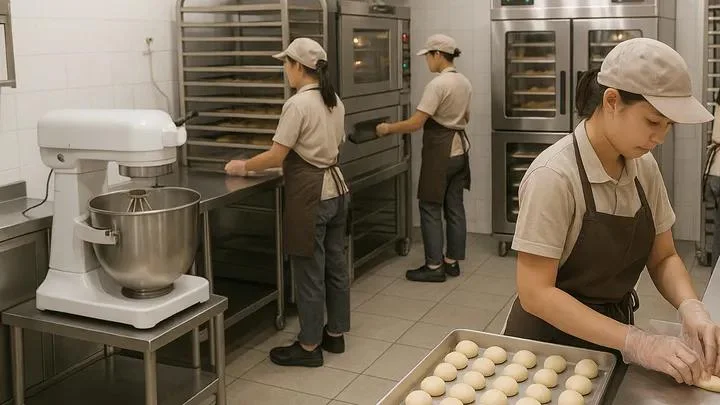
To understand its application, imagine a home-based bakery that produces 100 loaves of bread every day because the owner is worried about running out of stock.
After recording, it turns out that average sales only reach 80 loaves per day. This means there are about 20 loaves that potentially go unsold every day if demand remains at that level.
On the other hand, the production process is often hampered because workers have to search for trays, mixers, and other equipment that are not stored in an organized manner.
Through the Lean approach, the business owner begins recording sales patterns, adjusting production quantities, and rearranging equipment positions according to the order of use.
These changes have the potential to reduce wasted materials, lower the number of unsold products, and speed up work processes.
This example is an illustration, not research results or data from a specific SME. In practice, production decisions still need to consider demand fluctuations, special orders, and safety stock requirements.
The same principles can be applied to various business fields, ranging from catering and garment manufacturing to crafts and bottled beverage production.
Each sector certainly has different characteristics, but all can benefit from more measurable and organized work processes.
Efficiency Does Not Mean Reducing Quality
Lean implementation is sometimes misinterpreted as an effort to cut costs as much as possible, including by reducing material quality or limiting labor.
In reality, the main goal is not just to cut expenses, but to eliminate activities that do not provide added value while maintaining or improving product quality.
In the Lean concept, defective products are actually a form of waste that needs to be prevented. This means quality control must be part of the production process, not just performed when the product is finished.
For SMEs, consistent product quality plays an important role in building customer trust. Products that meet consumer expectations can increase the likelihood of repeat purchases and strengthen the business's reputation.
Therefore, savings made through Lean should be directed at inefficient processes, not at aspects that determine customer safety and satisfaction.
Starting Change with the Simplest Things
Increasingly tight business competition demands that SMEs not only focus on increasing sales but also understand how costs arise during the production process.
Before deciding to add capital, expand production capacity, or raise selling prices, business owners can first evaluate whether there is waste that can actually still be reduced.
Start by recording the number of unsold products, measuring the time required to complete one order, or observing how often workers have to stop activities due to equipment constraints.
Such simple records can serve as a basis for more accurate decision-making.
Involving workers in the evaluation process is also important because they deal directly with operational activities and often know about problems that are not visible to the business owner.
Ultimately, Lean is not just a production method, but a mindset for continuously improving work processes.
For SMEs, efficiency does not have to start with large investments. Sometimes, the most significant steps come from the courage to evaluate old habits and consistently fix one small instance of waste.
Because increasing profits does not always mean having to sell more. Sometimes, profits can increase when a business learns to reduce what has been wasted all this time.








Comments 0
Write a Comment Share your response