


By: Muhamad Marlo Yuda Pratama
Student, Faculty of Law, Mulawarman University
Student ID: 2608016021
JurnalPost.com - The price of oil palm Fresh Fruit Bunches (FFB) has once again become a focus for the government. Periodic price setting by provincial governments is fundamentally aimed at protecting farmers' income so that it is not entirely determined by market fluctuations or price manipulation at the buyer level.
However, behind this policy, there are still unresolved issues. Independent farmers remain in a relatively weak bargaining position within the palm oil trade chain.
Normatively, the FFB pricing mechanism has provided certainty for farmers who have partnership agreements with companies. They can obtain prices based on the K-index and the decisions of the FFB pricing team.
The problem is that these benefits are not fully felt by independent farmers who do not have direct partnership relationships with palm oil mills (PKS).
For some independent farmers, the choice of where to sell their harvest still depends on intermediaries or middlemen. This condition can cause the prices received by farmers to fall below the government's reference price.
If this condition persists, the goal of setting FFB prices to provide protection for farmers' income will certainly not be achieved optimally.
The Bargaining Position of Independent Farmers
The issue of pricing cannot be separated from the position of farmers in the distribution chain.
Farmers who lack direct access to mills tend to have more limited buyer options. Dependence on intermediaries means farmers do not always have sufficient room to decide to whom their harvest will be sold and at what price.
On the other hand, farmers also face various production costs.
Fertilizer prices, transportation costs, and plantation maintenance expenses continue to be significant components of plantation activities. Therefore, an increase in FFB prices does not automatically improve farmers' welfare if net profits are still eroded by high production costs.
This condition shows that the issue of oil palm farmer welfare cannot be viewed solely from the FFB price figures announced periodically.
What also needs attention is the price actually received by farmers in the field after passing through the distribution chain and being deducted by various costs.
Oversight Must Reach the Farmer Level
In East Kalimantan, oversight of FFB price implementation needs to be strengthened down to the level of farmer transactions.
Oversight is important so that the government's reference price does not just remain an administrative figure, but has a real impact on farmers' income.
In addition, strengthening cooperatives and legally incorporated farmer groups can be a step toward improving the bargaining position of independent farmers.
Through stronger institutions, farmers have a greater opportunity to organize their harvests, strengthen production capacity, and open up more direct marketing access to mills.
This condition can reduce farmers' dependence on overly long trade chains.
Cooperatives and farmer groups can also serve as a forum to advocate for farmers' interests collectively, including obtaining information on prices, improving harvest quality, and building more balanced business relationships with companies.
Legal Protection and Fair Trade
Strengthening the position of independent farmers is not enough just by setting prices.
Regulations need to be consistently monitored so that policies designed to protect farmers are truly applied in FFB trading practices.
Such protection is important because farmers are one of the parties at the beginning of the palm oil industry chain.
Without adequate bargaining power, farmers risk remaining the party that receives the smallest share of the economic value created in the business chain.
Therefore, price monitoring, strengthening farmer institutions, and expanding independent farmers' access to mills must go hand in hand.
Thus, the palm oil trade will not only be oriented toward price certainty on paper, but also toward the creation of fairer trade relations.
Ultimately, the success of the FFB pricing policy cannot be measured solely by the figures set by the government.
A more important measure is the extent to which independent farmers truly obtain price certainty, have choices in selling their harvests, and feel the economic benefits of the policy.
When farmers have better market access and a stronger bargaining position, legal protection for planters no longer remains just a normative concept.
It can be present in the real lives of farmers.
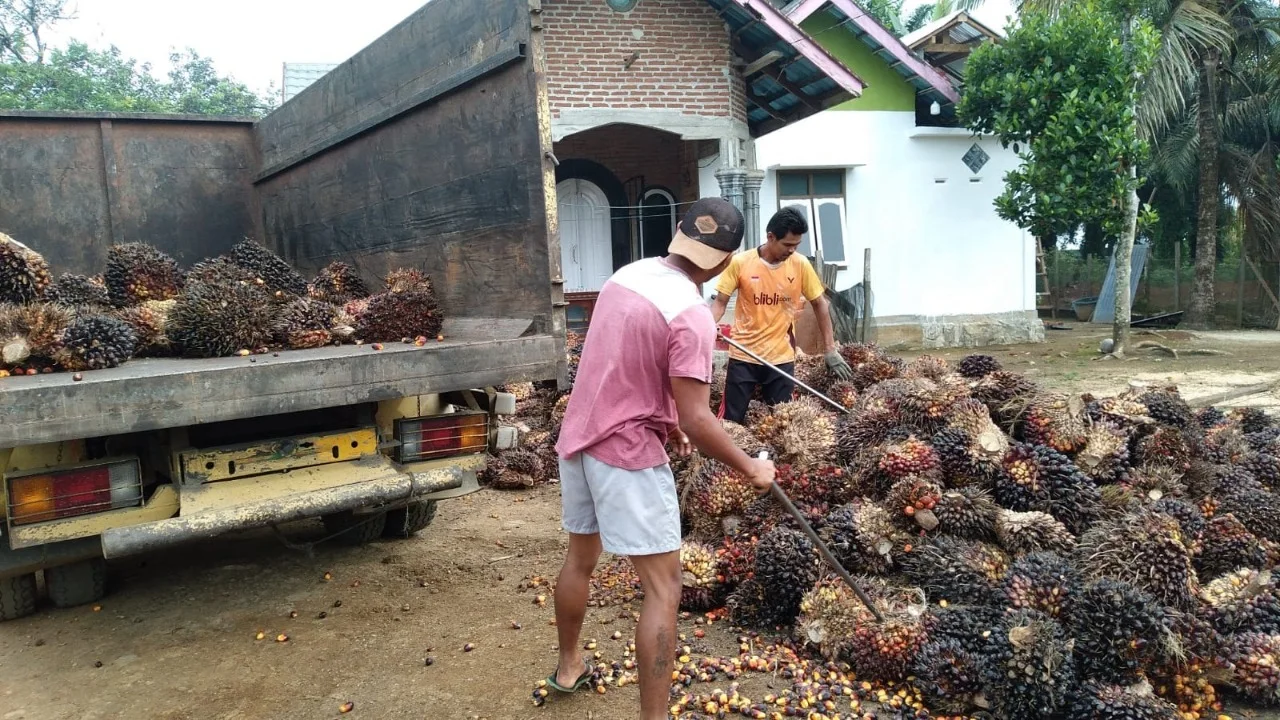
Documentation of Oil Palm Planters in the Plantation
Documentation shows the process of harvesting and transporting fresh fruit bunches (FFB) by oil palm planters before the harvest is taken to the mill. This activity illustrates the role of oil palm plantations as a source of livelihood for the community as well as the importance of protection and FFB price oversight for independent farmers.
Author Biography
Muhamad Marlo Yuda Pratama is a student of the S1 Law Study Program, Faculty of Law, Mulawarman University. He has an interest in agrarian law issues, public policy, and the protection of community rights. Through this opinion piece, the author encourages the strengthening of legal protection and the improvement of the bargaining position of independent farmers in the palm oil trade in East Kalimantan.






Comments 0
Write a Comment Share your response