

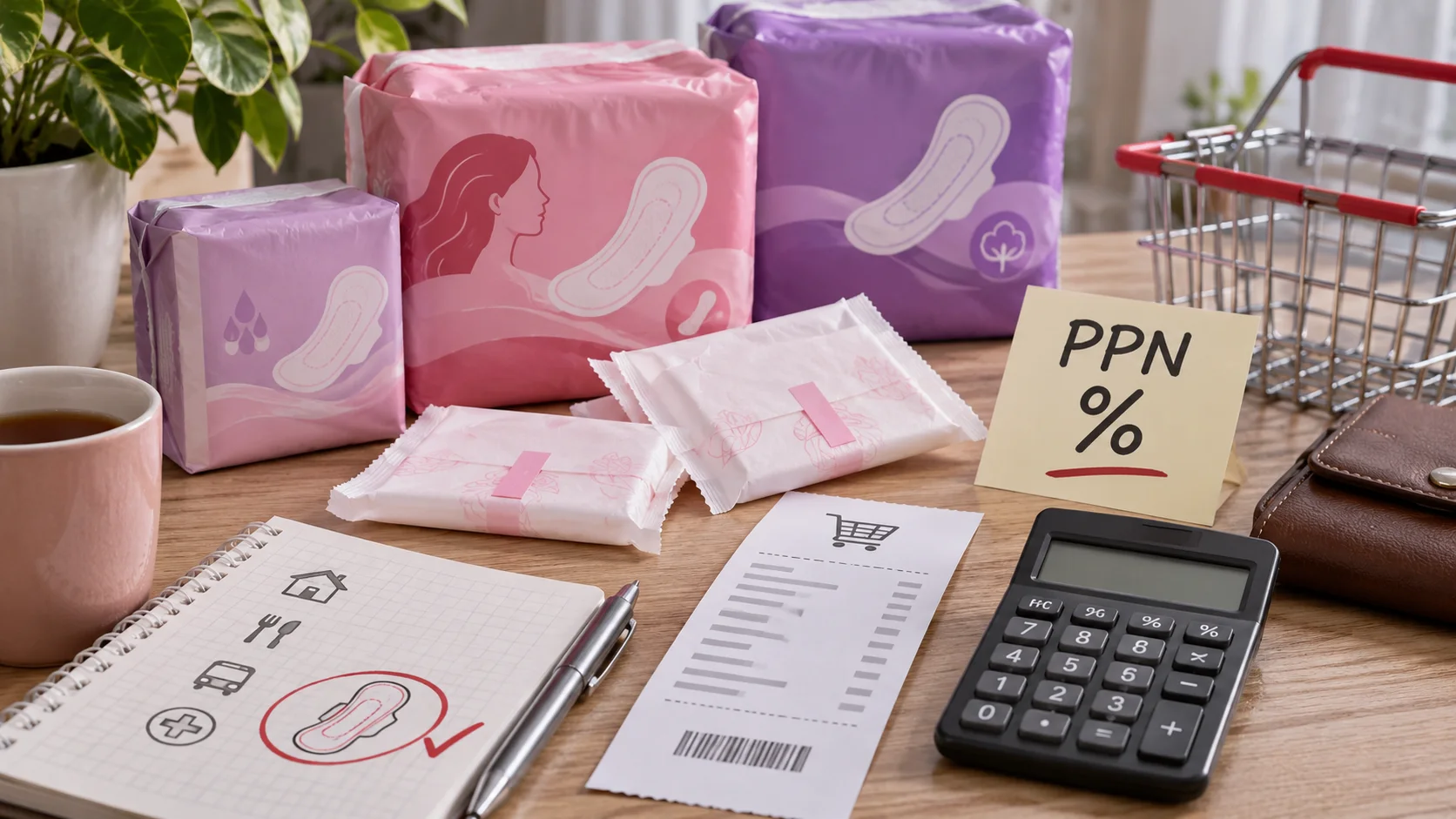
JurnalPost.com - Menstruation is a natural biological process experienced by women. Every month, millions of women must secure supplies to maintain hygiene and health during their menstrual cycle. One of the most common products used is the sanitary pad. Yet, who would have thought that this unavoidable necessity is still subject to Value Added Tax (VAT)?
In late October 2026, the issue of the sanitary pad tax became a trending topic on social media. Many citizens questioned why items related to women's biological needs are still taxed, especially when their use is not merely a choice or a preference.
The question may sound simple. However, upon closer inspection, this issue touches upon tax policy, the economic capacity of the public, reproductive health, and social justice.
To me, the discussion regarding the sanitary pad tax should not stop at whether the tax amount is large or small. There is a more fundamental question: does current policy sufficiently consider the needs of women from diverse economic backgrounds?
Why Are Sanitary Pads Still Subject to VAT?
On 29 October 2026, the Directorate General of Taxes (DJP) provided an explanation regarding the imposition of VAT on sanitary pads sold in Indonesia.
The DJP explained that sanitary pads are classified as Taxable Goods (BKP). For non-luxury items, the VAT rate applied is 12 percent with a tax base of 11/12 of the selling price. With this calculation, the effective VAT burden remains at 11 percent.
Sanitary pads are also not yet included in the group of goods that receive VAT exemption facilities under current regulations.
This means that the imposition of VAT on sanitary pads is not a new tax specifically introduced in October 2026. These products have long been part of consumer goods subject to VAT.
From a tax regulation standpoint, this explanation is understandable. However, from the perspective of public needs, I feel there are still points worth questioning.
Should all consumer goods be treated with the same consideration? Is there not a distinction between goods purchased out of desire and goods that must be used to fulfill biological needs?
Sanitary pads are not luxury goods. Women do not buy them to follow trends or enhance their lifestyle. These products are needed regularly to support hygiene and comfort during menstruation.
Therefore, in my view, menstrual needs deserve special attention in the formulation of tax policy.
A Small Burden That Recurs Every Month
For women with sufficient income, the cost of purchasing sanitary pads may not significantly affect their financial condition.
However, the situation is different for women living with economic limitations.
Students dependent on allowances, university students managing monthly expenses, low-income workers, and women from underprivileged families certainly have varying financial circumstances.
Every month, they must set aside money to buy sanitary pads amidst other needs such as food, transportation, education, and household expenses.
At a glance, the tax on one pack of sanitary pads may seem small. However, these purchases are a recurring necessity that continues for years.
A burden that is small for some is not necessarily small for others.
The issue is not just how many rupiahs in tax must be paid, but how this additional cost affects a woman's ability to meet her basic needs.
In my opinion, fair policy must consider the reality that every citizen does not have the same economic capacity.
Lawsuit to the Constitutional Court and DPR Response
The debate over the sanitary pad tax has also reached the legal realm.
On 2 November 2026, the Constitutional Court registered a petition for judicial review of Law Number 7 of 2021 concerning the Harmonization of Tax Regulations, filed by Bernita Matondang under case number 406/PUU-XXIV/2026.
The petition challenges the regulation of basic necessities that receive tax facilities, including the lack of adequate accommodation for menstrual hygiene needs.
This case is one of the public's efforts to question whether tax regulations have proportionally considered women's biological needs.
Attention to this issue has also come from the Speaker of the Indonesian House of Representatives (DPR RI), Puan Maharani.
On 5 November 2026, Puan requested that the government use public aspirations regarding the sanitary pad tax as material for consideration in evaluating policy.
“Sanitary pads are a primary need for women concerning their biological or reproductive cycle. Therefore, sanitary pads are not secondary goods,” said Puan in a statement published by the DPR RI.
This statement shows that the issue of sanitary pads is no longer just a topic of conversation on social media, but has gained attention in public policy discussions.
Nevertheless, these discussions and legal challenges have not automatically changed the prevailing VAT provisions.
Taxes Are Important, but Social Justice Must Also Be Considered
I understand that taxes are an important source of state revenue. Through taxes, the government can fund infrastructure development, education, health, and various other public services.
Therefore, criticism of the sanitary pad tax does not mean that the public rejects the obligation to pay taxes as a whole.
The issue is how the government determines which goods deserve certain tax facilities or treatment.
In my view, tax policy should not only consider the aspect of state revenue. The government also needs to look at its impact on groups of people with different economic conditions and needs.
Sanitary pads are related to menstrual hygiene, reproductive health, and needs that must be met periodically.
If access to menstrual products becomes difficult due to economic limitations, the problem can expand from mere household expenses to issues of women's health and well-being.
This is where the importance of considering social justice in tax policy lies.
Justice does not always mean providing identical treatment to every type of good. In certain conditions, differences in characteristics and public needs should actually be the basis for determining policy.
Seeking Solutions That Better Support Women's Needs
In my opinion, the government can consider several alternatives to increase the affordability of menstrual products.
One of them is to study the possibility of providing VAT exemption facilities for sanitary pads and other menstrual hygiene products.
Such an alternative must certainly be accompanied by an analysis of its impact on state revenue and the extent to which the benefits are truly felt by consumers.
In addition, the government can also consider providing menstrual products for women from underprivileged families.
Providing sanitary pads through health facilities, schools, or social assistance programs designed to be well-targeted could be a viable option to explore.
However, such policies should not stop at the provision of goods alone. The government also needs to pay attention to access to information regarding menstrual hygiene and the availability of adequate sanitation facilities.
Another thing that is no less important is involving women from various groups in the policy evaluation process.
The experiences of students, university students, informal workers, low-income women, and communities in areas with limited access can provide a real picture of the problems they face.
By listening to these experiences, the government can have a more complete basis for consideration before making decisions.
Menstruation Is Not a Choice, Its Needs Must Be Addressed
Ultimately, the debate over the sanitary pad tax is not just about discussing the amount of VAT listed in the price of a product.
This issue invites us to question how state policy understands women's biological needs and their impact on daily life.
Menstruation is not something chosen by women. However, the needs that arise during this process must still be met, regardless of whether someone comes from a wealthy or underprivileged family.
I do not deny the importance of tax revenue for national development. However, I hope the government can reconsider the tax treatment of menstrual products by paying attention to aspects of health, affordability, and social justice.
Because the measure of a policy's success lies not only in its ability to generate state revenue, but also in how that policy considers the needs of the community.
For me, sanitary pads are not just goods to be traded. They are part of a woman's basic needs that deserve serious attention in public policy.







Comments 0
Write a Comment Share your response