


JurnalPost.com - Between lectures, a student's phone screen lights up. A notification from a group chat reads: "info login!" Those two words are enough to get their thumbs moving, even before they have a chance to consider whether today's assignments are finished or how many hours of sleep they have left tonight.
For online gamers, especially those playing team-based games like Mobile Legends, "info login!" is a common invitation to jump in and play together. The phrase has become part of the community's communication culture. For some students, such invitations are merely a distraction. However, for others, opening the game has become an automatic response that occurs before they make any conscious decisions. That is the point where "info login" shifts from a casual invitation to a red flag, as the urge to log in arises faster than any rational consideration.
Playing games is fundamentally a normal recreational need. Problems arise when this activity no longer functions as recreation. The World Health Organization (WHO) included gaming disorder in the International Classification of Diseases 11th edition (ICD-11) as a pattern of play characterized by impaired control, increasing priority given to gaming over other activities, and the continuation of gaming despite the occurrence of negative consequences. This pattern is generally observed over a period of at least 12 months (WHO, 2020). This means that long playing hours alone are not proof of addiction.
Why are students vulnerable? University life combines significant schedule autonomy, loose supervision, and academic burdens that demand self-regulation. Yet, the prefrontal cortex, which serves as the center for self-control, is still developing in early adulthood. Gaming habits can easily shift without one realizing it.
Games offer quick feedback, measurable progress, and social recognition within minutes. University assignments offer the opposite: delayed results, vague measures of success, and rewards that only appear at the end of the semester. For a brain that places high value on immediate gratification, that discrepancy makes gaming always appear more attractive.
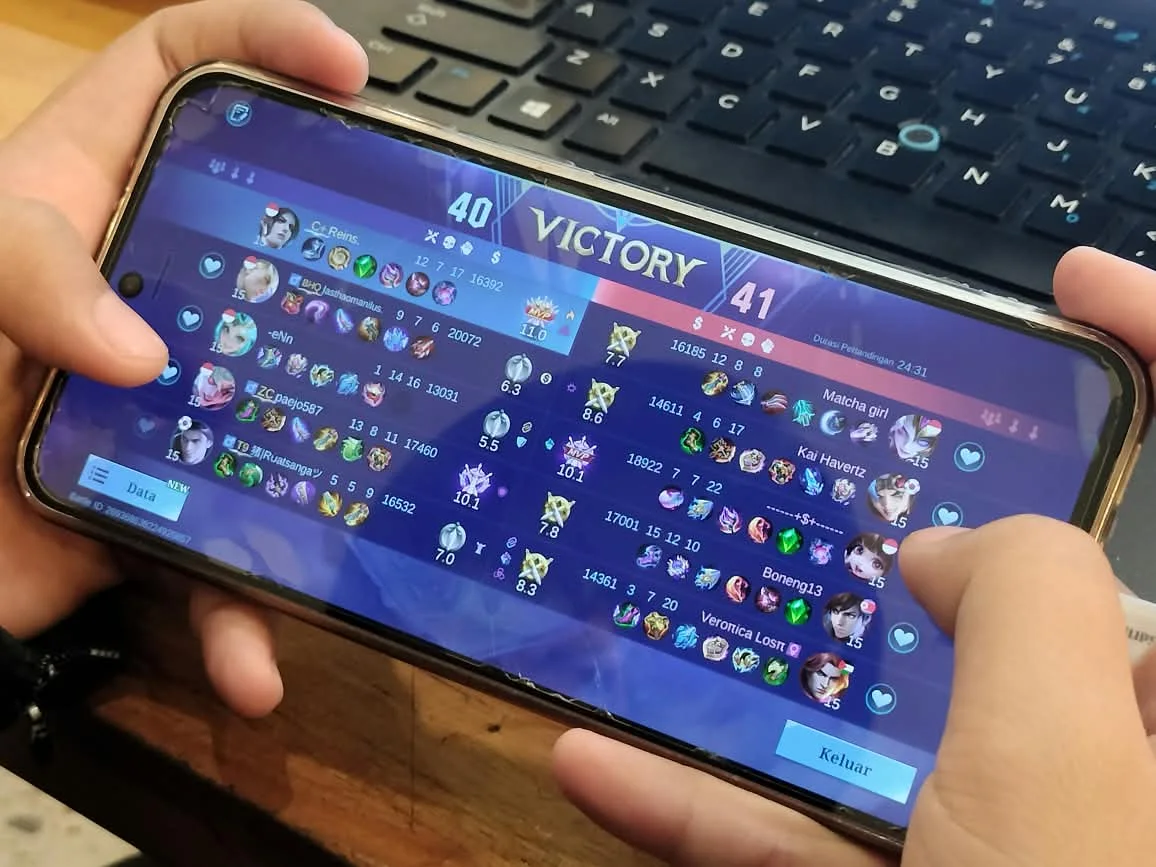
Brain imaging studies show that the tendency to choose immediate gratification is accompanied by lower activation of the dorsolateral prefrontal cortex, while game-related cues trigger activation of the anterior cingulate, which is associated with strong urges to play and a weakened ability to resist impulses.
Internal factors also play a role. If gaming is used to relieve stress, it becomes an increasingly dominant emotion regulation strategy, while other ways of coping with pressure are practiced less frequently.
So, does gaming automatically ruin academic achievement? The evidence is not that simple. In Indonesia, a study of 291 medical students at Mulawarman University did not even find a correlation between online gaming addiction and grade point averages (Putra et al., 2024). These results are not an excuse to be complacent; grade point average is only a crude measure.
More tangible losses occur before grades are released. Among students in China, online gaming addiction is associated with decreased learning engagement, and that decline is what subsequently weakens achievement motivation (Sun et al., 2023). What is eroded first is focus, mental presence in class, and enthusiasm for completing assignments.
From here, two preventive steps can be taken. First, for the students themselves: because cues play a major role in the addiction process, the most realistic step is to manage those cues. Record when, how long, and what triggers you to play over two weeks so that the "info login" pattern becomes clearly visible. Mute team groups and turn off notifications during study and sleep hours. Apply a simple rule: finish today's tasks first, then log in. Also, agree on playing hours with teammates so that declining an invitation no longer feels like a betrayal. If gaming is used to escape stress or feelings of falling behind, seek out campus counseling services.
Second, for universities: ideally, counseling services should be easily accessible and objective. Screening should also look at functional impairment, such as disrupted sleep, academic performance, and relationships, rather than just playing hours, so that students who simply enjoy gaming are not mislabeled.
Ultimately, online gaming addiction does not start with playing, but with the loss of control over the decision to play. The process is gradual, involving cues, habits, and how we manage pressure, and its impact on university life is first seen in focus and motivation, and only later in grades. Games are not the enemy, and students who find it hard to stop are not weak. Self-control is a skill that can be trained, and we have all been at the point where one invitation felt too difficult to refuse. Therefore, the question worth asking is not "how long do I play," but "who decided I should log in today?"










Comments 0
Write a Comment Share your response