

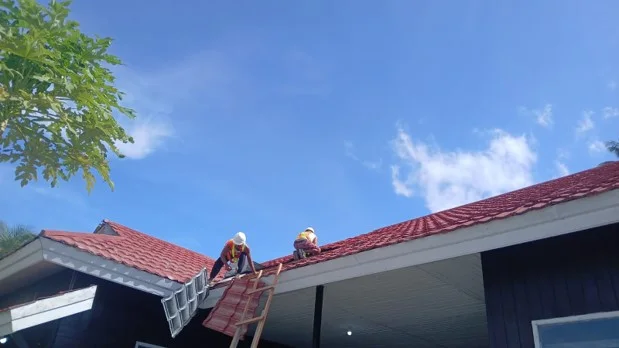
JurnalPost.com - Community health center (Puskesmas) renovation work is often categorized as a small project. The contract value may not be as high as that of hospital construction or high-rise buildings, and the scope of work might be limited to roof, ceiling, floor, service room, installation, or painting repairs. However, a small contract value and limited scope do not mean the safety risks are equally small.
At a renovation site, workers may face risks such as falling from heights, being struck by falling materials, electric shocks, dust exposure, injuries from tools, or slipping and tripping over construction debris.
At the same time, a community health center is a healthcare facility that may continue to receive patients, medical staff, and the public. Consequently, a single uncontrolled work area can endanger more than just the construction workers.
The critical question is: why is the aspect of Occupational Health and Safety (OHS) 3 still potentially treated as an afterthought in healthcare facility renovation work?
The Assumption That Small Projects Do Not Require Major Controls
One source of the problem is the assumption that small-scale work does not require serious safety management.
Because the work only lasts for a few weeks or touches only specific parts of the building, safety preparations are sometimes considered simple, or even limited to just providing helmets and vests.
In reality, the level of risk is not determined solely by the contract value or the size of the building. Replacing a roof still carries the risk of falling. Dismantling a ceiling still has the potential to drop materials and generate dust.
Repairing electrical installations still carries the risk of electric shock and fire. Even short-term work can lead to serious accidents if hazards are not identified and controlled.
OHS 3 should begin before workers enter the site, through hazard identification, risk assessment, the establishment of safe work methods, the division of responsibilities, and the inspection of equipment readiness.
Community Health Centers Are Not Empty Buildings
The nature of community health center renovations differs from work on unused buildings. In certain circumstances, healthcare services continue to operate while construction is underway.
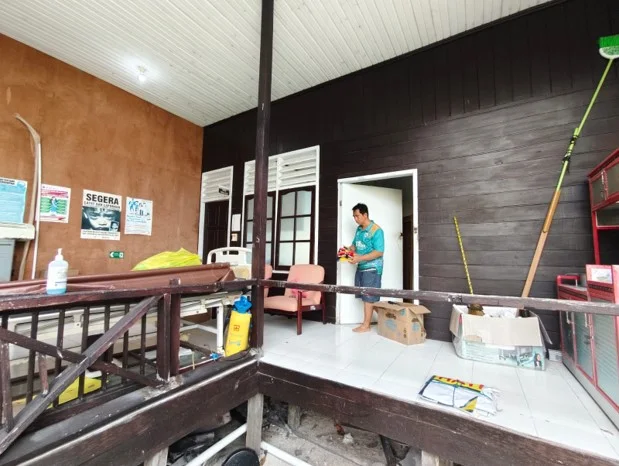
Patients arriving may include infants, pregnant women, the elderly, people with disabilities, or those who are ill. They are not always able to recognize hazards or avoid construction areas quickly.
Demolition dust can disrupt the comfort and cleanliness of the service environment. Noise can interfere with communication between staff and patients.
Materials placed in corridors can block access, while temporary cables or uneven floors can cause people to trip. If the construction area is not properly separated, project risks can shift into risks for patient and visitor safety.
Therefore, the community health center management and service providers need to agree from the start on whether services will continue, which parts must be temporarily closed, how patient and worker paths will be separated, and how evacuation and emergency access will remain available.
If risks cannot be controlled, rescheduling or temporarily relocating services must be considered.
PPE is Important, But Not the Only Answer
Compliance with using Personal Protective Equipment (PPE) is often the most visible aspect when assessing OHS 3.
Helmets, safety shoes, vests, gloves, and respiratory protection are indeed necessary according to the hazards faced. However, PPE cannot replace risk control at the source.
Work on a roof, for example, cannot be declared safe simply because the worker is wearing a helmet.
It is necessary to ensure that access is safe, ladders or scaffolding are appropriate and placed correctly, the condition of the work surface is checked, the area below is restricted, and fall protection is prepared according to the risk assessment results.
Similarly, demolition work needs to pay attention to the stability of the building structure, area security, dust control, and material handling.
In principle, safety must be built through work planning and control, not just by relying on the caution of the workers.
Who Must Ensure OHS 3 is Implemented?
The implementation of OHS 3 cannot be burdened on one party alone.
Service providers or contractors are responsible for planning and executing work safely, providing competent personnel, appropriate equipment, PPE according to risks, and hazard control in the field.
Supervising consultants need to inspect the execution of work and report findings that require improvement.
The Technical Implementation Officer (PPTK) and regional activity management agencies need to include safety aspects in contract control and monitoring, not just check physical progress, quality, schedule, and administration.
The Head of the Community Health Center needs to coordinate to protect patients, medical staff, visitors, and the continuity of services. The Health Office plays a role in coordination and ensuring that risks to healthcare services receive attention.
The division of roles must be clear from the beginning. When unsafe conditions are found, there must be a party authorized to take action, including requesting repairs or temporarily stopping hazardous activities according to their authority.
Do not wait for an accident to happen to determine who is responsible.
Measuring Success is Not Just About the Finished Building
Government projects must meet quality, time, cost, and contract requirements. However, the success of a community health center renovation is incomplete if the construction process ignores safety.
A building completed on time cannot be an excuse to tolerate workers working without protection, patients crossing dangerous areas, or evacuation routes blocked by materials.
OHS 3 supervision needs to be part of routine inspections. Findings must be recorded, the person responsible and the deadline for repairs determined, and then verified.
Near-miss incidents also need to be reported and studied because they can serve as a warning before more serious accidents occur.
Simple Steps That Cannot Be Compromised
In every community health center renovation project, at least the following things must be ensured:
Hazard identification and risk assessment are carried out before work begins, according to the type and condition of the location.
Construction safety plans and documents are prepared according to applicable regulations and the nature of the work.
The construction zone is separated from the service zone with clear barriers and signs.
Patient paths, emergency access, and evacuation routes remain safe and unobstructed.
Work at heights, demolition, and electrical work have specific work methods and controls.
PPE, equipment, ladders, scaffolding, and temporary installations are checked for their suitability.
Dust, noise, construction waste, and material placement are controlled so as not to disrupt services.
Periodic inspections, reporting of unsafe conditions and near-miss incidents, and follow-ups are carried out and documented.
The area is inspected before being handed over and reused to ensure there are no remaining hazards from the work.
Do Not Wait for an Accident to Consider It Important
Community health center renovations aim to improve facilities used to maintain public health. That goal will lose its meaning if the renovation process actually endangers workers, patients, medical staff, and visitors.
A small project is no excuse to lower safety standards. Precisely because the scope is often considered simple, supervision needs to ensure that no hazards escape attention.
Local governments, service providers, supervising consultants, PPTK, and community health center management need to build a common understanding: OHS 3 is not an additional matter after work begins, but part of the planning, implementation, supervision, and handover of work.
The project value may be small, but the value of human safety is never small. A community health center renovation can only be called successful if the building is improved without sacrificing the safety of the people working and active within it.
“Do not measure the success of a project only by the finished building, but also by the safety of everyone during the construction process.” — Nur Hamidah.
Regulatory References
Republic of Indonesia. Law Number 1 of 1970 concerning Occupational Safety.
Republic of Indonesia. Law Number 2 of 2017 concerning Construction Services and its amendments.
Republic of Indonesia. Government Regulation Number 50 of 2012 concerning the Implementation of the Occupational Health and Safety Management System.
Ministry of Public Works and Housing. Minister of PUPR Regulation Number 10 of 2021 concerning Guidelines for the Construction Safety Management System.
Ministry of Health of the Republic of Indonesia. Minister of Health Regulation Number 19 of 2024 concerning the Implementation of Community Health Centers.









Comments 0
Write a Comment Share your response