

JurnalPost.com The phrase “Jogja is in a waste emergency” serves as a reminder that the waste problem in Yogyakarta still requires serious attention. This issue is not only related to the sheer volume of waste generated daily but also to the limited processing facilities and the public's habits in managing waste.
Based on a study by the Ombudsman of the Republic of Indonesia for the Special Region of Yogyakarta (DIY) presented in October 2025, waste generation in Yogyakarta City reaches nearly 300 tons per day. Meanwhile, the effective processing capacity of all Waste Processing Units (UPS) is only about 150 tons per day.
This condition reveals a gap between the amount of waste produced and the capacity of processing facilities. This problem cannot be solved simply by adding more processing infrastructure; it also requires a change in how the community manages waste at the source.
The Ombudsman of the Republic of Indonesia for DIY also found that the majority of waste entering the UPS is still mixed, containing both organic and inorganic materials. This condition increases the workload for staff, accelerates equipment damage, and lowers the quality of the processed output.
Therefore, waste sorting must become a habit applied in daily life, including within educational institutions.
One educational institution that plays a significant role in building this habit is the pesantren (Islamic boarding school). As both a residence and a place of learning for students (santri), the pesantren has the opportunity to instill values of environmental care through simple, consistently practiced activities.
Cultivating Waste Sorting Habits in the Pesantren Environment
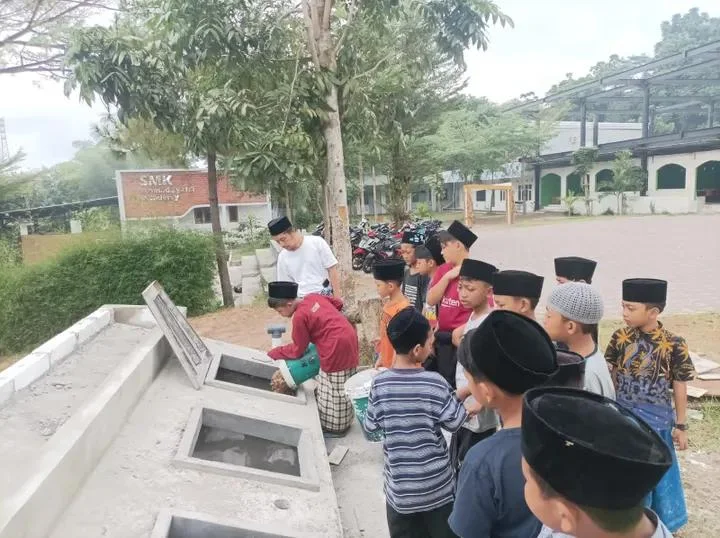
In the pesantren environment I observed, waste sorting has become part of daily life. Students are directed to dispose of waste in designated bins based on its type.
Waste such as plastic bottles, paper, organic matter, inorganic matter, and residues are separated according to their respective categories. Afterward, the sorted waste undergoes further processing at a sorting facility.
At that facility, waste that still has market value, such as plastic bottles and paper, is collected for sale. Meanwhile, organic waste is separated and handled specifically.
All these activities are also under the supervision of the pesantren administration. Thus, waste management involves various parties, from the students who perform the sorting to the administrators responsible for the management process.
These activities provide benefits on two fronts. From an environmental perspective, sorting facilitates easier waste management and allows materials with remaining utility to be reused.
Meanwhile, from an educational perspective, this activity serves as a means for students to learn responsibility for the waste they generate.
Through this habit, students understand that maintaining environmental cleanliness is not just the duty of janitors or school administrators, but a shared responsibility of all members of the pesantren community.
Waste Sorting as a Form of Character Education
The habit of sorting waste is not merely about teaching how to separate items by type. More than that, this activity is part of character education that instills values of discipline, responsibility, and environmental concern.
When students are accustomed to disposing of waste according to its category, they are learning to understand the consequences of their daily activities.
The waste produced should not be considered someone else's problem. Every individual has a responsibility to ensure that waste is managed properly.
In Islamic teachings, protecting the environment is also closely related to the human responsibility not to cause destruction on Earth.
Allah SWT states in Surah Al-A'raf verse 56:
وَلَا تُفْسِدُوا فِي الْأَرْضِ بَعْدَ إِصْلَاحِهَا
“And do not cause corruption upon the earth after its reformation.”
In Zubdatut Tafsir min Fathil Qadir, Sheikh Dr. Muhammad Sulaiman Al-Asyqar explains that the prohibition against causing corruption on Earth encompasses various actions that can damage life and the environment.
This verse serves as a reminder that humans have a responsibility to protect and preserve the Earth. In daily life, making a habit of sorting and managing waste can be one form of effort to fulfill that responsibility.
Thus, maintaining environmental cleanliness is not just a matter of healthy living habits, but also relates to the application of religious values in daily life.
Building Awareness, Not Just Compliance
Rules and supervision are indeed necessary to form the students' habit of sorting waste. However, the educational process should not stop at mere compliance with established rules.
What is more important is the growth of awareness that maintaining cleanliness is both a personal and a collective responsibility.
Students are expected not only to sort waste when under the supervision of administrators but also to do so out of their own awareness.
This awareness can be built through habits practiced repeatedly. When waste sorting becomes part of a routine, students will become increasingly accustomed to paying attention to the cleanliness and condition of their surroundings.
In this regard, the pesantren plays a crucial role because the educational process does not only take place through classroom learning but also through experience and daily life practices.
The habit of sorting waste can be one example of how character education is applied tangibly within an educational environment.
The Role of Pesantren in Shaping Environmental Concern
A pesantren is not only responsible for providing education while students are within the institution's environment. Education also needs to prepare students to live in the wider community.
Through the habit of sorting waste, students are expected to develop an environmental concern that they will continue to apply after completing their education.
Simple habits learned at the pesantren can serve as a foundation when they return to their families or their respective communities.
While a pesantren cannot solve the waste problem in Yogyakarta entirely, this educational institution can take part through waste management at the source and the formation of habits practiced consistently.
In an environment inhabited by many people, the habit of sorting waste can contribute to environmental management while serving as an educational tool for the students.
Ultimately, sorting waste is not just about separating plastic bottles, paper, and food scraps. Within it lies a lesson about responsibility, concern, discipline, and ethics in protecting the environment.
Moral education is not only seen in what is learned in the classroom but also in the simple habits applied in daily life.
From the pesantren environment, the habit of maintaining cleanliness and sorting waste is expected to grow into an awareness that students will carry with them when they return to society.
References
Ombudsman RI Representative for DIY. There is a Policy Gap and Capacity Disparity in Yogyakarta City Waste Management. October 2025. https://ombudsman.go.id/perwakilan/news/r/pwksiaran--ombudsman-diy-terdapat-jurang-kebijakan-dan-kesenjangan-kapasitas-pengelolaan-sampah-kota-yogyakarta
TafsirWeb. Surah Al-A'raf Verse 56. https://tafsirweb.com/2510-surat-al-araf-ayat-56.html






Comments 0
Write a Comment Share your response