

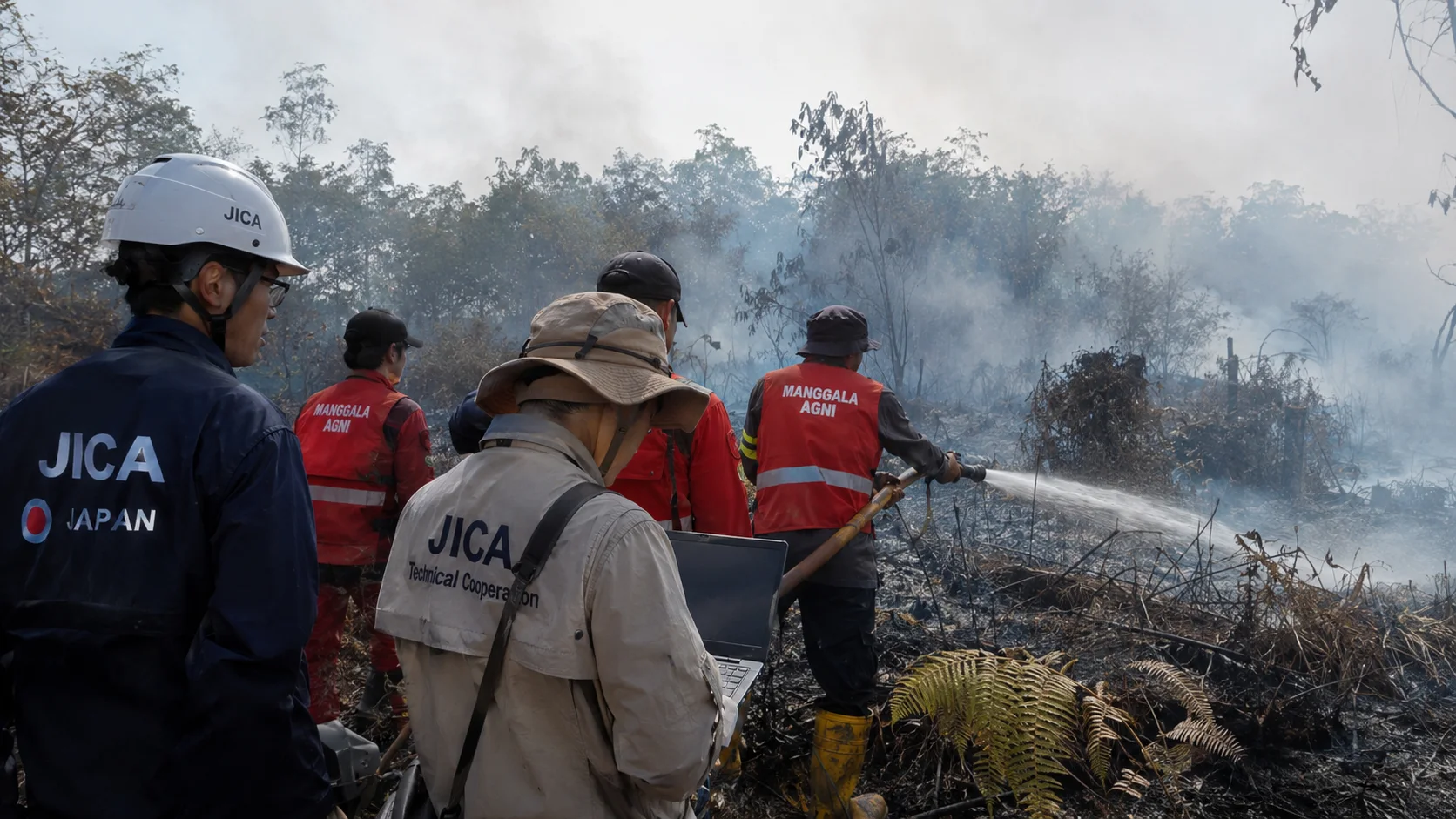
JurnalPost.com -- Why is a country that does not face peatland fire issues on the scale of Indonesia involved in handling forest and land fires in Kalimantan?
For Indonesia, forest and land fires (karhutla) have become a perennial problem. Every dry season, several regions face the threat of haze that disrupts public health, educational activities, and the economy. In some instances, the smoke has even spread to neighboring countries.
Amidst these recurring issues, there is an international partner whose contribution has not received much attention: Japan.
Since 1996, through the Japan International Cooperation Agency (JICA), Japan has been involved in various efforts to handle forest and land fires in Indonesia, ranging from hotspot monitoring to research and peatland management.
So, what has Japan done, and what lessons can Indonesia learn from this collaboration?
Two Decades of Cooperation in Fire Management
The cooperation between Japan and Indonesia in handling forest and land fires has spanned nearly two decades, from 1996 to 2015. This collaboration was carried out in four phases, as outlined by the Japan International Cooperation Agency (JICA) on 2016.
In the initial stages, the cooperation focused on developing early warning systems, detecting hotspots (hotspot), and mapping high-risk fire areas.
Over time, the program expanded to include institutional strengthening, capacity building through training, and community-based fire prevention, including in peatland areas.
This approach demonstrates that handling forest and land fires is not just about the ability to extinguish flames, but also about the readiness of prevention systems before fires occur.
Why Are Japanese Researchers Studying Kalimantan's Peatlands?
Beyond technical cooperation, Japan has contributed to the development of scientific research on forest fires and peatland management in Indonesia.
Hokkaido University, JICA, and the Japan Science and Technology Agency (JST) have collaborated with several Indonesian institutions, including the University of Palangka Raya, the Indonesian Institute of Sciences (LIPI), the Agency for the Assessment and Application of Technology (BPPT), and the National Institute of Aeronautics and Space (LAPAN).
The research collaboration, which began in 2008, focused on fires and peat carbon management in Central Kalimantan.
This research aims to develop fire monitoring systems, understand carbon dynamics in peat ecosystems, and support sustainable peatland management.
The involvement of Japanese researchers shows that Indonesia's peat fire problem also has a global environmental dimension. Fires and peat degradation not only impact local communities but are also linked to carbon emissions into the atmosphere.
Peat Fires and the Importance of Maintaining Groundwater
One crucial aspect of peat fire prevention is groundwater level management.
Research by Takashi Hirano and his colleagues, published in the journal Global Change Biology on 2014, shows a correlation between declining groundwater levels and increased carbon dioxide emissions due to peat decomposition.
The research site in Central Kalimantan was also recorded to have lost approximately 0.7 meters of the top peat layer due to two fire events.
These findings show that dried-out peat not only becomes more susceptible to burning but can also continue to release carbon even when not actively on fire.
Therefore, water management to maintain peat moisture is a vital part of forest and land fire prevention efforts.
Controlling groundwater levels, monitoring land conditions, and restoring damaged peat areas must be carried out in a planned manner, taking into account the characteristics of each region.
Three Important Lessons for Indonesia
In 2016, JICA also presented a community-based fire prevention program plan for the period of 2017–2022.
The program is planned to cover six provinces: Riau, West Kalimantan, Jambi, South Sumatra, Central Kalimantan, and East Kalimantan.
Its scope includes strengthening fire control capacity, developing fire-free villages, and managing peat and water systems.
From the experience of the Indonesia-Japan partnership, there are three important lessons to consider.
First, prevention must be the priority.
Fire suppression is necessary when flames appear, but these efforts must be balanced with early supervision, monitoring, and land management to prevent fires from spreading.
Second, scientific data must be applied to field actions.
Information regarding hotspots, fire risk levels, and peat groundwater conditions should serve as the basis for decision-making and rapid action by local governments and communities.
Third, communities need alternatives to slash-and-burn land management.
Education on the dangers of forest and land fires must be accompanied by guidance and support for facilities so that farmers have viable options for managing land without using fire.
These three lessons highlight the importance of linking scientific research, government policy, and community needs into a sustainable prevention system.
International Aid Does Not Replace Indonesia's Responsibility
The experience of the Indonesia-Japan partnership shows that handling forest and land fires requires science, good governance, and community involvement.
However, Indonesia's biggest challenge is not merely a lack of knowledge, but how to apply that knowledge consistently.
As long as land clearing by burning continues and peat water management is not yet optimal, the risk of fire will remain.
International aid can strengthen capacity, but it cannot replace Indonesia's responsibility to prevent fires from the start.
Concrete steps need to start with peat water management tailored to local conditions, providing non-burning land-clearing alternatives for farmers, and strengthening early warning systems down to the village level.
Canal blocking, for example, can be one way to re-wet peat in suitable locations. Meanwhile, guidance and facility support are needed so that communities can implement safer land management practices.
In this context, Japan can act as a partner in knowledge exchange, technology development, and human resource capacity building. The direction of policy and its implementation, however, remain Indonesia's responsibility.
Fire Prevention Requires Everyone's Involvement
Forest and land fire prevention cannot be burdened solely on one institution or community group.
Local governments need to ensure that prevention programs run sustainably, rather than just being a response once a fire has occurred.
On the other hand, the community can contribute by not burning trash or clearing land indiscriminately, and by immediately reporting signs of fire to authorized officials.
These efforts also need to be supported by consistent supervision and law enforcement so that practices increasing fire risk can be controlled.
Cooperation between the government, the public, academics, and international partners is essential to ensure that research results and fire management experiences are truly applied in the field.
The dry season will return, but forest and land fires should not continue to be a recurring annual problem.
Indonesia needs to prove that the extensive experience and international cooperation it has undertaken can produce real change.
Lessons from Japan show that the success of fire management is not measured only by how quickly flames are extinguished, but by how effectively fires can be prevented before they occur.





Comments 0
Write a Comment Share your response