

SURABAYA, JurnalPost.com – A single sack of plastic bottles can look full, even though most of it is just air. That is the issue we encountered at the RW 09 Waste Bank in Ampel, Semampir, Surabaya. In this densely populated settlement, every corner is occupied by residents, meaning piles of bottles waiting to be collected quickly become a spatial burden.
As students from the University of 17 August 1945 (UNTAG) Surabaya conducting our Community Service Program (KKN) there, our group designed a manual wooden bottle press using a lever mechanism.
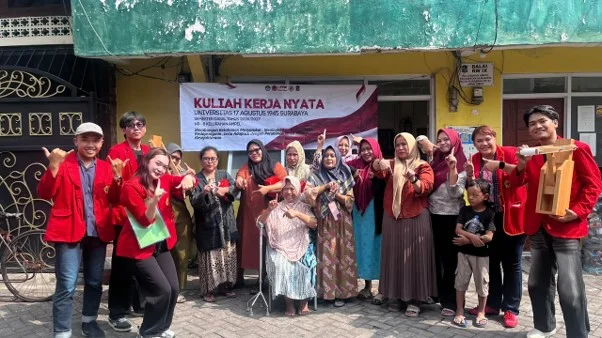
We handed the device over to the waste bank management on 21 November 2026 at the RW 09 Hall, following a socialization session and practical demonstration with 10 participants and local residents.
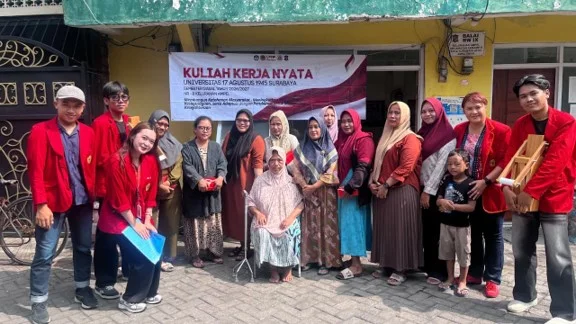
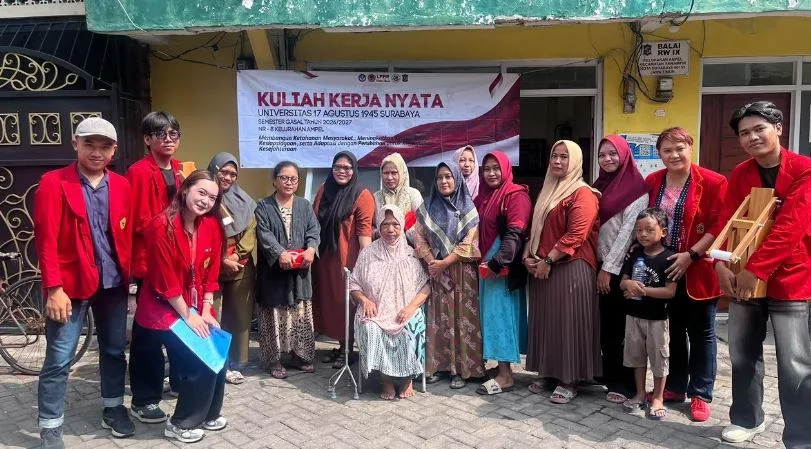
Photo 1. UNTAG Surabaya KKN students with residents and the management of the RW 09 Ampel Waste Bank, 21 November 2026.
Simple Innovation to Save Space
Before the handover, we tested the device on 100 bottles, consisting of 53 bottles with a capacity of 600 milliliters and 47 bottles with a capacity of 1,500 milliliters.
The results showed that the final size of the 600 milliliter bottles was in the range of 5–7 centimeters, while the 1,500 milliliter bottles were around 7–10 centimeters.
These figures are modest, but they sufficiently demonstrate that bottles which were initially bloated can be flattened before entering the sack. We have not yet measured the exact volume saved, so I prefer not to make exaggerated claims. That is the next task to tackle.
Photo 2. A manual wooden bottle press with a lever mechanism.
Sorting Habits Add Economic Value
Nevertheless, my experience in the field has led me to believe that the tool is only half the story.
The management noted that bottles still mixed with caps and labels are valued at around Rp2,000 to Rp3,000 per kilogram, whereas bottles that have been separated are valued at around Rp5,000 per kilogram.
That difference comes from the habit of sorting, not from the pressing process. Of course, these figures do not account for the time and effort spent sorting, but the message is clear: the tool helps save space, while disciplined habits add value.
Service Does Not End at Handover
Therefore, I believe that student community service should not end at the handover ceremony. Taking photos with residents is easy.
What is more difficult is ensuring that months later, the tool is still being used, its lever and hinges are maintained, caps and labels have their own containers, and sales results are recorded by material type.
Only when those small details are functioning can a simple tool be considered truly useful.
Technology That Grows With the Community
The RW 09 Ampel Waste Bank taught me one thing. Good technology at the village level is not the most sophisticated, but rather that which can be understood, maintained, and operated by the residents themselves.
Our duty as students is to design with humility, listen first, and then return home with the conviction that good habits in the smallest environment will spread to larger ones.
By: Abiel Jireh
Student ID 1412300059 | Industrial Engineering Study Program, Faculty of Engineering
University of 17 August 1945 Surabaya




Comments 0
Write a Comment Share your response