

JurnalPost.com - Food loss and spoilage remain significant challenges within Indonesia's food system. Various agricultural, livestock, and fishery commodities are at risk of quality degradation during storage, transportation, and distribution to consumers.
Fresh fruits and vegetables, for instance, are prone to physiological changes that accelerate ripening and decay. Meanwhile, animal products such as meat and fish are highly perishable due to microbial activity and chemical reactions during storage.
These conditions are often exacerbated by limited cold chaincold chainfacilities, suboptimal post-harvest handling, and the use of packaging systems that fail to maintain product quality effectively.
On the other hand, the use of conventional synthetic plastic packaging poses environmental problems. Most of these materials are not naturally biodegradable and can increase waste accumulation if not managed properly.
In response to these challenges, the field of Food Technology continues to develop packaging innovations that not only serve as a protective barrier but also help maintain freshness and provide information regarding the condition of the food.
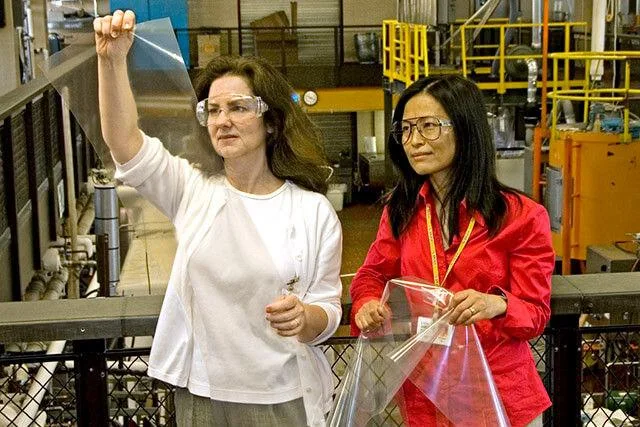
One promising approach is the development of active and intelligent packaging based on biopolymers derived from local tubers, such as cassava, purple sweet potato, and canna.
Utilizing Local Tubers as Eco-Friendly Packaging Materials
Indonesia possesses a diverse range of tuber commodities with the potential to be utilized as industrial raw materials, including for the development of bio-based food packaging.
Cassava, sweet potatoes, and canna are examples of plants that contain starch and can be processed into biopolymer film-forming materials.
Starch has the ability to form thin films after undergoing specific processing. This characteristic makes it a widely studied material in the development of bioplastics and alternative food packaging.
However, using starch as a packaging material presents its own challenges. Pure starch films are generally relatively brittle and sensitive to moisture, necessitating the addition of other substances to improve their characteristics.
One approach is to combine starch with softening agents or plasticizers, such as glycerol, to increase flexibility.
Additionally, the use of reinforcing agents like chitosan can be considered to improve the mechanical properties and functional characteristics of the packaging.
Through precise formulation, starch-based biopolymers have the potential to be developed into more flexible packaging with protective capabilities tailored to product needs.
Although bio-based, such packaging still requires testing to ensure strength, moisture resistance, food-contact safety, and biodegradability under specific environmental conditions.
Active Packaging Technology to Maintain Food Freshness
Active packaging or active packaging is a packaging technology designed so that specific components within the system can interact with the environment surrounding the product.
Unlike conventional packaging, which primarily functions as a physical barrier, active packaging is developed to help control factors that accelerate food quality degradation.
One example of its application is the addition of natural extracts with potential antimicrobial and antioxidant activity.
Cinnamon and clove essential oils, for instance, contain bioactive components that have been extensively studied for their antimicrobial and antioxidant properties.
These substances have the potential to be used as active components in packaging to help inhibit the growth of certain microorganisms or slow down oxidation reactions.
However, their effectiveness depends on the concentration of the active ingredient, the packaging formulation, the characteristics of the food product, and storage conditions.
The use of essential oils must also consider the possibility of changes in the aroma and flavor of the product due to the migration of active components from the packaging to the food.
In addition to adding natural extracts, active packaging can be developed by utilizing gas-absorbing materials.
In certain fruits and vegetables, ethylene gas plays a role in the ripening process. The accumulation of ethylene during storage can accelerate physiological changes in commodities sensitive to the gas.
Materials such as zeolite have the potential to be used as part of a gas control system within the packaging. However, the ethylene absorption capacity must be tested based on the type and characteristics of the material used.
With proper development, active packaging technology can be an approach to maintain the quality of horticultural products and reduce the risk of damage during distribution.
Intelligent Packaging Capable of Detecting Freshness Changes
Beyond active packaging technology, another innovation attracting attention in Food Technology is intelligent packaging or intelligent packaging.
This technology is designed to provide information regarding the condition of the product or specific changes that occur during storage.
One form of development is the use of color indicators based on natural pigments that are sensitive to changes in acidity or pH levels.
Anthocyanin pigments found in butterfly pea flowers and purple sweet potatoes exhibit color-changing characteristics under different pH conditions.
This property can be utilized as a basis for developing food freshness indicators.
In products like meat and fish, the process of freshness decline can be accompanied by the formation of volatile basic compounds due to microbial activity and biochemical changes.
These compounds are related to the Total Volatile Basic Nitrogen (TVB-N) parameter, which is often used as an indicator to evaluate quality changes in fishery and certain animal products.
In an intelligent packaging system, anthocyanin indicators can be designed to respond to chemical changes in the environment surrounding the product.
When a pH change occurs that matches the indicator's characteristics, the color on the label may change, for example, from purple to blue or greenish.
However, this color change is not always the same for every formulation. The indicator's response is influenced by the source of the anthocyanin, material composition, acidity level, and storage conditions.
Therefore, color indicators must undergo a calibration and testing process to ensure that the displayed changes are truly correlated with the product's freshness condition.
This technology has the potential to provide additional information to consumers without having to open the packaging. Nevertheless, freshness indicators cannot replace all food safety inspection procedures.
Integrating Active and Intelligent Packaging into a Single System
Combining active and intelligent packaging technologies is an attractive approach for development in the food industry.
Active packaging helps control factors causing spoilage, while intelligent packaging provides information regarding changes in product condition during storage.
For example, cassava starch-based packaging can be developed with the addition of antimicrobial components to help maintain product quality.
This system can then be equipped with an anthocyanin-based indicator label to monitor chemical changes related to freshness.
Developing both technologies within a single system is expected to provide both protective functions and food quality monitoring.
However, its implementation requires further research. Aspects that must be considered include the mechanical strength of the packaging, permeability to gases and water vapor, stability of active ingredients, accuracy of indicator responses, and the safety of materials in contact with food.
Shelf-life testing also needs to be conducted to compare the effectiveness of innovative packaging with conventional packaging under controlled storage conditions.
Opportunities to Reduce Food Loss and Increase Local Commodity Value
The development of tuber-based biopolymer packaging is not only related to technological advancement but also has the potential to provide economic and environmental benefits.
Utilizing starch from cassava, sweet potatoes, and canna can open opportunities for the diversification of local agricultural commodity use.
If developed sustainably, this innovation has the potential to create added value for agricultural products and encourage the development of a domestic resource-based packaging industry.
In terms of food management, packaging that helps maintain freshness has the potential to reduce losses due to spoilage during storage and distribution.
Meanwhile, the use of intelligent indicators can help provide information on product conditions so that decision-making in food handling can be carried out more accurately.
Nevertheless, the success of implementing this technology still depends on production cost feasibility, raw material availability, industrial-scale production capabilities, and acceptance by business actors and consumers.
Environmental aspects must also be assessed comprehensively because the use of bio-based materials does not automatically result in a lower environmental impact compared to all types of conventional packaging.
Towards a More Sustainable Food Packaging System
The innovation of active and intelligent packaging based on tuber biopolymers shows that local agricultural commodities have the potential to be developed into value-added food technology materials.
The use of tuber starch as a base material for packaging, the addition of active components from natural extracts, and the use of anthocyanin indicators are a promising combination of technologies for further research.
This approach can be part of efforts to improve food packaging systems, extend product shelf life under certain conditions, and reduce the risk of post-harvest food loss.
However, such innovations still require research, safety testing, economic evaluation, and production technology development before they can be widely applied.
With the support of research and collaboration between universities, the food industry, and business actors, active and intelligent packaging based on local materials has the potential to become a supporting solution for building a more efficient, innovative, and sustainable food system in Indonesia.









Comments 0
Write a Comment Share your response