

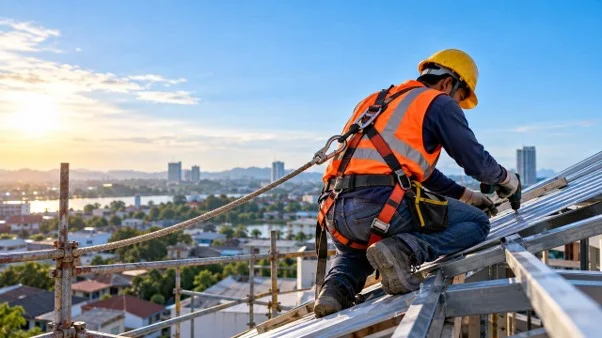
JurnalPost.com - Every day, workers climb onto roofs, install building frames, paint walls, or repair hard-to-reach parts of buildings. For them, working at heights is part of the effort to make a living. However, when work is performed without adequate protection, one small mistake can lead to a serious accident. The issue is not just whether the worker is careful, but whether the work has been planned to be safe.
Informal workers often find themselves in difficult situations. Jobs are obtained through verbal agreements, work tools are adapted to available capabilities, and completion time is the primary consideration.
In such conditions, safety aspects can be sidelined by the need to finish the job quickly and earn wages. Risks that should be controlled before work begins may instead be considered a normal part of daily work.
The Scale of the Informal Sector and Challenges in Worker Protection
Data from the Central Statistics Agency (BPS) via the August 2025 National Labor Force Survey (Sakernas) recorded 84.70 million people, or 57.80 percent of the working population, engaged in informal activities. This figure highlights the large group of workers who need attention in labor policy.
Although this is not specific data on workers at heights, the size of the informal sector is a crucial reason to ensure that safety guidance and protection do not only reach large companies.
Working at heights carries serious potential hazards. Falling from roofs, ladders, or scaffolding can cause severe injury, disability, or even death.
The impact extends beyond the individual involved in the accident. Families may lose their breadwinner, while medical costs and reduced ability to work can worsen the household's economic condition.
Therefore, Occupational Health and Safety (OHS 3) must be viewed as a fundamental necessity, not an additional facility available only to workers in large companies. Everyone who works needs to receive protection appropriate to the hazards they face.
OHS Management Systems (SMK3) Are More Than Just Administrative Documents
Indonesia actually has a legal foundation to prevent workplace accidents. Government Regulation Number 50 of 2012 concerning the Implementation of the Occupational Health and Safety Management System (SMK3) regulates a systematic process that includes policy, planning, implementation, monitoring and evaluation, as well as continuous review and improvement.
Meanwhile, the Minister of Manpower Regulation Number 9 of 2016 specifically regulates OHS 3 in work at heights.
Both regulations can serve as a foundation to strengthen accident prevention. Safety is not sufficiently realized by providing helmets or asking workers to be more careful.
Work must be planned by identifying hazards, choosing safe work methods, ensuring equipment is in proper condition, and using appropriate fall protection systems.
However, the implementation of formal SMK3 has a specific scope of obligation. Government Regulation Number 50 of 2012 mandates the implementation of SMK3 for companies employing at least 100 workers or those with a high level of potential hazard.
Therefore, it is inaccurate to assume that all informal workers automatically have the same obligation to implement SMK3 as companies that meet those criteria.
This distinction is important to ensure that the discussion is legally accurate. Nevertheless, the limitations of formal management system implementation should not be an excuse to allow work at heights to proceed without adequate risk control.
The challenge is to bring safety principles into small-scale work environments that may not yet have written procedures or specialized OHS 3 personnel.
Why Blaming Workers Is Not Enough
When an accident occurs, workers are often the first to be blamed for being negligent or not using personal protective equipment. In reality, the causes of accidents need to be examined thoroughly.
Have the workers received training? Is safe work access available? Are the scaffolding and fall protection equipment suitable for the job requirements? Have time and budget been planned with safety in mind?
These questions help us understand that worker behavior does not form in a vacuum.
Workers may be aware of the hazards but lack adequate tools, face time pressure, or fear losing income if they refuse unsafe work.
Such situations do not mean workers are free from responsibility, but they demonstrate that safety responsibility cannot be placed solely on the workers themselves.
An OHS 3 approach that relies only on appeals will struggle to produce sustainable change. Education must be accompanied by adequate facilities, work planning, supervision, and a clear division of responsibility.
A safety culture will grow more easily if workers are not only asked to work safely but are also supported to be able to do so.
Three Steps to Extend Protection to Informal Workers
First, expand OHS 3 guidance for informal workers.
Local governments need to expand OHS 3 guidance to reach construction workers, renovation workers, building maintenance service providers, and small business owners.
Guidance can be provided through worker communities, construction service associations, village offices, training institutions, and partnerships with OHS 3 service providers. The material needs to be practical, easy to understand, and focused on hazard identification and risk control before work begins.
Second, incorporate safety aspects from the work planning stage.
Employers, project owners, and parties controlling the execution of work need to pay attention to safety from the planning stage.
The condition of access, ladders, scaffolding, edge protection, and fall prevention devices must be assessed according to the characteristics of the work.
The equipment used must be suitable and appropriate, supported by worker competence and emergency rescue procedures. Safety costs need to be calculated from the beginning, rather than being solely a burden on the worker.
Third, strengthen supervision and assistance for small businesses.
Supervision needs to be accompanied by assistance tailored to the characteristics of small-scale businesses.
The government and stakeholders can encourage the use of simple risk assessment guides, affordable training, and mechanisms to report unsafe conditions.
The success of the program is not measured solely by the number of socialization events, but also by changes in work practices, the availability of hazard controls, and follow-up on findings in the field.
These three steps require collaboration. The government plays a role in guidance, regulation, and supervision according to its authority.
Employers and those controlling the work need to manage the risks within their responsibility. Meanwhile, workers need to be involved in identifying hazards and reporting unsafe conditions.
Safety will be more sustainable if all parties understand their roles.
Completed Work Must Still Leave Safety Behind
The success of a job should not be measured only by the finished building, the appropriate cost, or the achieved completion time. The safety of the people doing the work must be part of that measure of success.
Work that generates income should not require someone to risk their life because the protection that should have been available was not prepared.
SMK3 will lose its meaning if it is only understood as an administrative obligation, while prevention principles do not reach groups of workers facing real risks.
Regulations are indeed important, but their implementation requires guidance, support facilities, supervision, and the commitment of all parties.
It is time for informal workers working at heights to be viewed not merely as labor to complete construction, but as human beings who have families, life needs, and the right to work safely.
The measure of OHS 3 progress is not just the completeness of company documents, but the extent to which accident prevention is present in daily work practices.
Because every job should provide a livelihood, not risk a life.







Comments 0
Write a Comment Share your response