

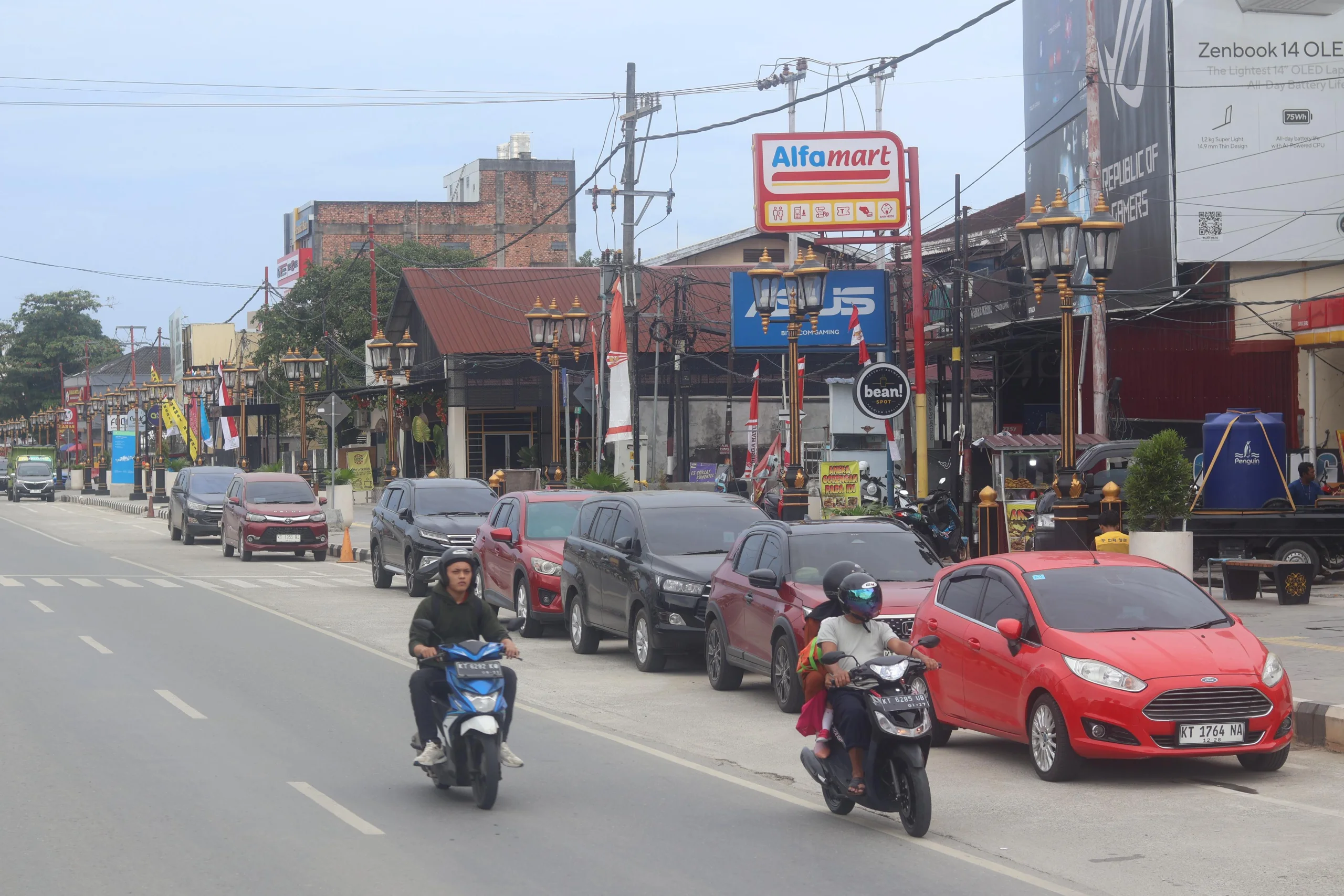
JurnalPost.com - Vehicles are seen parked in front of shops along the roadside almost every day. As a result, the road narrows, forcing other motorists to slow down or overtake under risky conditions.
During peak hours, vehicle queues can stretch out simply because one or two cars are using part of the road as a parking space.
This occurrence is so common that many people now consider it normal. Yet, this habit is slowly changing how society views roads, shifting them from shared public spaces to areas that anyone feels entitled to occupy.
The question is, why do such visible violations persist and seemingly become a part of daily life?
In reality, Indonesia already has regulations governing how vehicles should stop and park.
Article 43 of Law Number 22 of 2009 concerning Road Traffic and Transportation (UU LLAJ) regulates the provision of public parking facilities. In principle, parking facilities should be provided outside the road right-of-way, while parking within the road right-of-way is only permitted in specific locations that meet the requirements.
Motorists are also required to comply with stopping and parking regulations as stipulated in Article 106 paragraph (4) letter e.
Thus, the issue is not merely the presence of vehicles on the roadside, but the use of public space without regard for regulations, safety, and the interests of other road users.
When Violations Become a Habit
In my view, the main problem with illegal parking is not a lack of regulations, but rather weak law enforcement and the formation of a social habit that allows violations to continue unchecked.
When violations occur repeatedly without consistent action, the public gradually loses awareness that such actions carry legal consequences.
As a result, illegal parking is no longer viewed as a violation but as an acceptable habit.
In such conditions, the existence of law becomes less meaningful if it is not accompanied by firm and consistent enforcement.
Yet, legal provisions already provide consequences for violating stopping and parking procedures.
Article 287 paragraph (3) of the UU LLAJ stipulates a maximum imprisonment of one month or a maximum fine of Rp250,000 for motorists who violate traffic movement rules or stopping and parking procedures.
Meanwhile, violations of orders or prohibitions stated through traffic signs or road markings can be subject to a maximum imprisonment of two months or a maximum fine of Rp500,000, as stipulated in Article 287 paragraph (1).
However, these sanctions will not provide a meaningful deterrent if enforcement in the field is not carried out consistently.
Local governments and authorized officials must ensure that rules are truly applied, rather than just existing in legislation.
Therefore, the problem of illegal parking lies not only in the absence of law but also in the gap between existing regulations and their implementation.
Limited Parking Space and Economic Interests
On the other hand, the increasing number of private vehicles is not always matched by the availability of adequate parking space.
Some shops have limited parking, leading visitors to use the road shoulder or the road itself because it is considered more practical.
This practice can also provide short-term benefits for merchants by facilitating customer access, while simultaneously serving as a source of income for parking attendants.
However, this convenience comes at a significant cost, ranging from traffic congestion and increased accident risks to the obstruction of pedestrian access.
The economic interests of small merchants and parking attendants certainly deserve attention. However, these interests should not come at the expense of the safety and rights of other road users.
Roads are public facilities used by everyone. Everyone has the right to use them in accordance with their function and applicable regulations.
Therefore, the issue of illegal parking cannot be solved solely through law enforcement; it also requires the provision of proper parking facilities and an orderly management system.
Law Enforcement and Public Awareness Must Go Hand in Hand
Concrete steps must be initiated by local governments through the provision of official parking lots, the installation of clear signs and markings, and routine, consistent enforcement.
Business owners also need to consider the parking needs of their visitors so that the burden is not entirely placed on the road space.
On the other hand, parking attendants can be involved through official management systems in accordance with local regulations, so that parking activities can be more orderly and not disrupt traffic flow.
The public also has a responsibility to start getting used to using provided parking facilities and not using prohibited locations to park their vehicles.
Changing these habits cannot happen instantly. However, if law enforcement is carried out consistently and supported by public awareness, illegal parking practices can be reduced gradually.
Ultimately, road order depends on shared responsibility, not just the number of regulations.
Laws that are only written without being applied in reality will not provide optimal protection for road users.
Because the road is a shared space, not a place that can be claimed by whoever arrives first.









Comments 0
Write a Comment Share your response