

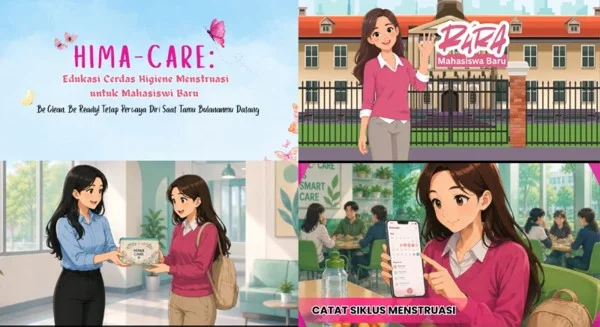
MALANG, JurnalPost.co - Reproductive health education through digital media is showing positive results in helping new female students understand the importance of maintaining hygiene during menstruation. Research conducted by the Midwifery Department team at the Faculty of Medicine, Universitas Negeri Malang (UM), found an improvement in menstrual hygiene behavior after participants engaged with HIMA-CARE video education.
The study, led by Winny Kirana Hasanah, involved 72 first-year students from non-health study programs in Malang. Participants received educational material through videos specifically designed to enhance understanding and habits regarding the maintenance of reproductive organ hygiene.
The research results indicate that the respondents' menstrual hygiene behavior improved after receiving the education. These findings open opportunities for utilizing audiovisual media as a reproductive health promotion approach within higher education environments.
HIMA-CARE Serves as a Reproductive Health Education Medium
HIMA-CARE is an acronym for Hygiene Improvement Media for Awareness, Care, and Reproductive Education. This medium was developed as an educational video presenting various information regarding health and hygiene during menstruation.
The material covered includes an introduction to the menstrual process, steps for personal hygiene, habits to observe, and explanations regarding myths about menstruation that still persist in society.
Unlike conventional lecture-based delivery, the use of video allows information to be presented through a combination of images, sound, and explanations that are easier to follow.
This approach is considered relevant to the characteristics of students who are accustomed to accessing information via digital devices.
In this study, the team measured the menstrual hygiene behavior of respondents before and after watching the educational video. The measurement results were then compared to observe behavioral changes following the intervention.
From this comparison, the team found an improvement in menstrual hygiene behavior among the study participant group.
New Female Students Deemed Vulnerable to Information Gaps
The head of the research team, Winny Kirana Hasanah, explained that first-year students are an interesting group to study because they are facing changes in their daily lives.
Some students begin living far from their families and are required to be more independent in managing personal needs, including maintaining reproductive health.
However, this independence is not necessarily accompanied by adequate understanding regarding menstrual hygiene practices.
"They are just starting to take care of themselves, including during menstruation. If the information they have is incorrect or limited, improper habits can persist," said Winny.
According to her, students from non-health study programs do not necessarily receive specific instruction on reproductive health during their higher education.
This condition was one of the considerations for the team in determining the study's target group.
Beyond the issue of information access, discussions about menstruation are still often considered a sensitive, private topic. Consequently, some women may feel uncomfortable asking questions or seeking explanations directly.
Yet, correct understanding is necessary to prevent the formation of improper hygiene habits.
Menstrual Education is Important for Health and Comfort
Maintaining hygiene during menstruation is part of reproductive health care that needs to be observed from adolescence through adulthood.
Poor hygiene practices can increase the risk of irritation and complaints in the genital area. This condition also has the potential to cause discomfort that disrupts daily activities.
For female students, discomfort during menstruation can impact concentration in learning and academic activities.
Therefore, education should not only explain the biological process of menstruation but also provide practical guidance on proper self-care.
Information regarding the use and changing of menstrual products, hand hygiene, and genital area care are important parts of menstrual health education.
On the other hand, various information circulating on social media does not always have a health basis that can be accounted for.
The presence of educational media specifically compiled is expected to help students obtain explanations that are more directed and easier to understand.
Digital Video Considered More Comfortable for Sensitive Topics
Winny stated that the use of audiovisual media is one way to reduce communication barriers when discussing reproductive health.
Through video, participants can receive explanations without having to directly reveal personal experiences or questions in front of others.
"This topic often makes people awkward if discussed directly. Through video, the same message can be delivered more lightly without losing the accuracy of the content," said Winny.
The video format also allows the material to be reused in health education activities on campus.
Nevertheless, the results of the study on 72 respondents do not immediately show that a similar approach will produce the same changes in all student groups.
Follow-up research with a wider range of participants is needed to determine the consistency of results and the sustainability of behavioral changes in the long term.
Potential to be Applied in Campus Health Programs
The research team hopes that HIMA-CARE can become an alternative health promotion medium utilized by higher education institutions in supporting students, especially during the early period of their studies.
Educational programs of this kind are considered to have the potential to be integrated with campus life orientation activities, student health services, and reproductive health literacy improvement programs.
"We want education like this to be replicable, so that female students have a foundation for clean and healthy living habits from the start of college and reproductive health does not become an obstacle to their achievements," said Winny.
The research was also linked to efforts to support the Sustainable Development Goals or Sustainable Development Goals (SDGs), specifically the third goal regarding good health and well-being and the fourth goal regarding quality education.
Through the utilization of digital technology, reproductive health education is expected to no longer be limited to formal learning but can reach students more broadly.
The HIMA-CARE findings simultaneously show that a communication approach tailored to the needs of participants is one of the important aspects in efforts to increase awareness and behavior in maintaining reproductive health in higher education environments.





Comments 0
Write a Comment Share your response