

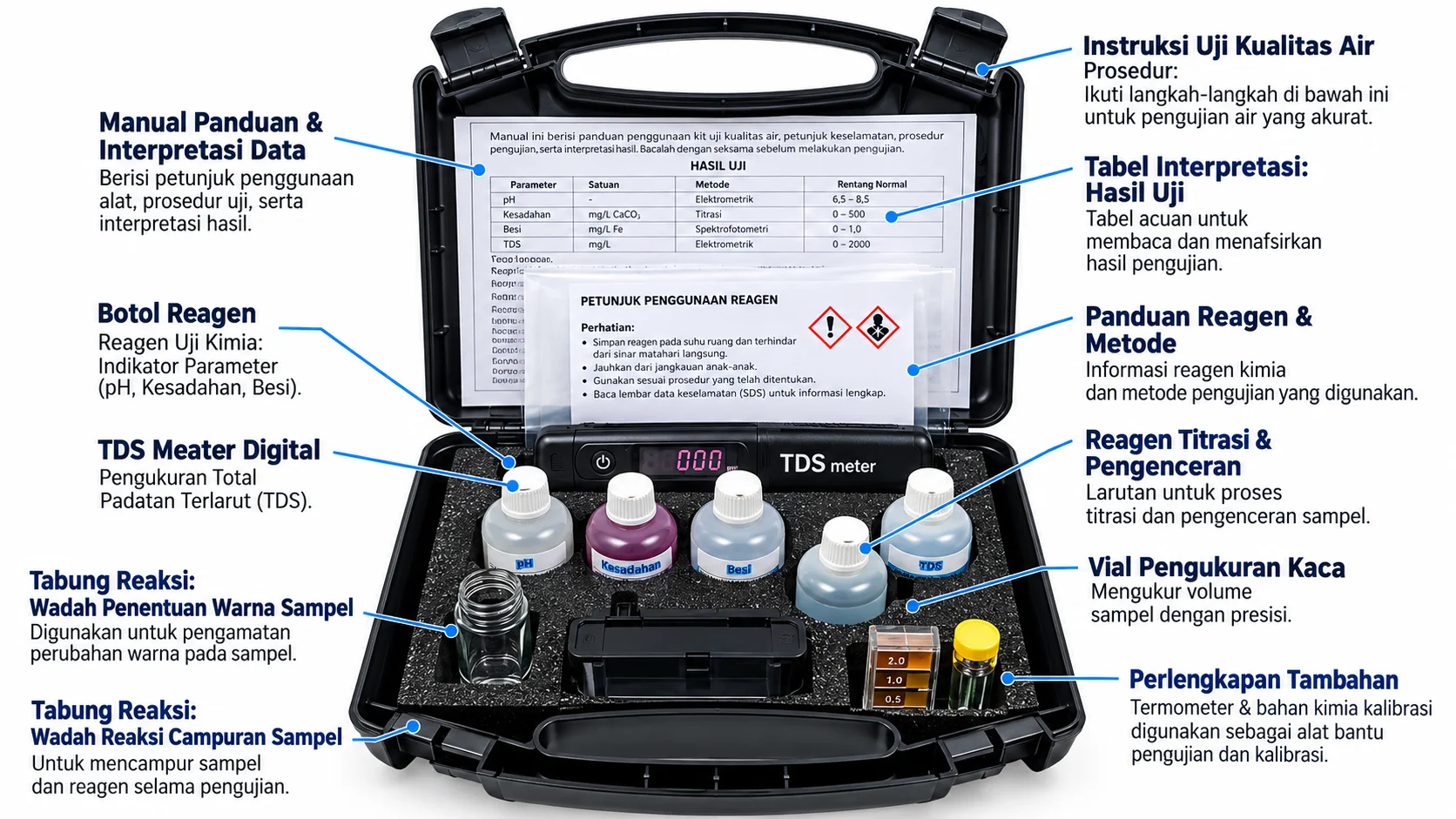
JurnalPost.com - Water quality is a critical aspect of public health, environmental conservation, and the survival of various organisms. Water contaminated with chemicals, heavy metals, or pathogenic microorganisms can cause significant problems if consumed or used without prior testing.
Therefore, regular water quality monitoring is essential to assess water conditions and detect pollutants that could pose risks to health and the environment.
Typically, water quality testing is conducted through laboratory analysis. However, limited facilities, high costs, a shortage of experts, and long turnaround times often present obstacles, especially in regions with poor access to testing laboratories (Kumar et al., 2025).
One alternative to overcome these limitations is the use of Water Quality Field Test Kits (FTK). These devices are designed to perform water quality testing directly in the field without constant reliance on laboratory facilities.
The use of FTKs allows for the examination of various water quality parameters in a more practical, rapid, and relatively economical manner. The results can be used as a preliminary screening (screening) to determine water conditions and identify potential contamination.
Furthermore, these devices support community-based water quality monitoring, as they can be operated by users who have received training in the appropriate testing procedures.
The History of Water Quality Field Test Kits
The development of Water Quality Field Test Kits originated from the need to conduct direct water quality inspections to detect pollution that could impact human health.
One of the early water testing devices was the Danchell-type water testing kit developed in England between approximately 1867 and 1904. This device was used to check for organic matter and chemical pollutants in water.
Entering the period of 1920–1940, the development of water testing devices accelerated. During this time, various portable testing tools equipped with examination kits were introduced, allowing simple analyses to be performed directly in the field (Science Museum Group, n.d.).
A significant subsequent development occurred in 1985 when Oxfam collaborated with the University of Surrey to develop a portable water testing device to address the difficulties of transporting water samples to laboratories.
The device was designed to check several water quality parameters, such as microbiological content, turbidity levels, free chlorine, total chlorine, and pH.
The result of this development became known as the DelAgua Water Testing Kit. This device was subsequently used in various water quality monitoring activities in several countries, particularly in regions requiring practical and portable testing methods (DelAgua, n.d.).
Principles and Operation of Water Quality Field Test Kits
The operating principle of Water Quality Field Test Kits depends on the parameters being tested and the analytical methods used by each device.
In general, FTKs work by utilizing chemical reactions between water samples and specific reagents. These reactions can produce color changes, turbidity levels, or other measurable responses used to estimate the presence or concentration of specific substances in the water.
One common method is colorimetry (colorimetric method), an analytical method based on color changes after a water sample reacts with specific chemicals.
The intensity of the color formed is then compared to a color scale provided with the device to estimate the concentration of the substance in the water sample.
The testing process generally begins by collecting a water sample using the provided container. The sample is then placed into a test tube according to the specified volume.
Next, a reagent in the form of a solution, powder, or tablet is added to the sample. The reagent reacts with specific substances in the water, resulting in a color change or other characteristics.
After the designated reaction time has elapsed, the test results are observed and compared with the color card or indicators included with the device.
For example, chlorine levels can be tested by adding a reagent that produces a color change corresponding to the chlorine concentration. Meanwhile, pH testing can use indicator paper that changes color based on the acidity or alkalinity of the water.
In addition to colorimetry, some FTK devices employ simple titration methods. This method involves adding a reagent solution gradually until a color change occurs, indicating that the reaction endpoint has been reached.
As technology has advanced, a number of portable water testing devices have also been equipped with electronic sensors or photometers to measure test responses more objectively.
How are Water Quality Field Test Kits Used to Analyze Research Results?
Results obtained using Water Quality Field Test Kits can be used to obtain an initial overview of water quality conditions at a research site.
Each parameter tested yields different data, whether in the form of concentration values, color changes, or specific categories.
For example, pH testing produces a value indicating the acidity or alkalinity of the water. Meanwhile, nitrate testing can provide an estimate of nitrate concentration based on the color intensity formed after the sample reacts with the reagent.
The test data is then recorded and categorized based on the sampling location, time of examination, and the type of parameter analyzed.
The next step is to compare the test results with water quality standards or benchmarks appropriate for the research objectives and the intended use of the water.
This comparison is conducted to determine whether the value of a parameter remains within specified limits or indicates potential pollution.
For instance, if the pH measurement falls outside the range established in water quality standards, this condition may indicate a change in water characteristics that requires further investigation.
Additionally, results from multiple locations can be compared to identify differences in water quality conditions based on region or sampling time.
Nevertheless, results from FTK examinations must be interpreted with consideration for the precision and limitations of each device.
Some devices produce qualitative or semi-quantitative data, meaning their accuracy may not be equivalent to laboratory analysis methods.
Kumar et al. (2025) conducted a study evaluating four FTK devices for arsenic testing and compared their results with the Atomic Absorption Spectrophotometry–Hydride Generation (AAS-HG) method.
In that study, one device showed a testing agreement level of 55% when compared to laboratory results using a tolerance of ±5%. This figure increased to 90% when the comparison tolerance was expanded to ±10%.
These findings demonstrate that the accuracy of FTK examination results can be influenced by various factors, including field testing conditions and the operator's skill in following testing procedures.
Therefore, FTKs are most appropriately used as preliminary screening and routine monitoring tools. If signs of pollution are detected or if results with a high level of precision are required, follow-up testing using validated laboratory methods remains necessary.
Conclusion
The development of Water Quality Field Test Kits shows how water quality testing technology continues to evolve, moving from simple devices to increasingly practical portable tools.
The presence of these devices provides convenience for researchers, field officers, and the public in conducting preliminary examinations of water quality conditions without having to rely solely on laboratory facilities.
Through various testing methods, such as colorimetry, titration, and the use of sensors, FTKs can help detect a number of important parameters related to water quality.
Although they have limitations in terms of precision and accuracy, these devices play a vital role in supporting environmental monitoring, field research, and efforts to increase public awareness regarding the importance of maintaining water resource quality.
References
Kumar, J., Garg, A., Gaurav, et al. (2025). A reliable model to strengthen community-based water quality monitoring and surveillance via field test kits. Scientific Reports, 15, 8794. https://doi.org/10.1038/s41598-025-92240-0
Science Museum Group. (n.d.). Source of information on the history of water testing device development.
DelAgua. (n.d.). Source of information on the history of DelAgua Water Testing Kit development.










Comments 0
Write a Comment Share your response