


Palembang, JurnalPost.com — Research into Alzheimer's disease is not only advancing among professional researchers and institutions but is also gaining significant attention from students through various scientific research programs.
Five students from the Faculty of Medicine at Universitas Sriwijaya (FK Unsri), namely Fahri Habib Al Azka, Muhammad Chaidar, Inez Shafa Damhudi, Aliya Shafa Kahirunnisa, and Yusram Praja Hamidi, are conducting experimental research on Alzheimer's through the Student Creativity Program for Exact Research (PKM-RE).
Under the guidance of Dr. Rahmat Hidayat, M.Sc., Ph.D., the team is exploring the use of exosomal fractions from platelet growth factors in an Alzheimer's animal model.
This study stems from the team's interest in examining how biological materials can be investigated in more specific fractional forms. In the experiment, the team explored exosomal fractions derived from platelet growth factors administered via the intranasal route in animal models.
This approach was then compared with the administration of whole platelet growth factors and several other control groups.
The series of experiments was designed to observe changes in memory aspects as well as pathological features associated with Alzheimer's disease.
Conducted at the Biomolecular Laboratory
The research was carried out at the Biomolecular Laboratory and the Anatomical Pathology Laboratory of the Eureka Research Laboratory, Palembang.
Access to laboratory facilities provided the students with the opportunity to be directly involved in various stages of the research, from material preparation and experimental execution to the observation of predetermined research parameters.
Throughout this process, the students were not only required to understand the theory behind Alzheimer's disease but also to learn how experimental research is systematically designed, executed, and analyzed.
The entire research sequence obtained ethical approval and was conducted by applying the 3Rprinciples, namely Replacement, Reduction, and Refinement in the use of laboratory animals.
These principles are a vital component of experimental research involving animals, ensuring that ethical aspects and animal welfare are considered throughout the study.
Observing Spatial Memory and Amyloid-β Deposition
In this study, the team used Wistar rats as an animal model and observed two primary parameters: spatial memory and amyloid-β deposition in brain tissue.
Observations of spatial memory were conducted to obtain an overview of changes in cognitive function within the research model.
Meanwhile, brain tissue examinations were performed to observe pathological features, specifically amyloid-β deposition, which is a critical aspect of Alzheimer's disease research.
Through this series of tests, the team successfully obtained data that could be used to address the established research objectives.
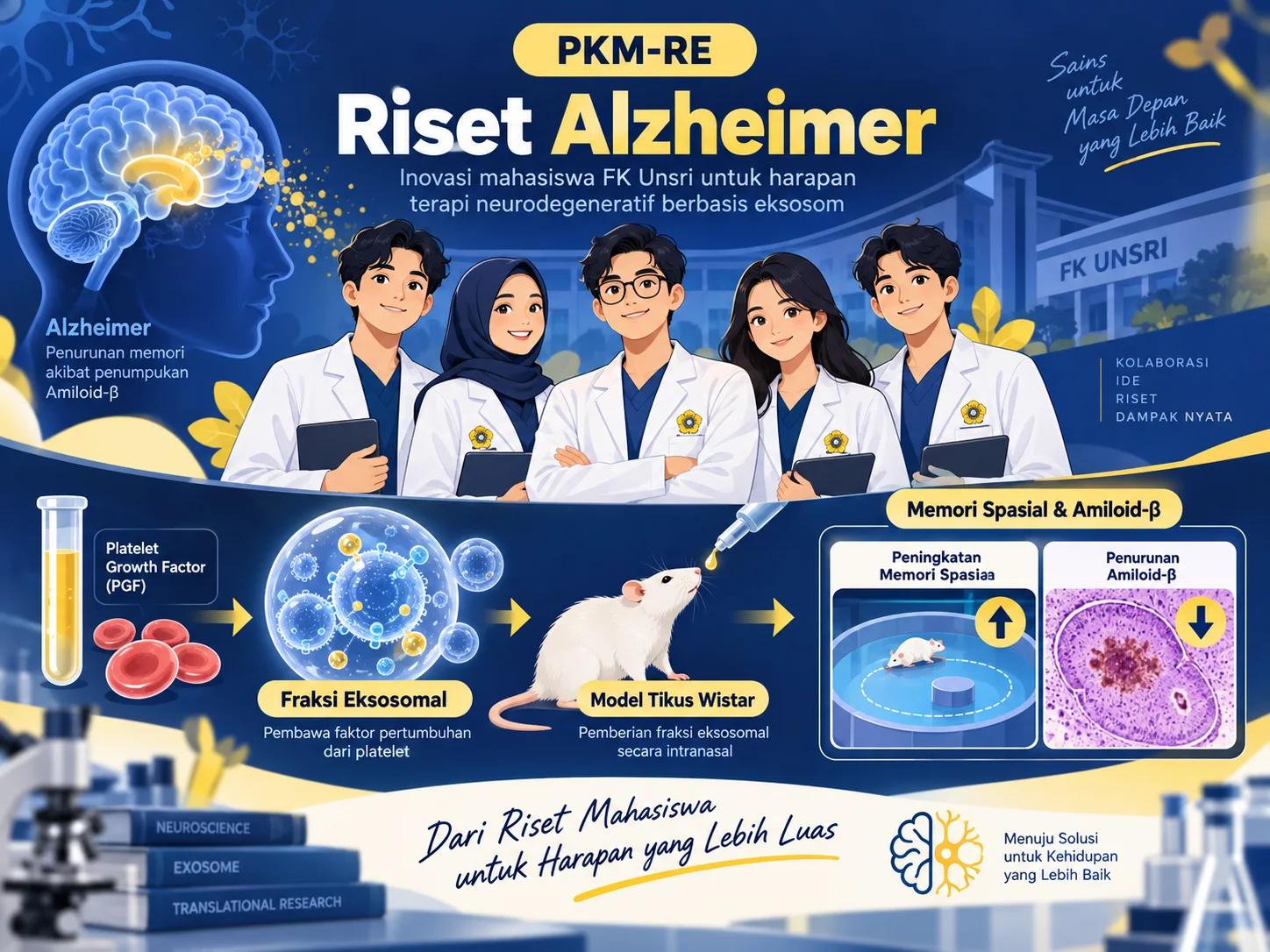
Thus, the PKM-RE activity carried out by the five FK Unsri students did not stop at the development of scientific ideas but extended to the execution of experiments and the evaluation of research results.
Direct student involvement in research also provided experience in various research stages, including method development, experimental execution, data collection, and result interpretation.
Understanding Alzheimer's from a Broader Perspective
This research also provided the students with the experience of viewing Alzheimer's from a broader perspective.
Alzheimer's is not only related to a decline in memory but is a disease that can affect cognitive function and an individual's quality of life.
The impact is also felt by the patient's family and surrounding environment, especially as patients may require assistance in performing daily activities.
Therefore, the development of research on Alzheimer's must go hand-in-hand with increasing public understanding of brain health, cognitive function, and neurodegenerative disorders.
Although they have generated data from a series of experiments, the team emphasized that the research is still at the preclinical stage using animal models.
The results of this study cannot yet be equated with the success of a therapy in humans.
Further research is still required, including safety testing, efficacy studies, and other research stages before any approach can be considered for development toward clinical use.
Through this PKM-RE, the five FK Unsri students gained space to develop research skills while exploring scientific approaches in Alzheimer's disease research.
Author: Inez Shafa Damhudi





Comments 0
Write a Comment Share your response