

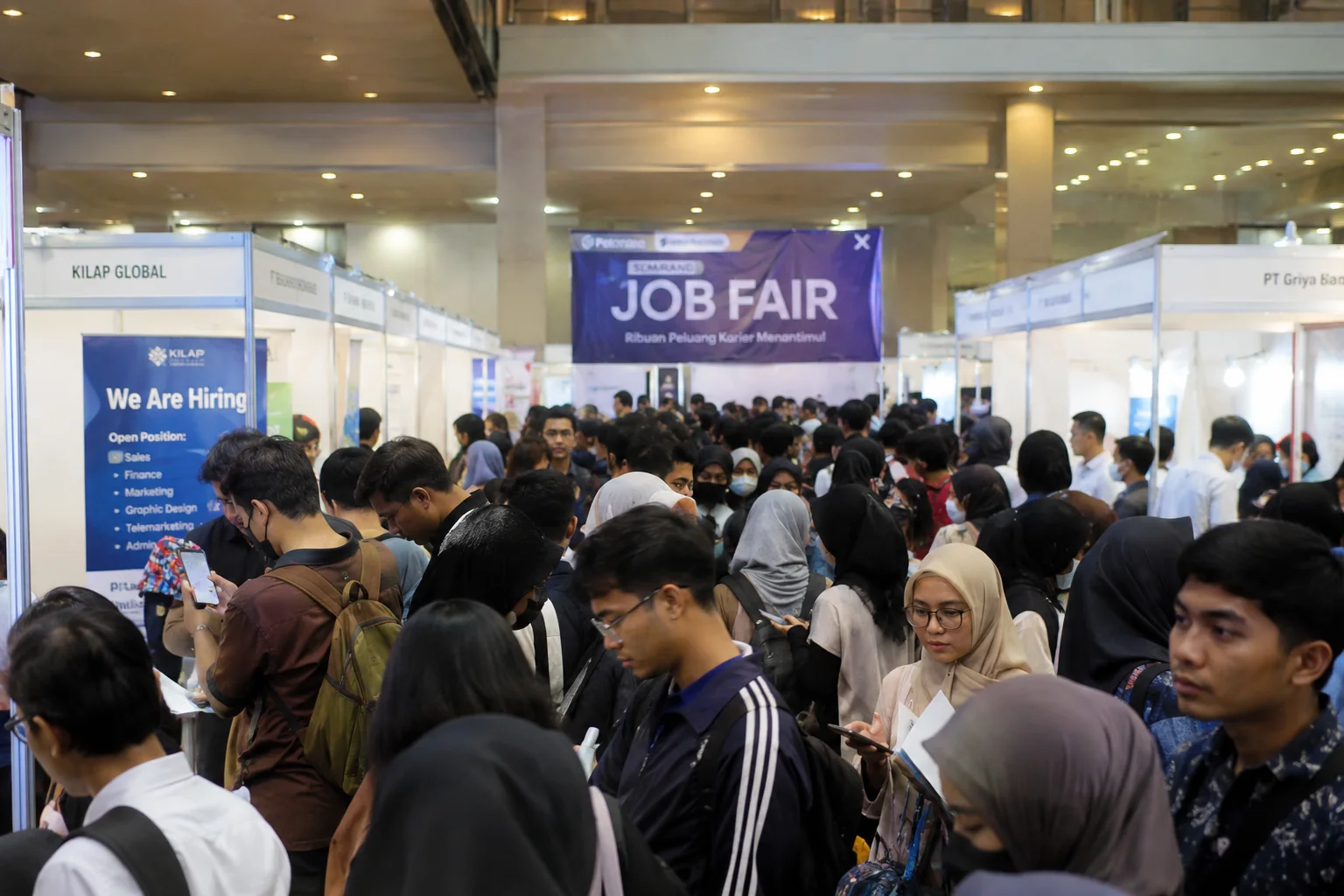
JurnalPost.com - Some time ago, while watching television, my attention was drawn to a CNN Indonesia report on the bustling job fair or job fair at the Independent Workforce Expo 2026 in Jakarta. The report, later uploaded to YouTube under the title “Parents and Children Compete for Jobs,” illustrated the intense competition people face in securing employment.
Thousands of job seekers crowded the venue in hopes of finding an opportunity. Interestingly, those present were not just young people who had recently finished their education, but also more mature age groups, including job seekers aged 40 and above.
According to the CNN Indonesia report (2026), 8,000 applicants attended in person, while approximately 40,000 others accessed the job fair online. This figure illustrates both the high level of enthusiasm and the community's desperate need for employment opportunities. However, behind the long queues and the volume of applications submitted, there is no guarantee that every job seeker will secure the position they desire.
This phenomenon reflects the employment issues that remain a major challenge in Indonesia.
Based on data cited by Ridwan (2026), the number of unemployed people in Indonesia in August 2026 reached 7.38 million individuals, with the youth demographic being one of the most affected groups.
Amid increasingly tight job competition, securing a position in the formal sector is no easy feat. Many job seekers must send applications to various companies, undergo repeated selection processes, and face rejection without any certainty of when they will eventually find work.
This situation is also visible on social media. Various stories about the difficulty of finding work, experiences with interviews, and the anxiety of being unemployed for months have become part of daily discourse in the digital space.
When formal job opportunities cannot accommodate the entire workforce, some members of society eventually seek alternative income through various economic activities.
It is in these conditions that community creativity flourishes, including through project-based work, self-employment, and various services that leverage digital technology advancements.
The Gig Economy as an Alternative Amid Scarce Job Opportunities
The limited availability of formal jobs is driving some people to seek income sources outside of conventional employment systems.
This phenomenon can be seen in the growth of work as ride-hailing partners, creative workers, freelance service providers, and food and beverage entrepreneurs.
This work pattern is closely related to the concept of gig economy or the gig economy.
The term gained widespread attention when journalist and former The New Yorker editor Tina Brown used it in an article for The Daily Beast during the financial crisis of 2009. This concept describes the tendency of people to combine various freelance jobs, short-term projects, and consulting activities to meet their economic needs (Hasija et al., 2020).
In general, the gig economy is a labor market system that relies on independent workers, freelancers, or project-based contracts for a specific duration.
Unlike formal jobs that typically provide a fixed monthly income, workers in the gig economy generally earn income based on tasks, projects, or services successfully completed (Biscontini, 2017; ILO, 2025).
The term gig was originally used in the entertainment world to describe short-term jobs or performances. As the economy evolved, the term was adopted across various work sectors.
The development of digital platforms has further expanded gig economy practices by connecting service providers with consumers more easily.
For some, this system offers time flexibility and opportunities for additional income. However, for groups struggling to secure formal employment, the gig economy is often not just a choice, but a survival strategy.
The problem is that more and more people are trying to start businesses or offer services, while purchasing power and the number of consumers do not always grow proportionally.
As a result, competition also occurs in the informal sector. Creative workers must seek opportunities from various activities, ranging from bazaars and corporate events to community celebrations and music concerts.
Music Concerts and the Growth of Creative Economy Opportunities
Music concerts are no longer just entertainment spaces for fans and the general public. Behind the excitement of the stage, there are various economic activities involving small business owners and creative workers.
The momentum of concerts is utilized by the community to offer a variety of products and services, such as make-up artists (MUA), hairstylists, polaroid photography services, merchandise sellers, lightstick rentals, high-quality camera phone rentals, and group travel services to concert venues.
These various activities show that a single entertainment event can create income opportunities for many groups in society.
One interesting example is the development of specialized makeup services for concert fans, particularly within K-Pop fan culture.
For some fans, attending a concert is not just about watching their idol perform, but also an opportunity to express themselves through fashion and makeup.
They want to look their best on a day they consider special. This condition has opened up opportunities for MUAs to offer concert-specific makeup services.
While MUA work was previously more associated with weddings, graduations, or birthdays, they can now reach customers from music fan communities.
The services offered are increasingly diverse, ranging from eye makeup with glitter, gemstones, and bold-colored eyeshadow, to full-face makeup packages including hair or hijab styling.
For fans who lack self-styling skills or want a specific look, these services provide a practical solution.
Meanwhile, for service providers, concerts open up a new market that can be leveraged to increase income.
This phenomenon shows how needs arising from popular culture can evolve into economic opportunities.
Content Creators, Affiliates, and Digital Device Rentals
In addition to makeup services, the development of the creative economy around concerts is also visible through the activities of content creators and affiliate marketing.
Leading up to a concert, social media is usually filled with various fashion inspirations or outfits tailored to the concept and identity of the performing artist.
Content creators share recommendations for matching clothes, shoes, bags, and accessories such as necklaces, bracelets, belts, keychains, and various other trinkets.
Some creators then embed affiliate links that direct the audience to specific stores or products.
Through this scheme, they have the opportunity to earn a commission when a purchase is made via the shared link.
Activities that initially started as sharing fashion inspiration have evolved into a form of digital content monetization.
Another equally interesting phenomenon is the increasing need for devices to record artist performances during concerts.
In K-Pop fan culture, documentation in the form of performance videos or fancams is an important part of the concert-going experience.
Some fans not only want to enjoy the idol's performance in person but also want to capture it to watch again or share on social media.
However, many concert organizers implement restrictions on the use of professional cameras. This condition has created a business opportunity for renting mobile phones with superior camera capabilities.
Service providers offer devices with adequate recording quality to help fans document concert moments.
Even the performance documentation produced by fans has the potential to become part of community-based digital economic activity, although its commercial use must still respect organizer regulations and performance copyrights.
The existence of these businesses demonstrates the community's ability to read highly specific market needs.
Concert Open Trips as a New Business Opportunity
Not all fans live in the city where the concert takes place. When a major concert is held in Jakarta, for example, fans from various regions must consider travel costs, transportation access, and the safety of their return journey.
This need is what gave birth to various open trip concert services.
On social media, there are group travel service providers offering departures to concert locations from various cities.
These services generally accommodate the transportation needs of fans who want to travel together to the same destination.
According to discussions by Hardjosukanto (2026) and Aziizah (2026), limited access to transportation to concert venues is one of the opportunities for the growth of community-based travel services.
Interestingly, some of these services started from simple initiatives to find travel companions so that transportation costs could be shared.
As demand increased, these activities evolved into travel service businesses operated for every specific concert event.
This phenomenon shows that community creativity is not always manifested in physical products. The ability to identify problems and provide services that others need can also be a source of income.
However, like other gig economy activities, the sustainability of concert-based businesses is highly dependent on event schedules, the number of customers, and market conditions.
When the concert season ends or demand drops, income opportunities can decrease.
Community Creativity Amid Structural Vulnerability
It cannot be denied that the growth of the gig economy demonstrates the community's ability to adapt to economic pressure.
People are able to see opportunities, utilize technology, and create various forms of work that might not have been thought of before.
However, this phenomenon also presents fundamental issues.
Behind the creativity and independence of these workers lies a vulnerability that cannot be ignored.
Some gig workers lack guaranteed monthly income, adequate labor protection, or the welfare benefits generally available in formal employment relationships.
Their income can fluctuate based on the number of orders, projects, or available activities.
In the context of concert-based work, for example, income might increase when many events are taking place, but decrease when there are no activities to leverage.
Dependence on temporary work shows that the flexibility of the gig economy has two sides.
On one hand, this work offers freedom and entrepreneurial opportunities. On the other hand, income uncertainty can create sustained economic pressure.
Therefore, the increasing number of informal and project-based workers should not be viewed merely as proof of the community's success in creating business opportunities.
This phenomenon must also be read as a reminder that access to stable and decent formal employment remains an urgent need.
The government has a responsibility to expand job opportunities, improve the quality of the workforce, and ensure the existence of a protection system that reaches workers across various sectors.
Support for the creative economy is indeed important, but it should not be an excuse to ignore structural issues in the labor market.
Until When Must the Community Fend for Itself?
The community's creativity in facing economic difficulties is commendable. The emergence of various new businesses shows resilience and the ability to adapt amid limitations.
However, we need to ask a more fundamental question: until when must the community constantly create survival strategies when access to decent work is not yet evenly available?
Work should not only provide a momentary opportunity to earn income, but also be a path toward a safer, more stable, and dignified life.
The state needs to be present through labor policies capable of addressing these issues structurally.
The expansion of formal job opportunities, increased social protection, strengthening of workforce skills, and sustained support for small business owners are essential parts of this effort.
The community is indeed capable of turning limitations into opportunities. However, the ability to survive should not continue to be used as a substitute for the fulfillment of the right to obtain decent work and a livelihood.
Ultimately, the development of the gig economy presents a paradox. It showcases the creativity and independence of the community, but at the same time, it reveals the economic vulnerability that must still be faced.
As long as sustainable job opportunities and welfare protection are not adequately available, the growth of the creative economy will continue to raise questions about the extent to which the state has fulfilled its responsibilities toward the lives of its citizens.
References
Aziizah, F. (2026, 11 October). The “open trip” concert trend, a business niche amid limited transportation access. Kompas.id. https://www.kompas.id/artikel/open-trip-konser-celah-bisnis-di-tengah-keterbatasan-akses-infrastruktur
Biscontini, T. (2017). Gig economy. EBSCO Research Starters. https://www.ebsco.com/research-starters/business-and-management/gig-economy/
CNN Indonesia. (2026, 23 October). “Parents and children” compete for jobs [Video]. YouTube. https://youtu.be/dbWxUjG1J_Y
Hardjosukanto, F. F. (2026, 11 October). “Open trip” concert, shuttle business for the youth. Kompas.id. https://www.kompas.id/artikel/usaha-antar-jemput-ala-kaum-muda-mudi
Hasija, S., Padmanabhan, V. P., & Rampal, P. (2020, 1 June). Will the pandemic push knowledge work into the gig economy? Harvard Business Review. https://hbr.org/2020/06/will-the-pandemic-push-knowledge-work-into-the-gig-economy
International Labour Organization. (2025). Exploring the gig economy: Challenges and opportunities: A self-guided resource. https://doi.org/10.54394/NMBW0887
Nugroho, J., Hardian, V., Ismail, D. H., & Dwi Raharjo, J. S. (2023). Economic GIG in Indonesia: Challenges and opportunities for Gen Z and Millennials. Best Journal of Administration and Management, 2(1), 27–34. https://doi.org/10.56403/bejam.v2i1,112
Ridwan, A. (2026, 10 November). Youth dominate unemployment in Indonesia in August 2026. Databoks. https://databoks.katadata.co.id/ketenagakerjaan/statistik/6af1579211b41/anak-muda-mendominasi-pengangguran-di-indonesia-pada-agustus-2026
Singh, H. (2024). Gig workers: A comprehensive analysis of the rise, challenges, and future of the gig economy. International Journal for Multidisciplinary Research, 6(5). https://doi.org/10.36948/ijfmr.2024.v06i05.29525






Comments 0
Write a Comment Share your response