

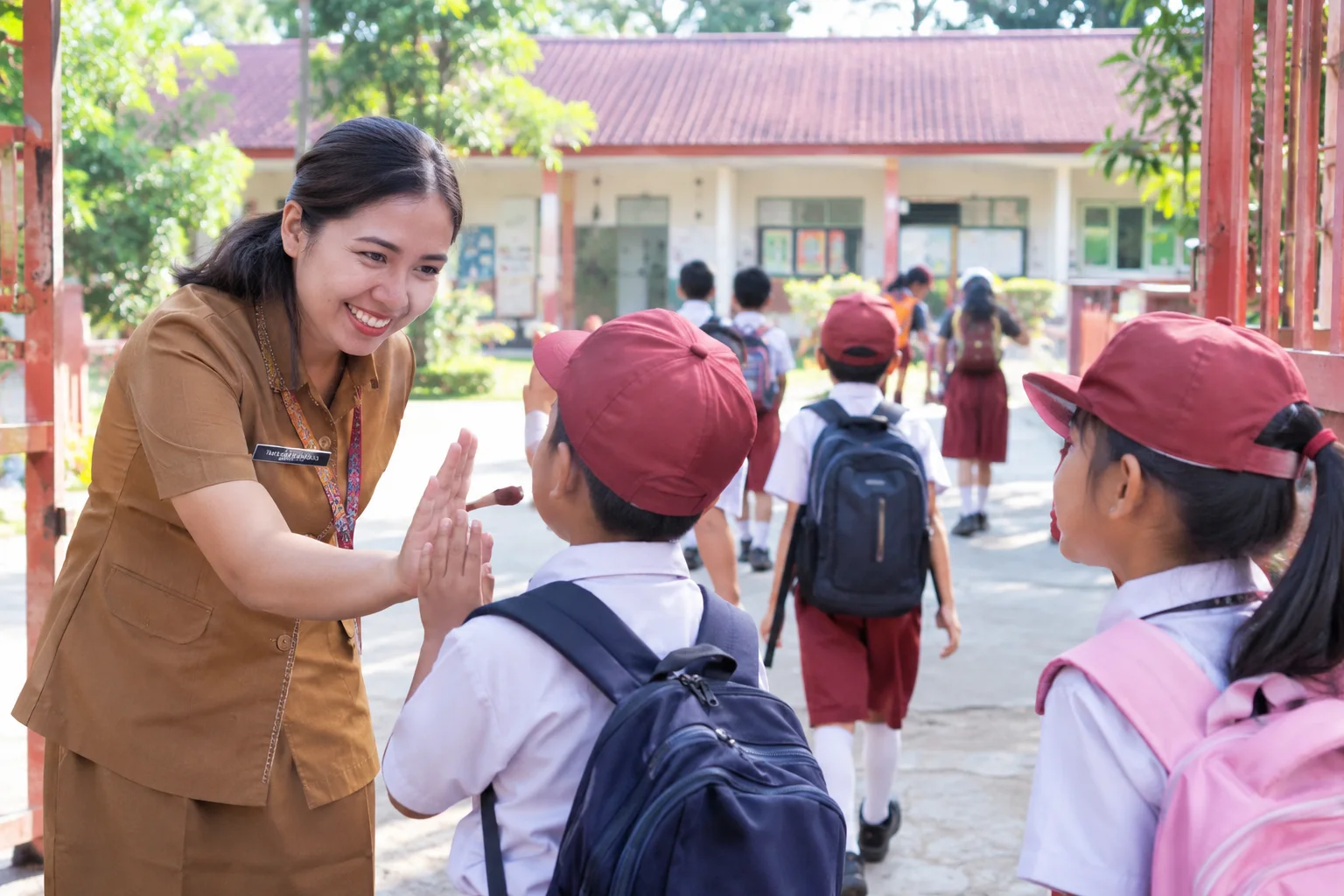
JurnalPost.com - A bright morning marks the start of activities at school. Teachers stand at the gate with friendly smiles, welcoming each student as they arrive. This smile is not merely a gesture of hospitality, but an effort to build a sense of security and trust with parents who entrust their children to the school.
Behind that smile, a teacher may be harboring various personal issues. Family problems, exhaustion, and work pressures are momentarily set aside to provide the best welcome for the students. However, few realize that behind an educator's smile lies a mental burden that is not always related to lesson plans, administration, or curriculum targets.
As technology advances and professional training becomes more accessible, many of a teacher's administrative tasks have become easier to manage. Yet, a new challenge has emerged that is equally draining: the rising demands and expectations of some parents or guardians toward teachers.
As a teacher, I feel that the current challenge in education is not just about helping children understand lessons, but also about maintaining good relationships with parents who hold diverse characters, perspectives, and expectations of the school.
Shifting Dynamics: From Full Trust to Excessive Oversight
One or two decades ago, the relationship between teachers and parents was generally built on a foundation of trust. When a child was reprimanded at school, parents typically sought to understand the reason for the action and supported the teacher in instilling discipline.
However, this dynamic has begun to shift. Some parents now exhibit tighter oversight of their children's activities at school, and it is not uncommon for them to question the professional decisions made by teachers.
This phenomenon can be linked to the concept of helicopter parenting, a parenting style where parents are overly protective, controlling, and involved in various aspects of their child's life.
The term helicopter parenting is rooted in the parenting pattern described by Haim Ginott in his book Between Parent & Teenager (1969). The concept gained further recognition through the ideas of Foster W. Cline and Jim Fay in 1990.
In an educational setting, this parenting style is evident when parents become overly involved in the learning process, question every decision a teacher makes, or attempt to shield their child from the consequences of their own behavior.
For example, when a child receives a low grade or a reprimand, some parents are more inclined to question the teacher's teaching methods rather than investigating the cause of the child's difficulties or behavior.
As a result, teachers sometimes find themselves in an uncomfortable position. They must explain the chronology of events, prepare evidence, and even defend actions that were actually taken to educate the student.
In certain conditions, the educational relationship slowly feels like a transaction between a service provider and a customer. Parents demand service that always meets their expectations, while teachers are seemingly expected to never make mistakes and to be available whenever needed.
In reality, education is not merely a service transaction. It is a collaborative process that requires trust, communication, and shared responsibility.
WhatsApp Groups and the Roots of Miscommunication
Advances in communication technology should facilitate the relationship between schools and parents. One such tool is the class WhatsApp group, used to convey information about lessons, school activities, and student progress.
Unfortunately, this ease of communication sometimes creates new problems. The boundaries between school interests, a teacher's personal time, and family matters become increasingly blurred.
It is not uncommon for a teacher to receive messages or phone calls at nine in the evening, or even later, just to ask about school assignments that could have been confirmed the following day.
There are also parents who share deeply personal family issues with teachers, even when those matters have no direct bearing on the child's learning activities.
Simple issues, such as a child's uniform getting dirty after playing during recess, sometimes escalate into lengthy complaints. Some parents even voice their protests openly in WhatsApp groups, where they are read by dozens of other guardians.
Situations like this make teachers feel as though they have become information service officers or a call center that must be ready to answer every question at any hour.
The problem is further complicated because communication via text message does not always convey intent and tone accurately. A teacher's report on a student's progress or behavior can be misinterpreted as a critique of how the parents raise their child at home.
The same applies when a teacher is slow to reply to a message. This delay is sometimes perceived as a lack of concern, even though teachers also have families, personal responsibilities, and a need for rest.
This condition can cause psychological pressure for educators. Some teachers eventually choose to be more cautious, or even reluctant to openly discuss a child's behavioral issues, for fear of triggering prolonged conflict with parents.
If this situation persists, the ones who suffer the most are the students. Children lose the opportunity to receive honest evaluations, proper guidance, and lessons on the consequences of their actions.
Building a Healthy Partnership: School and Home Are Not an Arena for Conflict
In my view as a teacher, school and home should be two educational environments that complement each other, rather than blame one another.
Teachers have the responsibility to educate and guide students while they are at school. Meanwhile, parents hold the primary role in shaping a child's character, habits, and life values within the family environment.
For these two roles to align, an agreement and healthy communication between the school and parents are necessary.
First, establish clear communication boundaries.
Schools, together with committees and parents, need to agree on reasonable communication hours. Outside of emergencies, questions or complaints regarding learning should be addressed during designated times.
Teachers also need time to rest and be with their families. When these needs are respected, teachers can return to their duties in better physical and mental condition.
Second, cultivate good faith and trust in teachers.
When a child complains about an incident at school, parents should not immediately jump to conclusions or blame a specific party.
Children understand events based on their own perspectives and experiences. Therefore, parents need to confirm the incident with the teacher using an open attitude and polite language.
Teachers, in turn, need to listen to parental concerns professionally. This way, issues can be resolved based on complete information rather than momentary emotions.
Third, use private communication channels for sensitive issues.
Not all issues need to be discussed in the class WhatsApp group. Complaints regarding a child's behavior, grading, or dissatisfaction with a teacher's actions should be conveyed through private messages or direct meetings.
Voicing criticism openly in a group has the potential to cause misunderstandings, embarrass certain parties, and damage previously established relationships.
Private communication provides space for teachers and parents to discuss matters more calmly and maintain the confidentiality of student information.
Fourth, give children space to learn from consequences.
One of the important tasks of education is to build a child's independence, discipline, and responsibility.
Parents need to understand that not every difficulty a child faces must be immediately resolved by an adult.
When a child forgets to bring a book, receives a low grade due to lack of study, or has a disagreement with a friend, these situations can be opportunities to learn how to be responsible and solve problems.
Of course, teachers and parents still need to provide appropriate support. However, support does not mean eliminating all consequences that should be part of the child's learning process.
By providing this space, children can develop resilience, decision-making skills, and the courage to face various challenges.
Restoring the Meaning of an Educator's Smile
Ultimately, teachers are not the opponents of parents, and schools are not service providers where the entire educational process can be dictated by the personal desires of each family.
Teachers and parents are partners with the same goal: to help children grow into knowledgeable, principled, independent, and responsible individuals.
Criticism of teachers is certainly still necessary as part of evaluation and improving the quality of education. However, criticism should be delivered in a constructive manner, based on clear information, and while upholding mutual respect.
Likewise, teachers must be open to input and realize that parental trust must be maintained through professional conduct, transparency, and care for the students' needs.
Quality education cannot be built by demanding perfection from one side alone. It requires the awareness that teachers and parents are both human beings who have limitations, responsibilities, and high hopes for the child's future.
I hope that the relationship between teachers and parents will no longer be filled with prejudice or excessive demands, but rather built through sincere cooperation.
Because when parents and teachers are able to sit side-by-side, listen to each other, and respect each other's roles, an educator's smile at the school gate will no longer be a mask for hidden exhaustion and pressure.
That smile will truly come from the heart, because the teacher feels trusted, respected, and valued as a partner in educating the next generation.






Comments 0
Write a Comment Share your response