

Introduction
The petrochemical industry is a strategic sector that plays a vital role in national economic growth and industrial development. Petrochemical products serve as raw materials for various downstream industries, ranging from plastics, textiles, and packaging to automotive, electronics, and pharmaceuticals. Consequently, the development of the petrochemical industry is not only about increasing production capacity but also about strengthening Indonesia's industrial independence and resilience.
Indonesia possesses significant domestic market potential. The Ministry of Industry 2022 notes that the national production capacity for several petrochemical commodities reaches approximately 7.1 million tons per year. However, this capacity has not yet fully met the needs of domestic industries.
According to Paramitasari 2025, Indonesia's domestic demand for major polymers is estimated to exceed 7.5 million tons per year, while domestic production capacity has historically only reached about 3 million tons. This condition results in more than 55 percent of national demand for these product groups still needing to be met through imports.
Compared to other countries in Southeast Asia, Thailand and Malaysia already possess petrochemical industries with large production capacities and relatively integrated supply chains. This indicates that Indonesia still has ample room to increase the capacity and competitiveness of its petrochemical industry.
One of the main issues facing Indonesia is the availability of raw materials. Products such as naphtha (naphtha), ethylene, propylene, polyethylene, and polypropylene remain essential parts of industrial demand that cannot yet be fully met through domestic production.
Naphtha is a hydrocarbon fraction obtained primarily from the oil refining process. This material can be used as a feedstock for olefin production, a group of chemical compounds that includes ethylene and propylene. These two compounds then become raw materials for various plastic products and other chemicals.
The high demand for naphtha and its derivatives opens opportunities for developing processing facilities and integrating oil refining with the petrochemical industry. By strengthening the upstream sector, Indonesia has the opportunity to build a more independent supply chain while reducing dependence on imports.
Opportunities for National Petrochemical Industry Development
The development of Indonesia's petrochemical industry has great prospects, especially since domestic demand is not yet fully met by local producers. A strong upstream industry will support the growth of downstream industries by providing more stable and efficient raw materials.
Currently, several major companies playing a role in Indonesia's petrochemical industry include PT Chandra Asri Pacific Tbk., PT Lotte Chemical Indonesia, PT Lotte Chemical Titan Nusantara Tbk., and PT Polytama Propindo.
Although these companies have contributed to national production, the large market demand highlights the importance of increasing production capacity and developing new industrial facilities.
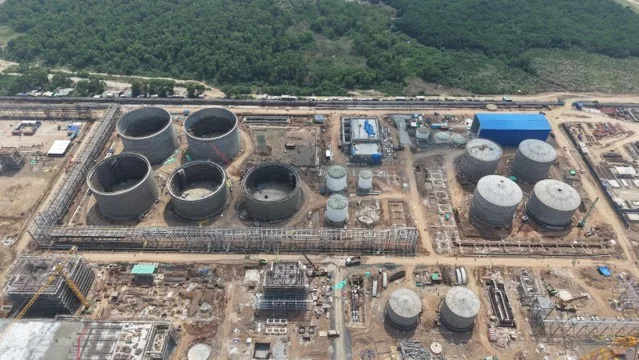
One example of petrochemical industry development is the Chlor Alkali–Ethylene Dichloride (CA-EDC) project developed by PT Chandra Asri Pacific Tbk. through its subsidiary, PT Chandra Asri Alkali (CAA), in Cilegon, Banten.
The project, which involves China Chengda Engineering Co., Ltd. as one of the main contractors, is designed to have a production capacity of approximately 400,000 tons of caustic soda (caustic soda) and 500,000 tons of ethylene dichloride (ethylene dichloride or EDC) per year.
Caustic soda is an important chemical used in the soap, detergent, paper, and alumina refining industries. Meanwhile, EDC is an intermediate material that can be processed into vinyl chloride, the raw material for making polyvinyl chloride (PVC), which is widely used in the construction and manufacturing industries.
The CA-EDC project is a concrete example of efforts to increase the domestic production capacity of strategic chemicals.
The development of this project also received investment support from Danantara Investment Management and the Indonesia Investment Authority (INA). According to an official statement from Danantara on 15 October 2026, both institutions have completed the strategic investment transaction for the project. Previously, the agreed joint investment value reached USD200 million, out of a total project value of approximately USD800 million.
This investment support demonstrates the importance of collaboration between industry players and investment institutions in strengthening the national industrial structure.
If other petrochemical projects can be developed sustainably, Indonesia has the opportunity to increase industrial value-added, create jobs, reduce imports, and strengthen the manufacturing sector's contribution to the national economy.
Challenges in Petrochemical Industry Development
Behind these opportunities, there are several challenges that must be faced. The three main issues affecting the development of the petrochemical industry are the availability of raw materials, energy requirements, and price competition with imported products.
1. Dependence on Imported Raw Materials
The availability of raw materials is a fundamental factor in the sustainability of the petrochemical industry. Dependence on imports makes domestic producers more vulnerable to changes in international commodity prices, currency exchange rates, and global logistics disruptions.
Geopolitical conflicts in the Middle East throughout 2026 provide an illustration of the magnitude of these risks. The conflict involving Iran, the United States, and Israel since February 2026 has caused security disruptions to shipping in the Strait of Hormuz, one of the world's strategic energy trade routes.
Disruptions to oil and gas shipments through this region have the potential to increase logistics costs, increase energy price volatility, and hinder the availability of industrial raw materials.
This situation serves as an important lesson for Indonesia to strengthen supply resilience through the diversification of import sources, increased domestic processing capacity, and the development of an integrated petrochemical industry.
Raw material independence cannot be achieved instantly. However, the greater the domestic capability to provide strategic raw materials, the better the position of the national industry in facing global market uncertainty.
2. Energy Availability and Costs
In addition to raw materials, energy is a critical component in petrochemical production activities. This industry requires large amounts of energy for various processes, including heating, separation, chemical reactions, and the operation of machinery and supporting facilities.
Natural gas plays an important role as it can be utilized as fuel, chemical feedstock, or an energy source for power generation.
In certain industries, natural gas is used to produce ammonia and methanol. Ammonia is an essential material for the fertilizer and chemical industries, while methanol is used as a raw material for various chemical compounds and industrial products.
PT Pupuk Indonesia (Persero) is one of the business groups that utilizes natural gas as a raw material for ammonia production.
The challenge facing Indonesia is not merely related to the amount of gas resources, but also to the certainty of allocation, distribution infrastructure, supply continuity, and competitive pricing.
Gas demand from the industrial sector must be managed alongside the needs of other sectors, including electricity and fertilizers. Therefore, integrated supply planning is essential to support the growth of the petrochemical industry.
The availability of energy at competitive prices can help lower production costs, increase operational efficiency, and strengthen the ability of national producers to face global competition.
3. Competition with Imported Products
Price competition is the next challenge. In trade, industrial consumers generally consider price, quality, supply consistency, and delivery reliability before selecting a supplier.
Imported petrochemical products with more competitive prices can be an option for downstream industries, especially if domestic producers face higher production costs.
In this context, Indonesia can study the development of the petrochemical industry in the People's Republic of China.
China has built a large production capacity through the development of integrated industrial zones, technology investment, infrastructure strengthening, and human resource development.
Large production scales and the connectivity between upstream and downstream industries allow for efficiency in raw material procurement, production processes, and product distribution.
However, increasing production capacity must also consider the balance between supply and demand. Paramitasari 2025 explains that a global petrochemical supply glut, including from capacity expansion in Asia, can depress selling prices and producer profit margins.
Thus, Indonesia's strategy should not only focus on building new factories. Industrial development must also be based on market needs, the selection of appropriate technology, production efficiency, and the ability to produce competitive products.
Strategies for Building a Sustainable Petrochemical Ecosystem
To leverage opportunities and address these various challenges, Indonesia requires a strong and integrated petrochemical industrial ecosystem.
There are four strategic steps that can be prioritized in the development of the national petrochemical industry.
First, strengthen the supply chain from upstream to downstream. Integration between oil and gas processing, basic chemical production, and downstream processing industries needs to be improved. This integration can help reduce dependence on imported raw materials, streamline distribution, and increase production efficiency.
Second, ensure energy availability at competitive prices. The government and industry players need to build long-term energy supply planning, including the development of gas, electricity, and industrial zone utility infrastructure. Supply certainty and energy costs are important factors in attracting investment.
Third, strengthen research and development (research and development or R&D). Mastery of production process technology needs to be a priority so that Indonesia does not only act as a technology user but is also capable of developing industrial innovation. Collaboration between companies, universities, and research institutions can drive energy efficiency, product quality improvement, and the development of more environmentally friendly technologies.
Fourth, strengthen government policy support. Ease of investment, regulatory certainty, financing facilities, fiscal incentives, and support for infrastructure development need to be implemented consistently. Such support must also be accompanied by good investment governance so that every project provides sustainable economic benefits.
In addition to these four steps, environmental and industrial safety aspects need attention. The petrochemical industry has complex process characteristics, thus requiring emission control, waste management, resource efficiency, and the application of strict safety standards.
Sustainable industrial development must be able to balance economic growth, business competitiveness, worker safety, and environmental protection.
Conclusion
Indonesia's petrochemical industry has great potential to grow in line with the increasing need for domestic industrial raw materials. High domestic demand, investment support, and the development of strategic projects are important capital for strengthening the national industrial structure.
However, this potential must be balanced with the ability to overcome major challenges, especially dependence on raw material imports, limited access to competitive energy, and competition with global producers.
Strengthening the upstream-to-downstream supply chain, energy supply certainty, technology development, and investment policy support are important steps to build a stronger industrial ecosystem.
Petrochemical industry independence does not mean closing trade with other countries, but rather increasing national capability in meeting strategic needs while strengthening competitiveness in the international market.
With an integrated industrial ecosystem, Indonesia is expected to be able to optimize petrochemical development opportunities, reduce vulnerability to global supply disruptions, and create greater value-added for the national economy.
Bibliography
Statistics Indonesia (BPS). 2026. Indonesian Foreign Trade Statistics: Imports 2025. BPS.
Danantara Indonesia. 2026. Danantara, INA, and Chandra Asri Group Complete Strategic Investment Partnership for CA-EDC Project, Strengthening Indonesia's Industrial Supply Chain. 15 October 2026.
Flanders Investment & Trade. 2023. Chemicals & Petrochemicals Industry in Malaysia.
Ministry of Industry of the Republic of Indonesia. 2022. Minister of Industry Targets Petrochemical Industry to Rank First in ASEAN.
Loft, P. 2026. Iran in 2026: Six Months After the US/Israeli Strikes. House of Commons Library.
Paramitasari, A. N. 2025. Indonesia's Petrochemical Industry. PEFINDO, September 2025.
Thiumsak, T. 2023. Industry Outlook 2023–2025: Petrochemicals. Krungsri Research.



Comments 0
Write a Comment Share your response