

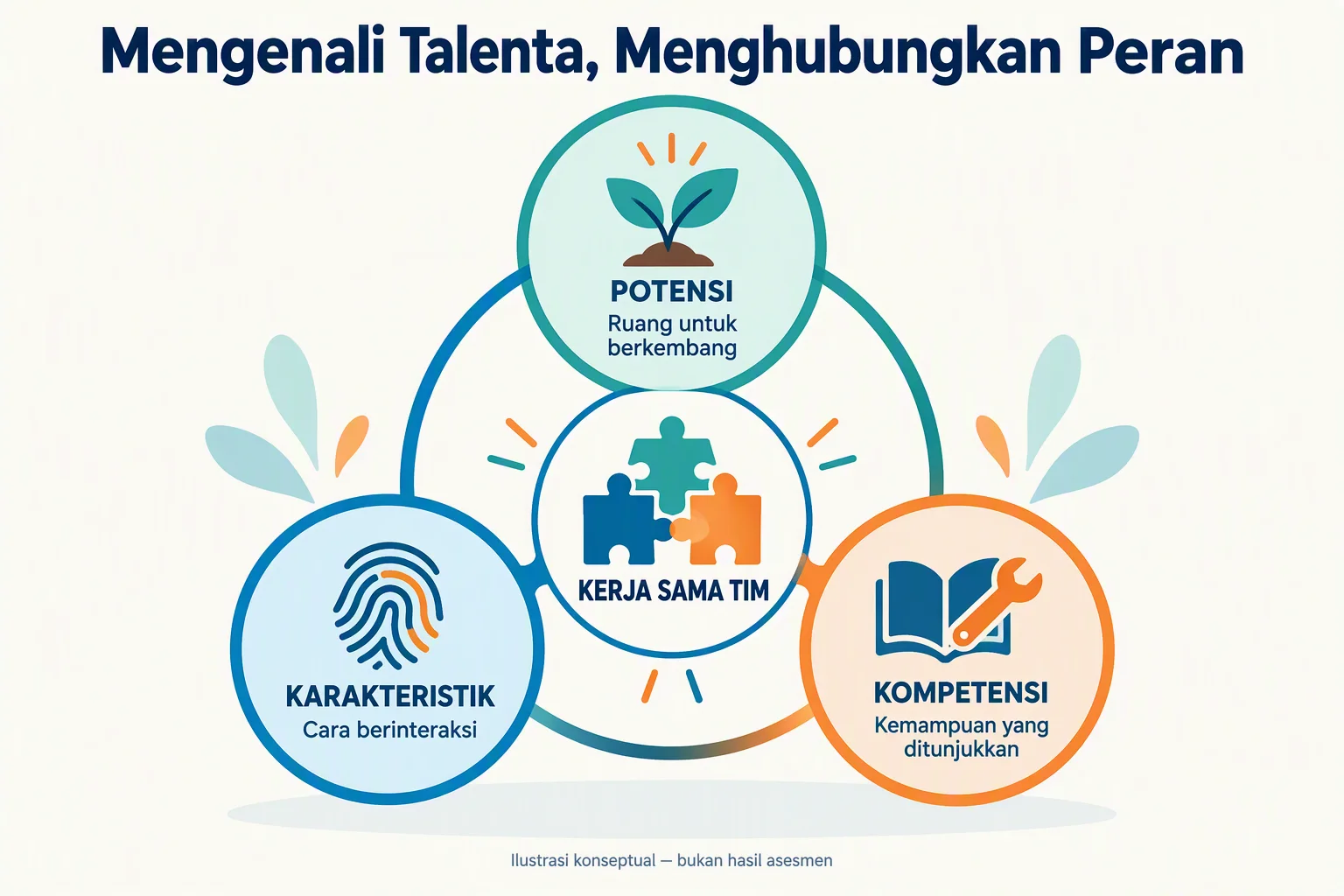
Recognizing Talent: Distinguishing Between Potential, Characteristics, and Competencies
For the purpose of this discussion, potential refers to capacity that can still be developed; characteristics refer to a person's tendencies when interacting and performing tasks; while competency is the knowledge, skills, and attitudes that can be demonstrated in action. Someone might have the potential to convey ideas but still needs practice in structuring a presentation. Conversely, the ability to write a report that is already evident does not mean that person must forever be placed as a writer.
This distinction is important so that the division of roles does not turn into labeling. In a study group, mapping should start from conversations about interests, examples of work results, and willingness to try new responsibilities. The question is not “Who is the best?”, but rather “What can we contribute, what do we want to learn, and what support do we need?”
Three Members, Three Areas of Contribution: A Fictional Illustration
Imagine three members receiving an assignment to compile an article and present it in class. They have one week to determine the topic, prepare materials, write the script, and practice the presentation. All actions and tendencies in the following sections are fictional to demonstrate choices in role division, not conclusions about actual personalities.
Indah Rosalina: Processing Materials into a Coherent Flow
In this fictional scenario, Indah Rosalina chooses to start the task by drafting key questions, grouping reading materials, and creating an outline. These habits illustrate a structured work characteristic. The competency illustrated is organizing information and connecting ideas so that the discussion does not jump around. The potential that can be explored is the ability to design a more comprehensive flow of discussion.
The group can offer her an initial role as an outline drafter, while still asking for her agreement. For that role to become a learning opportunity, Indah also tries to explain the opening section during presentation practice. Thus, the activity of processing materials does not limit her to tasks behind the scenes. In this design, the group agrees on a deadline for drafting the outline so that material review remains in line with the shared schedule.
Muhamad Rifki Maulana: Opening Conversations and Conveying Ideas
In this illustration, Muhamad Rifki Maulana tries several ways to open the presentation and invite other members to respond to his ideas. The simulated characteristic is a willingness to initiate conversations and try alternative delivery methods. The competency displayed through these activities is formulating messages orally and guiding discussions. His potential space lies in the ability to facilitate the exchange of ideas that still provides space for all members.
The initial role that can be agreed upon is guiding discussion practice and designing the presentation method. His learning opportunity is not to increase speaking time, but to practice listening, summarizing proposals, and checking the consistency of the message with the script. As a cross-role exercise, Rifki also drafts one section of the writing. That way, engaging delivery remains connected to the content understood by everyone.
Muhamad Sodikin: Connecting Plans with Implementation Steps
In this fictional story, Muhamad Sodikin proposes a task list, a shared folder, and a progress review schedule. These actions illustrate a work characteristic oriented toward concrete steps. The competency exemplified is organizing the sequence of activities and arranging files so they are easy for the group to use. The potential that can be tried further is coordinating interdependent work.
The group can agree on Sodikin as the initial schedule manager, not as the person who must bear all technical matters. His learning opportunity can be explaining the reasoning behind the sequence of tasks while also trying to draft the article's conclusion. If the schedule needs to be changed, the changes are discussed together. In this design, the task list serves to help coordination, not to control other members unilaterally.
Uniting Differences Without Locking Roles
The illustration brings together three needs in one task: coherent content, understandable delivery, and an organized work process. These three are not separate areas. The article outline needs to consider presentation time; the delivery method must follow the content; while the schedule needs to provide opportunities to revise the script. This meeting point is the center of teamwork.
For example, in a discussion simulation, the group faces a choice between adding material or finishing the draft immediately. Instead of viewing the difference as a personal issue, they return to the task criteria: is the additional material really needed to answer the main question? If needed, who is willing to prepare it and when will it be finished? If not, the material can be saved as a note. Differences of opinion are processed into decisions that have reasons and follow-up actions.
However, initial roles should not be considered fixed identities. Indah still has the opportunity to present ideas, Rifki tries to organize written materials, and Sodikin participates in developing the content. In this scenario, small rotations are designed so that each member gains new experience, while important decisions and final responsibilities remain shared.
From Mapping to Shared Work Habits
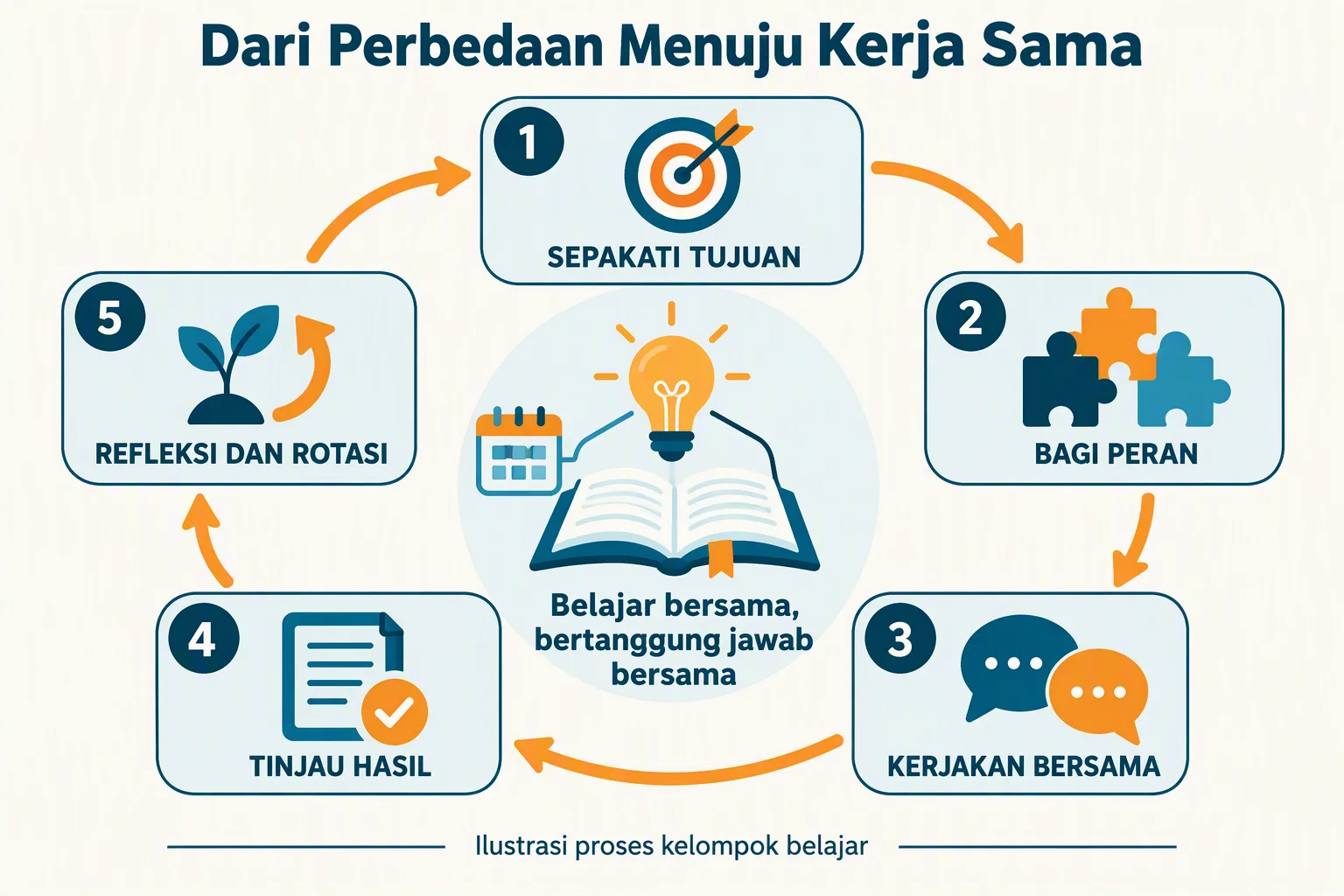
In this study group design, the first step is to agree on the results to be achieved. “Finishing the article” is still too general; the group needs to clarify the main question, the structure of the discussion, task requirements, and submission time. This agreement becomes a reference when new proposals arise, so the group does not have to repeat the conversation from the beginning.
The second step is to divide responsibilities through conversation, not assumptions. Each member expresses their interests, available time, and the parts they want to learn. Each task has a person in charge and a deadline, but remains connected to the tasks of other members. In this one-week example, the first two days can be used to agree on the outline and materials, the next three days to draft and review, and the last two days for revision and practice. This time allocation is just an example that can be adjusted.
The third step is to build actionable communication. Progress updates only need to answer three things: parts that are finished, obstacles encountered, and help needed. When there are obstacles, the conversation is directed toward tasks and solutions, not toward personal labeling. The sentence “This section does not have an example yet; let's complete it” is more appropriate for learning goals than blaming the person who wrote it.
The fourth step is to review the shared product before it is submitted. The group can check whether the main question has been answered, whether the sections are connected, whether the sources used are cited correctly, and whether the presentation matches the script. The focus of the review is on the quality of the results and the smoothness of the process, not on comparisons between members. Everyone also needs to understand the entire discussion, not just the part they wrote.
The final step is to reflect after the task is completed. Simple questions can be a starting point: what agreements helped, what process obstacles need to be improved, and what new experiences do we want to try on the next task? Reflection is not used to find the best or weakest member. The goal is to improve how the group works while keeping learning opportunities open for everyone.
Conclusion: Not Becoming the Same, But Learning to Complement Each Other
The fictional illustration of Indah Rosalina, Muhamad Rifki Maulana, and Muhamad Sodikin invites us to see talent analysis as a conversation about contributions and opportunities to grow. Potential shows what can be tried, characteristics help discuss how to work, and competencies become the basis for determining the support needed. These three are not reasons to fix someone in one role forever.
Ultimately, the teamwork to be built is not a state where all members always agree or do the same thing. The goal is the willingness to agree on a direction, keep responsibilities, discuss obstacles, and provide space for learning. A team does not have to consist of similar people; a team needs to provide ways for differences to be worked into a shared result.








Comments 0
Write a Comment Share your response