

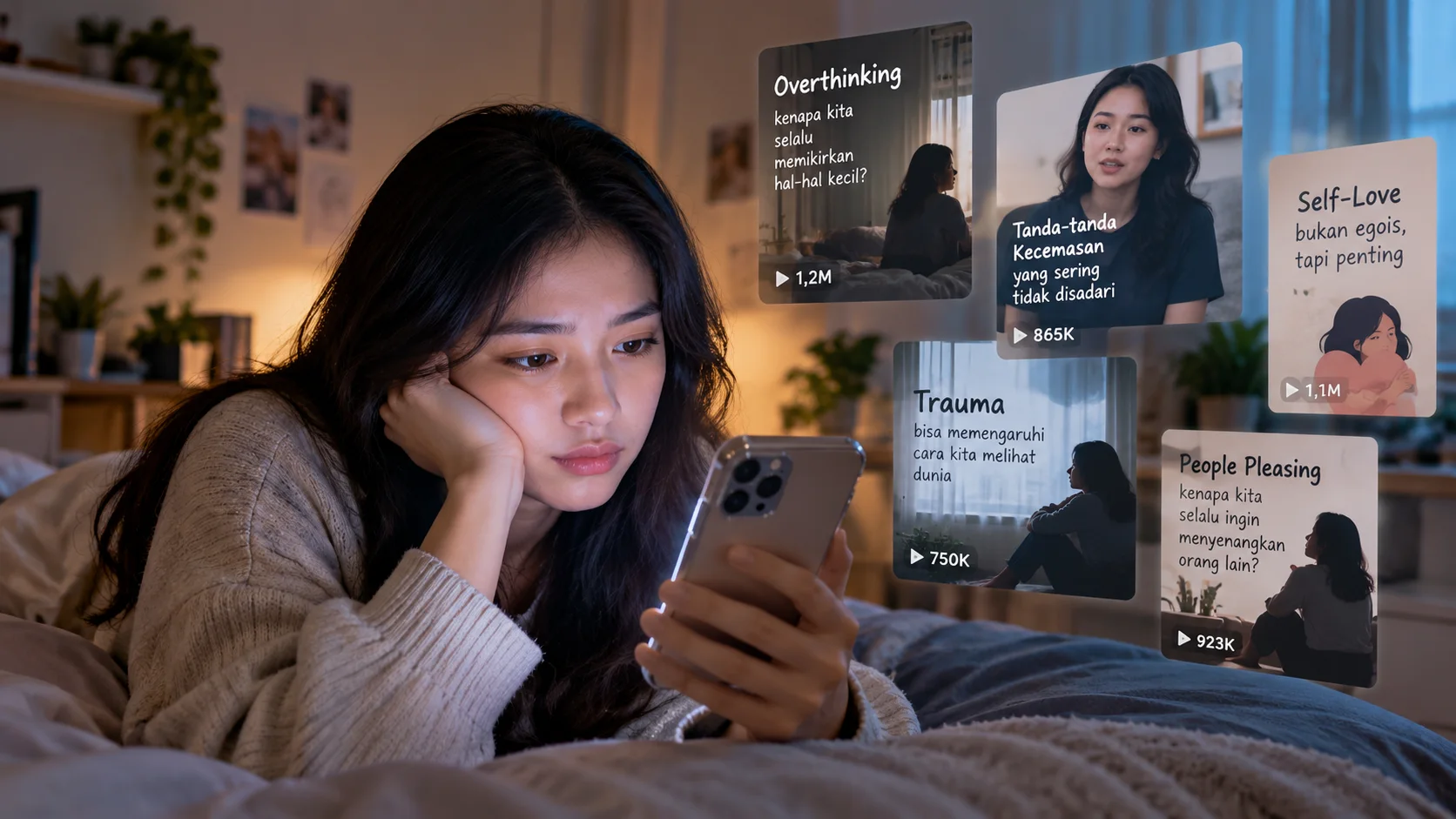
JurnalPost.com — Have you ever watched content about anxiety, overthinking, trauma, or people-pleasing, and spontaneously thought, “Why is this so relatable?” Then, you start searching for similar videos, matching your personal experiences with the described symptoms, until you feel you have a specific psychological disorder.
This experience is increasingly relevant as mental health information becomes easily accessible on social media. Short, relatable content that uses simple language makes psychological issues feel easier to understand. However, when content feels perfectly aligned with our own lives, does that mean the explanation is correct?
When Content Feels Highly Personal
One psychological explanation that helps us understand this phenomenon is the Barnum effect. This concept describes a person's tendency to accept general descriptions as if they specifically describe themselves.
Snyder et al. (1977) discussed how people accept personality interpretations that feel personal, even though the characteristics presented could apply to many people.
When content says, “You often appear strong in front of others, but you actually worry about small things alone,” the sentence may feel very accurate because many people have experienced similar situations.
When personal experiences feel represented, we tend to assume the content understands us deeply. In reality, this alignment does not necessarily mean that all the explanations within the content are true.
This phenomenon is also related to confirmation bias, which is the tendency to pay attention to information that supports pre-existing beliefs (Nickerson, 1998).
After feeling that one has anxiety, a person might pay more attention to videos mentioning signs of anxiety and recall experiences that fit. Conversely, experiences that do not align with the explanation might be overlooked, making the initial belief feel even stronger.
From Feeling Relatable to Self-Diagnosis
Feeling connected to mental health content does not always lead to a diagnosis. However, research by Hasan et al. (2023) shows that exposure to social media posts that normalize anxiety can increase the likelihood of someone engaging in self-diagnosis of anxiety.
This relationship is explained through identification with the person featured in the post. In other words, when someone feels they have similar experiences to the person in the content, they can more easily link that person's condition to themselves.
According to Amrah et al. (2024), the process of self-diagnosis can begin with a personal condition that feels disruptive, which is then linked to information about mental disorders on social media. The study also identified cognitive bias as a factor supporting this process.
These findings do not mean that everyone who feels a connection to content is definitely engaging in self-diagnosis. Mental health content can also help someone realize difficulties they previously did not understand and encourage them to seek help.
The problem arises when a similarity in experience is immediately taken as proof that one has a specific disorder.
Social Media: A Source of Information and a Challenge
Social media provides a space for people to share experiences, find support, and learn about mental health. However, mental health content on social media does not always provide accurate information.
Turuba et al. (2025) analyzed 970 TikTok videos with the hashtag #mentalhealth and found that 106 out of 319 videos provided advice or information deemed misleading by clinical experts.
Some videos provided inaccurate explanations or failed to consider context, including regarding symptoms of ADHD, attachment styles, and trauma responses. Researchers also found that videos deemed misleading received higher user engagement.
These findings show that popular content does not necessarily have a strong scientific basis. Personal stories can help viewers feel understood, but one person's experience cannot be used to explain everyone's condition.
Therefore, it is important to evaluate mental health information critically, especially when content feels like it perfectly describes your personal experience.
A mental health diagnosis cannot be determined solely based on a few symptoms that seem to match your own experience. Clinical evaluation must consider the type of symptoms, onset, frequency, duration, severity, and their impact on daily life.
Professionals must also consider alternative explanations before establishing a diagnosis (IGDA Workgroup, 2003; McKee & Brahm, 2016).
In the context of social media, research by Armstrong et al. (2025) shows that mental health information found online can play a role in shaping a person's beliefs regarding their own diagnosis.
Therefore, feeling that content is relatable can be a starting point for recognizing your condition, but it is not enough to confirm the presence of a mental disorder.
Understanding Yourself Without Rushing to Label
How should we respond to mental health content that feels highly relevant?
1. Use content as a starting point to recognize your own experiences, not as a diagnostic conclusion.
Firmansyah and Astuti (2026) found a positive correlation between help-seeking behavior and self-diagnosis. The researchers explained that self-diagnosis can be an initial stage for understanding one's condition and seeking information or help, but self-assessment cannot replace professional evaluation.
Feeling that content is relatable can encourage us to seek further understanding, not confirm that we have a specific disorder.
2. Verify the information you find.
Pay attention to who is delivering the information. Prioritize content created by professionals that cites scientific sources and explains the limitations of the information provided.
Avoid concluding a diagnosis based solely on a short list of symptoms or someone else's experience on the internet.
3. Observe your own experiences more comprehensively.
Note when a feeling or behavior arises, how often it occurs, and whether it affects your daily activities.
If these feelings or difficulties persist, cause distress, or interfere with daily life, you can consult a psychologist or a healthcare professional.
Research by Saniatuzzulfa et al. (2026) shows that some respondents with indications of common mental disorders try to solve problems themselves or ask friends for help, while only a portion seek professional help.
These findings remind us that recognizing difficulties and obtaining professional help are two different processes.
4. Try to understand your experiences without immediately judging or labeling them.
Patria and Rismarini (2026) found that self-compassion significantly predicts self-stigma in seeking help among students, with a 12.5% contribution to the explanation.
These findings do not directly test how to respond to social media content, but they provide a basis for discussing the importance of a more compassionate attitude toward oneself.
We can acknowledge that an experience feels heavy without immediately concluding that we have a specific disorder.
Ultimately, feeling relatable to mental health content is not something to be blamed. Such feelings can be a starting point for recognizing your needs and experiences.
However, understanding yourself requires more than just finding content that feels right. We need to look at experiences as a whole, consider various possibilities, and seek help when necessary.
The goal of recognizing mental health is not to find the most fitting label, but to understand yourself more accurately and find healthy ways to live your life.
About the Author
Ni Nyoman Yulia Niti Darma is a Master of Psychology student at Soegijapranata Catholic University. Her writing focuses on mental health literacy and the phenomenon of self-diagnosis in the digital era. Through a psychological perspective, she highlights the importance of approaching mental health content critically and understanding personal experiences within their context, without rushing to apply psychological labels to oneself.










Comments 0
Write a Comment Share your response