

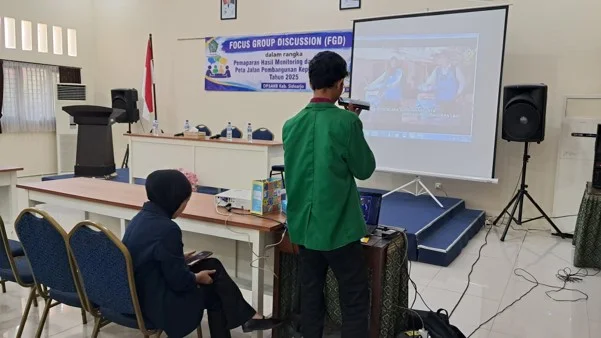
SIDOARJO, JurnalPost.com — The Sidoarjo Regency Office of Women's Empowerment, Child Protection, and Family Planning (DP3AKB) through its Population Control Division held a Focus Group Discussion (FGD) to present the results of the Monitoring and Evaluation (Monev) of the Sidoarjo Regency Population Development Roadmap (PJPK) for the years 2025–2029.
This activity is part of the Sidoarjo Regency Government's efforts to ensure that population development is implemented in a directed, measurable, integrated, and sustainable manner.
Through this forum, the DP3AKB and relevant regional government agencies (OPD) discussed program progress, indicator achievements, and various obstacles encountered in executing the population development action plan.
Evaluating the Implementation of the Population Development Roadmap
The Population Development Roadmap is a planning document that serves as a guide for the local government in formulating and implementing integrated population development policies.
This document covers various interrelated aspects, ranging from education, health, and employment to population administration, family development, and environmental conditions.
Because it involves many sectors, the implementation of the PJPK requires inter-agency coordination so that every program executed has aligned directions and targets.
Monitoring and evaluation are essential instruments for determining the extent to which the established action plans have been implemented by each regional agency.
This process focuses not only on achieving targets but also on assessing the alignment between planned programs, performance indicators, and actual results in the field.
During the FGD, the results of the PJPK monitoring and evaluation for the years 2025–2029 were presented for collective discussion. Through this presentation, participants were able to examine the progress of the action plan and identify areas requiring improvement.
FGD Serves as a Forum for Coordination and Synchronization Among Agencies
The FGD organized by the Sidoarjo DP3AKB also served as a coordination space for regional agencies and stakeholders involved in population development.
This forum provided an opportunity for each agency to discuss the implementation of action plans, the progress of population development indicators, and obstacles in program execution and data reporting.
The involvement of various regional agencies is considered crucial because population issues cannot be resolved through a single-sector approach.
Health programs, for instance, are linked to improving the quality of the population. The same applies to education, employment opportunities, population administration services, and family development.
Through collective discussion, each agency is expected to understand how its duties and authorities relate to the population development goals of Sidoarjo Regency.
Beyond serving as an evaluation tool, the FGD was also aimed at strengthening cross-sector communication to prevent programs from operating in silos.
Effective coordination is necessary to reduce the potential for overlapping activities, increase program effectiveness, and ensure that every action plan contributes to the established development targets.
Strengthening Data and Indicators as a Priority
One of the most important aspects of the PJPK monitoring and evaluation process is the availability of accurate, complete, and accountable data.
Data serves as the foundation for measuring program progress and determining the achievement levels of population development indicators.
Therefore, the completeness of the action plan and indicator reporting by each agency is a key focus during the evaluation process.
Systematically organized reporting will make it easier for the local government to identify programs that have met their targets and those that still require follow-up.
To support this process, the use of the SIPANDU PJPK Information System represents a step toward the digitalization of population development data management.
This system is expected to assist in the collection, management, monitoring, and analysis of data in a more structured manner.
The use of information technology is also expected to facilitate coordination between the DP3AKB and relevant agencies, particularly in submitting action plan progress reports and monitoring performance indicators.
With better-organized data, the results of monitoring and evaluation can be used as a basis for policy formulation and regional development decision-making.
Strengthening Synergy for Sustainable Population Development
Through this FGD, the Sidoarjo DP3AKB encouraged the strengthening of synergy and commitment among all regional agencies to support the success of the Population Development Roadmap for the years 2025–2029.
Population development is not the responsibility of a single agency but requires the involvement of various sectors according to their respective duties and authorities.
The results of the monitoring and evaluation are expected to serve as a basis for improvements in planning, program implementation, and the control of population development in the next period.
Furthermore, the discussion results can be used to determine follow-up steps for action plans and indicators that have not yet reached their targets.
Through continuous coordination, the Sidoarjo Regency Government is expected to increase the effectiveness of population development programs while strengthening the quality of services provided to the public.
These efforts are part of a regional development commitment that is oriented not only toward achieving administrative indicators but also toward improving the quality of the population, family welfare, and sustainable community development.








Comments 0
Write a Comment Share your response