

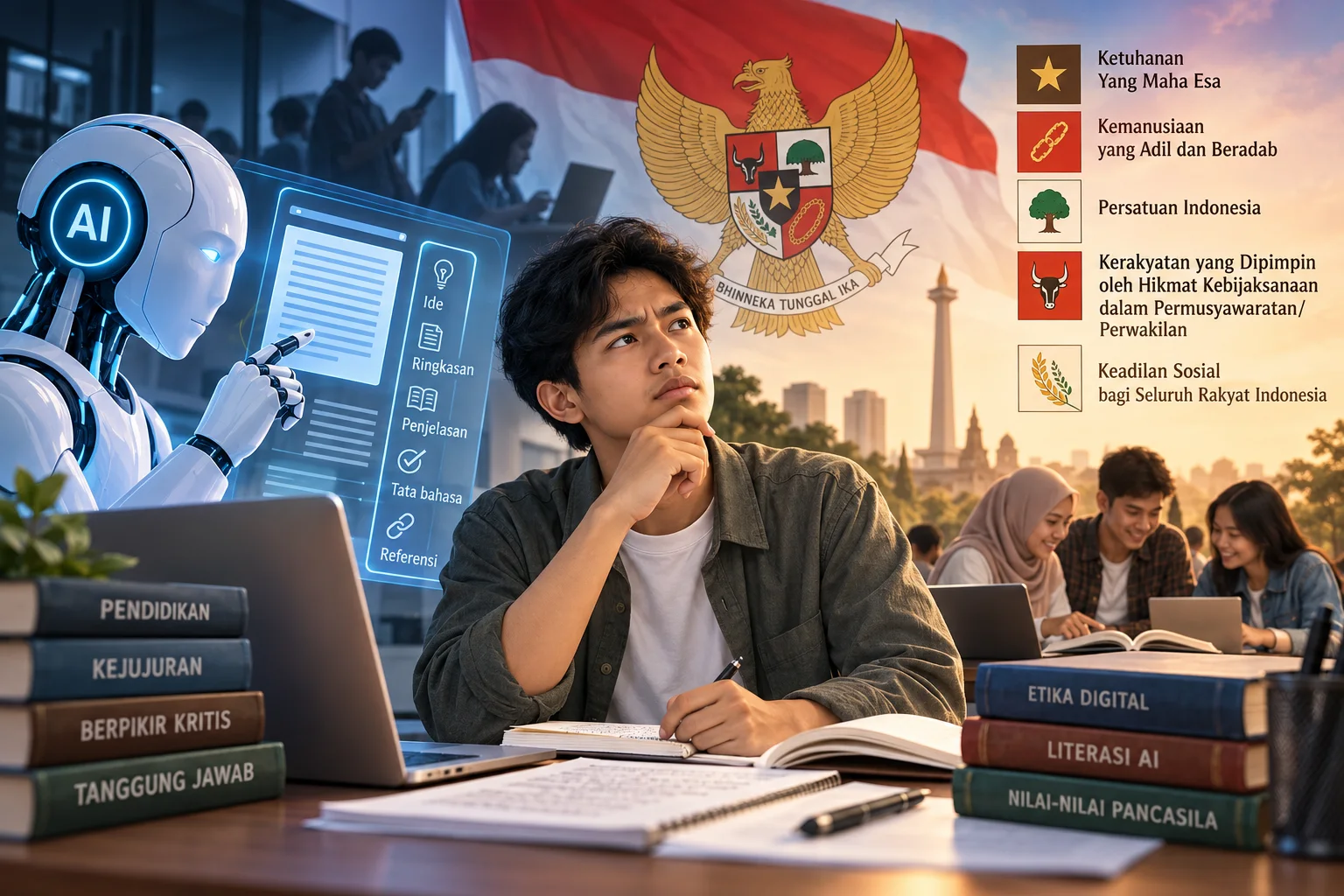
JurnalPost.com - The development of artificial intelligence or Artificial Intelligence (AI) has brought major changes to human life. This technology is capable of helping to draft text, answer questions, summarize material, and generate various ideas quickly. For students and university students, AI can simplify the learning process. However, this convenience also poses challenges to honesty and responsibility.
Problems arise when AI is no longer used as a tool, but replaces the entire human thinking process. Some students may copy AI answers without understanding the content. As a result, assignments that should be a means of learning become merely an activity to obtain grades. In this condition, Pancasila is important as a moral guide in using technology wisely.
Who is facing this issue? Students, university students, teachers, lecturers, and the general public need to understand the impact of AI usage. This technology influences how humans obtain information, complete work, and make decisions.
What is the main issue? The issue is the irresponsible use of AI. For example, a student asks AI to create an entire article, then submits it as their own work without reading or checking the content. This action can eliminate the opportunity to learn and create issues of academic integrity.
Why does this need attention? Education does not only aim to obtain grades, but also to form individuals who are honest, independent, and responsible. If someone continues to rely on AI, their ability to think critically and express their own opinions may not develop.
Nevertheless, the use of AI does not always mean cheating. AI can help explain difficult material, improve grammar, and provide inspiration. The most important thing is that users continue to understand the material, verify the accuracy of information, and follow applicable rules.
The values of Pancasila can be a foundation in facing the challenges of AI usage. The first principle, Belief in the One and Only God, reminds humans to uphold morality and honesty in every action.
The second principle, Just and Civilized Humanity, teaches that technology must help humans develop, not eliminate their responsibility. The use of AI must also respect the dignity and rights of others.
The third principle, The Unity of Indonesia, reminds users not to spread false information that can trigger hatred and division. Information generated by AI needs to be checked before being shared with the public.
The fourth principle, Democracy Guided by the Inner Wisdom in the Unanimity Arising Out of Deliberations Amongst Representatives, emphasizes the importance of thinking critically before making decisions. AI answers should not be accepted blindly without considering the reasoning and truth behind them.
The fifth principle, Social Justice for the Whole of the People of Indonesia, teaches the importance of fair opportunities in obtaining the benefits of technology. Schools and universities need to pay attention to students who have limited devices or internet access.
How can we apply honesty in using AI? First, students should try to understand the material and formulate their own ideas before asking for AI assistance. Thus, technology functions as a learning support, not a replacement for thought.
Second, every piece of information must be checked through books, scientific journals, or trusted sources. AI can produce incorrect answers, so users need to be critical.
Third, the use of AI must follow the rules set by teachers, lecturers, or educational institutions. If its use is required to be disclosed, students must do so honestly.
Fourth, teachers and lecturers need to encourage learning through discussion, presentations, and personal reflection. This method helps ensure that students truly understand the assignments they are working on.
When and where should the value of honesty be applied? This value must be applied every time AI is used, whether in schools, universities, workplaces, or on social media. Honesty is not just a written rule, but a habit that needs to be practiced consistently.
Artificial intelligence provides many benefits, but its use also presents challenges to human honesty and independence. The main issue is not just the use of AI, but how humans utilize that technology.
Pancasila can serve as a guide so that technological progress remains in line with moral values and responsibility. Humans need to verify information, think critically, and take responsibility for every action.
Ultimately, intelligence is not only measured by the ability to obtain answers quickly, but also by the ability to understand problems and determine the right course of action. AI may help humans think, but it should not replace the entire human thinking process and responsibility.








Comments 0
Write a Comment Share your response