


By: Wielfred Leorenzo/25.E2.0042/
Master of Psychology Student - Soegijapranata Catholic University
When Soulful Calling Meets Exhaustion: Hope, Gen Z, and the Art of Setting Boundaries
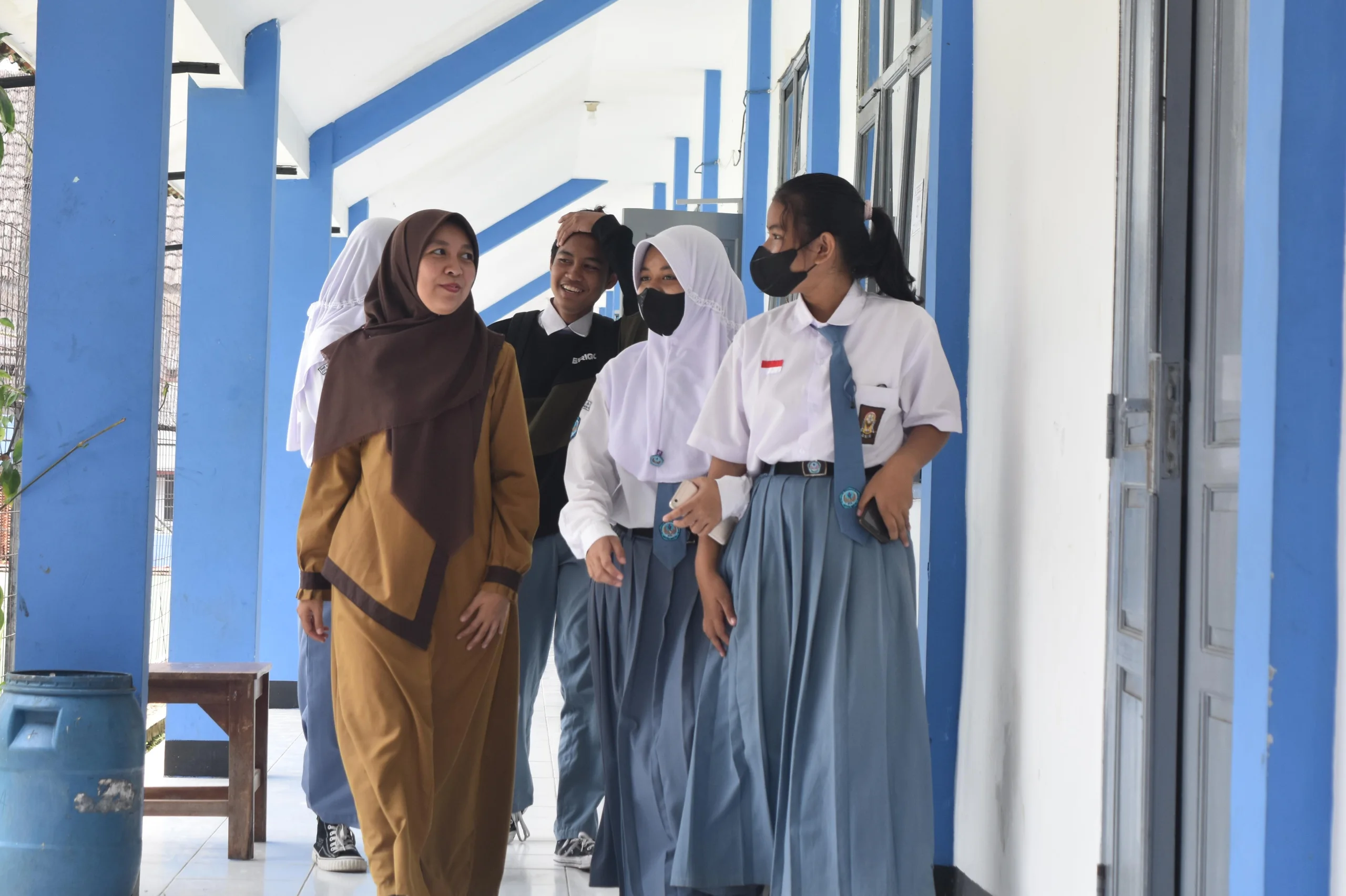
The phone screen flickers at 22.45 PM. A message pops up in a class WhatsApp group from a parent worried about their child's grades. In the corner of the room, a 24-year-old teacher stares at the screen with conflicting emotions.
Logic whispers, "This is outside working hours; get some rest." But the heart replies, "What if this is important? What if my student needs help?"
The choice to turn off the phone feels like an act of selfishness. For them, teaching is not just about arriving at seven in the morning and leaving at four in the afternoon. Teaching is a career calling.
This phenomenon is experienced by many Gen Z workers entering relational professions such as teaching, healthcare, or counseling. On one hand, Gen Z is often seen as a generation deeply concerned with mental health, work-life balance, and personal boundaries. Yet, on the other hand, when they love what they do, those boundaries slowly dissolve.
How can one draw a line when the work they do feels so meaningful?
The Trap of Meaningful Work
In vocational psychology, a career calling is a state where an individual feels their work has deep purpose, aligns with their life values, and provides a tangible contribution to society. Work is no longer viewed merely as a way to earn a living, but as a part of one's identity.
For a teacher, a calling is the primary fuel. Research by Zhao et al. (2022) found that teachers with a high level of calling tend to have stronger work engagement and are better protected from the risk of extreme burnout.
However, there is a hidden paradox behind that deep sense of meaning.
When teaching is viewed as a life calling, every problem at school can transform into a personal issue. A parent's message at night is no longer just an administrative matter, but a test of dedication. Guilt arises every time the body feels tired.
This is the trap: the most meaningful work is often the hardest to walk away from. Without realizing it, we risk our mental health to preserve that identity.
Gen Z: Wanting to Make an Impact, But Also Wanting to Stay "Alive"
There is often a stigma that Gen Z is a "less resilient" generation simply because they are vocal about advocating for work-life balance. In fact, findings by Venida (2022) show that Gen Z teachers actually carry two important values simultaneously: they have a strong intrinsic ambition to grow and make an impact, but they also value healthy working relationships and space for a personal life.
This means Gen Z is not indifferent. Quite the opposite: they care deeply, but they do not want work to consume every aspect of their lives.
Modern technology further blurs these boundaries. The autonomy and flexibility of work, which are touted as providing freedom, often trigger an autonomy paradox—a situation where time freedom allows work to seep into every spare moment. Instant messaging groups, emails at our fingertips, and digital deadlines collapse the physical boundary between the classroom and the bedroom.
So, how do we address this condition without having to sacrifice one for the other?
Hope: The Heart of Positive Psychology That Changes How We Survive
It is within this interaction between work demands and mental health that positive psychology offers a key answer: Hope.
Many people interpret hope as a passive attitude—a resigned whisper like, "I hope tomorrow will be better." However, in the Hope Theory developed by C.R. Snyder (2002), hope is an active and empowering cognitive construct.
Snyder explains that hope consists of two main foundations:
Teacher
Agency Thinking (Determination): The belief and mental energy that "I am capable and have the power to achieve my goals."
Pathways Thinking (Mapping/Finding a Way Out): The mental ability to find "many alternative paths when the main road is blocked."
In the framework of mental health psychology, hope is an integral part of Psychological Capital (PsyCap)—the psychological asset that makes a person resilient in the face of pressure.
Let's see how these three concepts interact in the mind of a teacher:
Calling answers the question: "Why do I do this work?" (Because it is meaningful to me).
Burnout / Stress poses a threat: "These demands are too heavy; you won't be able to handle it."
Hope provides a way: "Your goal is noble, but the way to achieve it is not by destroying yourself. Let's find another way."

Why Setting Boundaries Is the Highest Form of Hope
This is where the common misconception lies. Many people consider boundary management to be a form of hopelessness or a sign of diminished dedication. In reality, psychologically, setting boundaries is a concrete act of hope.
When an exhausted teacher chooses not to reply to work messages after eight in the evening, their Agency Thinking says, "I am entitled to rest so that tomorrow I have the energy for my students." Meanwhile, their Pathways Thinking plans the next step: "I will professionally communicate my messaging hours to the parents tomorrow morning."
Research by Choi et al. (2018) confirms this. Individuals with a high calling who are supported by psychological capital (including hope) experience significantly higher life satisfaction when they apply segmentation strategies—the courage to separate the work domain from the personal domain.
Setting boundaries is not a sign that we hate our work. Boundaries are protective fences so that our love for the work does not burn out from exhaustion.
Living Out Hope in Daily Life: The Art of Setting Boundaries
For anyone struggling in a profession filled with meaning and emotional demands, maintaining mental health through hope and boundary management can be realized through concrete steps:
Re-framing the Meaning of Dedication
Being a good professional does not mean being available 24 hours a day. The best dedication is born from a healthy and calm mental state, not from an emotionally drained one.Activating Pathways Thinking (Finding Alternative Paths)
When the workload feels overwhelming, avoid binary thinking ("I must finish this tonight" or "I'll just give up"). Use hope to find a third way: negotiating deadlines, delegating tasks to colleagues, or simplifying administrative processes.Building Clear Communication Boundaries
Agree on communication times from the start. Informing parents or colleagues about message response hours is not a form of unfriendliness, but a form of professionalism that manages mutual expectations.Separating Personal Identity from Professional Roles
Remember that "Teacher," "Counselor," or "Employee" is just one role in your life. You are also an individual, a child, a partner, a friend, and a human being who needs space to grow outside of the workplace.
Keeping the Fire Burning Without Burning Yourself Out
Meaningful work is a gift. However, meaningful work without the support of healthy boundaries can turn into a subtle cage.
Gen Z teaches us an important lesson about mental health: that asking for room to breathe does not mean we are running away from responsibility. Through the lens of positive psychology, hope gives us the courage to believe that we can remain dedicated without sacrificing our own well-being.
A teacher, or any worker, does not need to be a candle that lights the way for others by letting themselves burn out completely.
Because in the end, a candle that continues to burn steadily is one whose flame is cared for, whose wax is replenished, and which is protected from strong winds.
You are allowed to have a calling. You are allowed to have hope. And you are absolutely entitled to have boundaries.
References
Choi, Y. E., Cho, E., Jung, H. J., & Sohn, Y. W. (2018). Calling as a predictor of life satisfaction: The roles of psychological capital, work–family enrichment, and boundary management strategy. Journal of Career Assessment, 26(4), 567–582. https://doi.org/10.1177/1069072717723092.
Sathianwatchai, A., & Niramitchainont, P. (2022). Generation Z teachers’ quality of work life: Measurement and enhancement guidelines. Kasetsart Journal of Social Sciences, 43(3), 783–788. https://doi.org/10.34044/j.kjss.2022.43.3.34
Snyder, C. R. (2002). Hope theory: Rainbows in the mind. Psychological Inquiry, 13(4), 249–275. https://doi.org/10.1207/S15327965PLI1304_01
Venida, A. C. (2022). Exploring Generation Z teachers’ work values: Implications to educational leadership and management. International Journal of Education, 15(1). https://doi.org/10.17509/ije.v15i1.46153.
Zhao, X., Wu, K., Sun, B., & Li, W. (2022). Teacher career calling reduces burnout: The mediation effects of work engagement and psychological capital. Frontiers in Psychology, 13, 988467. https://doi.org/10.3389/fpsyg.2022.988467.
Herdianti, S. N., Rohayati, N., & Ramadan, R. (2026). Teacher well-being guru Gen-Z: Peran work life balance dan perceived organizational support. PAEDAGOGY: Jurnal Ilmu Pendidikan dan Psikologi, 6(3), 2627–2641. https://doi.org/10.51878/paedagogy.v6i3.11843.
Alamudi, A. K., & Rizqi, M. A. (2026). Flextime and Gen Z work-life balance: The moderating roles of job crafting and boundary management. Management Analysis Journal, 15(1). https://doi.org/10.15294/maj.v15i1.46933.
Ab Hamid, S. M. H. S., & Zainudin, Z. N. (2026). The impact of career calling on teachers’ well-being and professional outcomes: A systematic literature review. Pertanika Journal of Counsellor Educator and Counselling Psychology, 2(1). https://doi.org/10.47836/pjocecp.2.1.04.





Comments 0
Write a Comment Share your response