


JurnalPost.com - During my junior high school years, I was unfamiliar with artificial intelligence (AI). I did not know its functions, let alone how to use it. That was until a friend introduced the technology to me.
They used AI for almost all school assignments. Even when exams were conducted online, the questions were fed into AI to obtain answers. As a result, they managed to achieve high grades in class.
Since then, I began to wonder: what exactly is a student's grade measuring? Is it the ability to understand the lesson, the ability to find answers, or merely the ability to find the fastest way to get a grade?
I believe stories like this are no longer rare occurrences.
In a survey of 1,501 students aged 15–21 years old, ranging from high school to university, 86.21 percent of respondents admitted to using AI assistance to complete assignments at least once a month. This Tirto and Jakpat survey was even cited by the Minister of Communication and Digital, Meutya Hafid, in December 2024, with the figure rounded to 87 percent.
That figure shows that AI has become a part of many students' daily lives. Using AI to complete assignments is no longer something foreign.
The problem is, when AI is used solely as a shortcut to obtain answers, one important thing risks being lost: the thinking process.
I do not believe that children should be kept away from AI. On the contrary, they need to learn to recognize and use it. This technology will become increasingly integrated into their lives, both in education and the professional world.
The real issue is not the existence of AI, but how it is used.
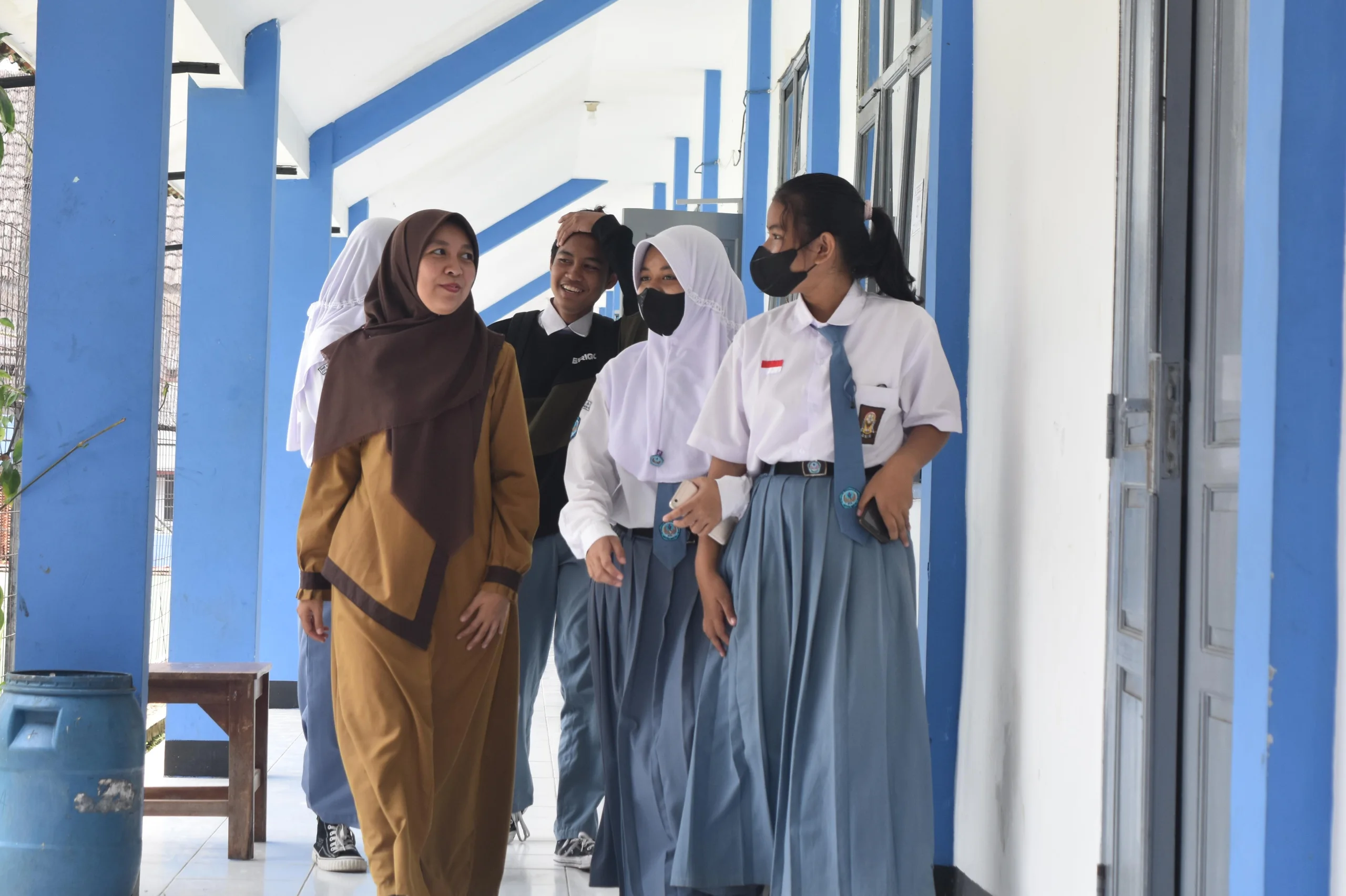
This is where teachers have an increasingly important role.
Parents certainly still have a responsibility to accompany their children in using technology. However, teachers are the ones who face the student learning process directly every day. Teachers observe how students complete assignments, participate in discussions, answer questions, grasp material, and face exams.
If AI is beginning to change how children learn, then the classroom should be one of the first places to discuss that change.
Accompanying the use of AI does not always mean banning it.
A total ban might sound like the easiest solution. However, with technology accessible via mobile phones and computers, a ban risks causing students to continue using AI secretly without understanding its limitations.
Therefore, what is needed are clear guidelines.
AI can be used to brainstorm ideas, help understand difficult concepts, compare information, or double-check work that has already been created. However, when students are being tested to determine their foundational skills, AI should not take over that process.
From here, the way teachers conduct assessments may also need to change.
Not all assignments must end in a submitted answer sheet. Students can be asked to present their work, engage in direct discussions, complete parts of assignments in class, or explain their answers using their own words.
By doing so, teachers do not just see the final result, but can also determine the extent to which students truly understand the material they are studying.
Students also need to be accustomed to being open about their use of AI. They can explain which parts they did themselves and which parts used technological assistance.
This kind of openness is important because AI does not always have to be treated as something that must be hidden. What is more important is ensuring that students remain the ones doing the thinking, while AI serves only as a tool.
At the same time, the existence of AI should also prompt us to re-evaluate the types of assignments given to students.
If a question can be solved by AI in seconds without requiring any meaningful understanding from the student, perhaps the problem does not lie solely with the student using AI. We also need to ask whether that type of assignment is still effective for measuring learning ability.
Teachers certainly cannot face this change alone.
They need training, clear guidelines on AI usage, and support from schools and the government. Teachers should not be asked to supervise students' AI usage while they themselves have never received sufficient preparation to understand the technology.
Teachers need to know not only how AI works but also its limitations. AI can produce answers that sound convincing but are incorrect. AI also does not always understand context like humans do. Therefore, the ability to verify information, question answers, and think critically becomes increasingly important.
This is where education faces a new challenge.
AI may be able to answer many questions, but education is not just about getting answers.
Education also teaches how a person arrives at an answer, how to defend their opinions, how to admit mistakes, how to distinguish between correct and incorrect information, and how to use knowledge to face real-world problems.
AI will not return to the past. This technology will only become closer to children's learning lives.
Therefore, the question we ask may no longer be just, “How do we stop students from using AI?”
The more important question is, “How do we ensure students keep learning when AI can do so many things?”
Teachers can be among those who help students find the answer. However, to fulfill that role, teachers also need to be given the space, rules, knowledge, and ability to face technological change.
Because in the end, what needs to be worried about is not when AI is capable of producing the correct answer.
What is far more concerning is when student grades look high, while we no longer know if they truly understand what they are working on.






Comments 0
Write a Comment Share your response